Nice, but depressing, at the same time..Nice to see a well organised tidy workshop.


PhilP.

Nice, but depressing, at the same time..Nice to see a well organised tidy workshop.

Nice, but depressing, at the same time..
PhilP.



Now that's a proper lathe! Makes mine look very Toytown -but then again, I'd need to reinforce the floor to take something that size!Ok some more progress made on the masts. Mk2 version.
View attachment 352968
The bits before assembly, steel parts mig welded , brass /copper to be soft soldered together.
Made a mistake on this one, the 5mm brass rod should of been threaded into the post, except I drilled a 5mm hole in the post.
Oh well this one can be glued in.
View attachment 352969
Assembled before painting. 2 different base types for different spots.
Threaded one is to go through the baseboard supports and be held on with a nut.
The other is to go into the 100mm Besser blocks I use as the track base. I turned it down to 8mm but newer ones will be 10mm, stronger and quicker to make.
A lot will need the separate round rod for the base as I will not know deep they will need to be smacked into the ground until I try.
With a separate base rod I can smack in a long 8mm rod then cut it to the right length and drop the finished mast on top.
View attachment 352970
Mk1 on the left, Mk2 centre and right, all painted.
I like the Mk2 version much better, the original will not go to waste and can be used in a siding somewhere after I cut the top off.
I made the insulators narrower and longer, with a smaller spacing on the fins.
1mm copper wire for the tie hooks instead of the 1.6mm, should make for a neater support of cables.
The crossbar is longer and the brace has less of a angle, I worked out a neater way to weld them together too.
I changed the top feeder cable supports too, looks better to me and they are much quicker to make.
Edit. I am a dope, on the middle mast I see I have welded the top insulator support 90' out. Oh well a few minutes with the cut off wheel in the grinder an a zip back together the right way this time.
On the whole quite fun to make and if I make the bits in batches they shouldn't take too long to make enough to get a section of catenary in.
Next challenge will be to make the long multi track crossing support frames they have at stations.
I have an idea to try out with ally channel which I hope should look ok, and keep with the theme of being affordable.
Everything was slowed down by a lathe failure, something is shot in the headstock gearbox for the leadscrew and carriage drive, plus the pinion gear was bent and its bearing broken on the carriage gearbox. Still not sure what happened. The carriage was hardly able to be moved by the handwheel.
View attachment 352971
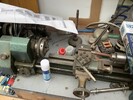
Using the lathe to repair its self with the leadscrew, drive shaft and carriage gearbox removed.
The carriage is bolted to the bed and machining a new bearing with the top slide and tailstock only. The carriage pinion after some heating and smacking with a wooden mallet with the straight section in the vice.
Amazingly I got it from 1.37mm out to 0.12mm out in 2 goes, close enough to straight for me.
View attachment 352972
New bearing in the carriage gearbox ready to reassemble, that took 3 goes to get right
View attachment 352973
All back together and usable again. No drive to the leadscrew or carriage drive so manual drive only.
The headstockdrive gearbox is to the bottom left and is a real PITA to pull apart and get back together right. I had to do it when I first got it 10 years ago.
That can wait till winter time when I have days to waste and nothing better to do.


Smaller lathes are better for making smaller parts, you get a better feel for how cuts are going on tiny bits and using tiny drill bits.Now that's a proper lathe! Makes mine look very Toytown -but then again, I'd need to reinforce the floor to take something that size!
Glad you like it Paul, its good for me to document stuff as I go along. So I don't forget and I can look back through later on.Stewie, your thread continues to entertain me.

That sounds like a great tip, I often have issues with parting off work.Smaller lathes are better for making smaller parts, you get a better feel for how cuts are going on tiny bits and using tiny drill bits.
This lathe is good and has many useful features but its nowhere near as rigid as a big lathe.
I have to run the parting tools upside down and cut in reverse to get reliable parting without snapping tools or damaging parts.
Any flex pushes the tool away instead of digging in.
I've heard of running a lathe backwards -mainly when boring- but not for parting off. Presumably this is to counter any wear in slides and/or bearings: the tool geometry will be the same.That sounds like a great tip, I often have issues with parting off work.
 . Which is why the leadscrew is disconnected, too...
Yeah any wear and flex in the system with the tool upside and running in reverse.I've heard of running a lathe backwards -mainly when boring- but not for parting off. Presumably this is to counter any wear in slides and/or bearings: the tool geometry will be the same.
My lathe has been wired not to run in reverse. It is a refugee from the school workshops, where pupils would go from 'full ahead' to 'full astern', Casey Jones style, breaking the drive belts in the process. Running the tool into the chuck also occurred, and once (not on my shift, and not on my machine) reversing the carriage under feed until it hit the tailstock; which fractured the feedshaft mounting
Reminds me of a safety officer who looked at our concrete cube-crusher in the site laboratory, and asked what force the crusher exerted. We explained it was xxx tons, so he asked whether the floor was reinforced to take that pressureNow that's a proper lathe! Makes mine look very Toytown -but then again, I'd need to reinforce the floor to take something that size!

Probably quite a sensible question, if you're not trained in concrete crushingReminds me of a safety officer who looked at our concrete cube-crusher in the site laboratory, and asked what force the crusher exerted. We explained it was xxx tons, so he asked whether the floor was reinforced to take that pressure

That sounds like a cracking good story.Reminds me of a safety officer who looked at our concrete cube-crusher in the site laboratory, and asked what force the crusher exerted. We explained it was xxx tons, so he asked whether the floor was reinforced to take that pressure
My lathe nit wired for reverse running. I think I would be slightly reluctant to even tray that as I am not sure if the motor would take it so be happy to try what @grizzmo suggests with the parting off tool.I've heard of running a lathe backwards -mainly when boring- but not for parting off. Presumably this is to counter any wear in slides and/or bearings: the tool geometry will be the same.
My lathe has been wired not to run in reverse. It is a refugee from the school workshops, where pupils would go from 'full ahead' to 'full astern', Casey Jones style, breaking the drive belts in the process. Running the tool into the chuck also occurred, and once (not on my shift, and not on my machine) reversing the carriage under feed until it hit the tailstock; which fractured the feedshaft mounting
Not nessecelery (to quote an old comedian) - you have a hydraulic machine with two faces (upper and lower) that press together ........... all the force is in the machine.Probably quite a sensible question, if you're not trained in concrete crushing

That's a shame it really is a easy way to achieve reliable parting off , are you able to mount the toolpost behind the the work piece?My lathe nit wired for reverse running. I think I would be slightly reluctant to even tray that as I am not sure if the motor would take it so be happy to try what @grizzmo suggests with the parting off tool.
Probably, but knowledge is all!Not nessecelery (to quote an old comedian) - you have a hydraulic machine with two faces (upper and lower) that press together ........... all the force is in the machine.
The sensible question might have been to ask how the machine worked
No I do not think I can as it would put the control other side of the work, not a good plan.That's a shame it really is a easy way to achieve reliable parting off , are you able to mount the toolpost behind the the work piece?
Some lathes have a extra mounting spot or T slots in the carriage.
If so you can run normal direction with the parting tool upside down, a lot less convenient thou.
 .
.