
David1226
Registered

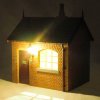
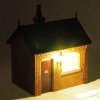
This is the last building kit that I have bought for the Claptowte Railway. I have always been a fan of Kippo Models, and several of the buildings on the Claptowte Railway are from that company’s earlier range of resin cast kits. I was in need of a lineside building that I could utilise as a yard office to complement the other structures at Phidell Yard.
Kippo Models have now gone over to a new range of models, 3D printed in plastic. These new kits are far superior to their older resin cast products in many ways. The biggest and most noticeable difference is that the shell of the building is printed in one piece, with the walls perfectly square and of a consistent thickness, rather than four separate walls that needed the castings cleaning up and the corner joints filling in, once assembled. The separate roof is also a single print. The new kits are much easier to assemble, with fewer parts and excellent detail.
A minor hiccup, was that the kit supplied to me, was missing the pair of drainpipes, a situation that was swiftly remedied by Eddy, at Kippo Models.
All of my other buildings have been kit bashed to a greater or lesser degree, but this one, with the exception of the addition of battery LED lights, and a sign on the door, is standard.
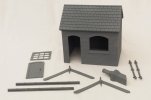
The pic below shows the kit of parts, out of the box, with the exception of the missing drainpipes.
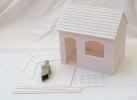
The one piece building shell and one piece roof.
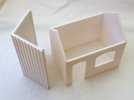
The parts, including drainpipes, spray primed with grey plastic auto primer.
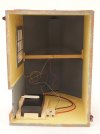
A view of the interior of the building showing the lighting arrangements. The power, for the 3 volt LED lights, is provided by a switched 3 volt ( 2 x AA cell) battery pack. The pack is mounted in a cradle, constructed out of 1mm plywood and ¼” square wood strip. The cradle was then glued to the inside of the wall. The battery pack is held in place by a movable arm made from a scrap piece of 3mm plasticard. This arm facilitates the easy removal of the battery pack to permit battery changes.
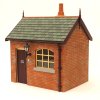
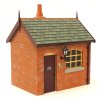
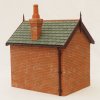
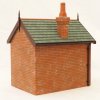
The finished model
David
Kippo Models have now gone over to a new range of models, 3D printed in plastic. These new kits are far superior to their older resin cast products in many ways. The biggest and most noticeable difference is that the shell of the building is printed in one piece, with the walls perfectly square and of a consistent thickness, rather than four separate walls that needed the castings cleaning up and the corner joints filling in, once assembled. The separate roof is also a single print. The new kits are much easier to assemble, with fewer parts and excellent detail.
A minor hiccup, was that the kit supplied to me, was missing the pair of drainpipes, a situation that was swiftly remedied by Eddy, at Kippo Models.
All of my other buildings have been kit bashed to a greater or lesser degree, but this one, with the exception of the addition of battery LED lights, and a sign on the door, is standard.
The pic below shows the kit of parts, out of the box, with the exception of the missing drainpipes.
The one piece building shell and one piece roof.
The parts, including drainpipes, spray primed with grey plastic auto primer.
A view of the interior of the building showing the lighting arrangements. The power, for the 3 volt LED lights, is provided by a switched 3 volt ( 2 x AA cell) battery pack. The pack is mounted in a cradle, constructed out of 1mm plywood and ¼” square wood strip. The cradle was then glued to the inside of the wall. The battery pack is held in place by a movable arm made from a scrap piece of 3mm plasticard. This arm facilitates the easy removal of the battery pack to permit battery changes.
The finished model
David