
David1226
Registered

Part 1 0f 2
A couple of years ago now, with the Grandsons visiting for Christmas, I decided that I ought to have something Christmassy to run around the bottom of the Christmas tree. I had a LGB Toy Train flat stake wagon that was surplus to requirements, from which the Christmas Special Wagon was created.
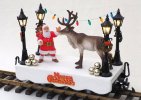
Here is a link, if you are interested, as to how the Christmas Special Wagon was constructed.
Claptowte Railway - Christmas Special Wagon
I decided that the wagon was too nice to only have out once a year, there ought to be some way of displaying it on the layout, as a conversation piece.
Since the dawn of the industrial age, the Vale of Claptowte, in which the railway is set, has been world famous for the manufacture of watnaims. As the history of the line recalls, there cannot be many engineering installations, throughout the former British Empire, indeed the world, not fitted with a Claptowte Watnaim. When the railway was originally built, Goudes Sidings was constructed, just outside Gernise End Station, specifically to handle the influx of the necessary raw materials and the export of assembled watnaims. With the coming of the electronic age, the demand for watnaims has diminished, to the extent that the sidings are no longer used for that purpose, and the goods handling facilities at Gernise End Station are sufficient to meet the needs of the trade, especially the demand for spare parts.
The redundant Goudes Sidings have been taken over by the Claptowte Railway Engineering Department. Their main use, now, is for the stabling of the Engineering Department’s travelling crane ‘Titan’. When not in use, it can be seen there, together with its associated support vehicles.
The premise is that the Christmas Special Wagon was built as a project by the apprentices of the Engineering Department, so Goudes Sidings would seem to be a logical location to store it for the eleven months of the year when it is not in use. In order to protect it from the elements, some kind of cover or shelter would be required. My first thought was to construct some sort of timber frame with a polythene cover, but I was not sure that it would be durable or robust enough, in model form, to cope. While trawling t’internet for ideas, I came across a 16mm scale laser cut plywood kit for a carriage shed, the idea was perfect, but the dimensions were all wrong, so a germ of an idea for a scratch build came into being. The apprentices of the Claptowte Railway Engineering Department were again set in motion, to build a carriage shed to house their Christmas Special Wagon, so that it can be permanently on display at Goudes Sidings..
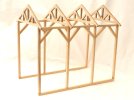
I already had some lengths of 6.5mm (1/4 inch) square stripwood, for the frame work. For some time I puzzled over the construction of the roof. This was solved, when, on eBay, I found scale roof trusses, sold, in various scales, as dummy loads for model road vehicles. The ones I chose 1/50th scale 9.75 metre trusses, also cut from ¼ inch plywood. A pack of four cost £10 + P&P, which considering the saving in work to construct them, seemed exceptional value. They span 170mm, which was perfect for my needs.
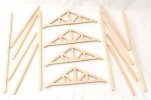
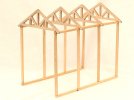
Having assembled the initial bits, it was pointed out to me that I could do with some additional bracing.
I had some 1.0mm plywood that was just about the right width to provide a sub base for the roof. With a lot of my scratch builds, I start off with an idea of what I want to achieve, and design much of it, or alter the design, as I go along. This was very much the case with this build. I decided that the truss overhangs would be in the way, so they were sawn off before the plywood roof was glued on.
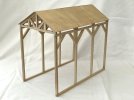
Unfortunately, from this point on I seem to have got carried away with the build, and there are no more stage photos.
I had already decided that the gable ends and the curtain sides would be made from 1.5mm plasticard sheet, scribed to represent planking and with the bottom edges drilled, cut and filed to give an ornamental finish. I researched the rest of the bits that I would need to complete the build. I obtained 1.0mm corrugated plastic roofing sheets from Bole Laser Craft, these had to be cut to size and glued over the plywood sub base.. The ridge was finished with a length of 10mm o/s – 8mm i/s half round plastic tube. The guttering and drainpipes are 3D printed items from Kippo Models. The tall drain pipes had to be shortened by 20mm, the guttering is made from a length and a half, cut appropriately and glued together. Having glued on the curtain sides, after painting, I decided that additional bracing was needed on the inside bottom edge, above the ornamental frill. This was provided by wooden coffee stirrers. At the same time coffee stirrer bargeboards were added to the gable ends.
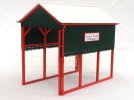
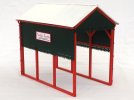
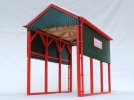
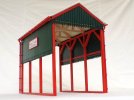
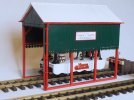
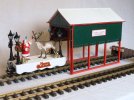
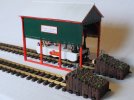
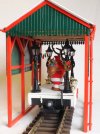
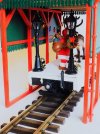
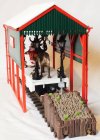
I wanted the carriage shed to be in Christmassy colours, in keeping with the theme. The apprentices, being resourceful, liberated the paint from the company stores. The roof was painted white, using white primer paint. The shed frame, guttering and drainpipes were painted with Signal Red. The gable ends and curtain sides were painted Hunter Green, the standard corporate livery of the Claptowte Railway diesel locomotives. All the various parts were pre-painted before assembly. I think the colours chosen give a nice Christmassy feel.
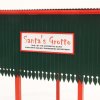
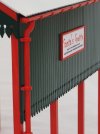
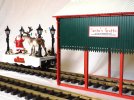
Signs were printed on white card and glued to red painted plasicard frames, which in turn, were glued to the curtain sides.
David
A couple of years ago now, with the Grandsons visiting for Christmas, I decided that I ought to have something Christmassy to run around the bottom of the Christmas tree. I had a LGB Toy Train flat stake wagon that was surplus to requirements, from which the Christmas Special Wagon was created.
Here is a link, if you are interested, as to how the Christmas Special Wagon was constructed.
Claptowte Railway - Christmas Special Wagon
I decided that the wagon was too nice to only have out once a year, there ought to be some way of displaying it on the layout, as a conversation piece.
Since the dawn of the industrial age, the Vale of Claptowte, in which the railway is set, has been world famous for the manufacture of watnaims. As the history of the line recalls, there cannot be many engineering installations, throughout the former British Empire, indeed the world, not fitted with a Claptowte Watnaim. When the railway was originally built, Goudes Sidings was constructed, just outside Gernise End Station, specifically to handle the influx of the necessary raw materials and the export of assembled watnaims. With the coming of the electronic age, the demand for watnaims has diminished, to the extent that the sidings are no longer used for that purpose, and the goods handling facilities at Gernise End Station are sufficient to meet the needs of the trade, especially the demand for spare parts.
The redundant Goudes Sidings have been taken over by the Claptowte Railway Engineering Department. Their main use, now, is for the stabling of the Engineering Department’s travelling crane ‘Titan’. When not in use, it can be seen there, together with its associated support vehicles.
The premise is that the Christmas Special Wagon was built as a project by the apprentices of the Engineering Department, so Goudes Sidings would seem to be a logical location to store it for the eleven months of the year when it is not in use. In order to protect it from the elements, some kind of cover or shelter would be required. My first thought was to construct some sort of timber frame with a polythene cover, but I was not sure that it would be durable or robust enough, in model form, to cope. While trawling t’internet for ideas, I came across a 16mm scale laser cut plywood kit for a carriage shed, the idea was perfect, but the dimensions were all wrong, so a germ of an idea for a scratch build came into being. The apprentices of the Claptowte Railway Engineering Department were again set in motion, to build a carriage shed to house their Christmas Special Wagon, so that it can be permanently on display at Goudes Sidings..
I already had some lengths of 6.5mm (1/4 inch) square stripwood, for the frame work. For some time I puzzled over the construction of the roof. This was solved, when, on eBay, I found scale roof trusses, sold, in various scales, as dummy loads for model road vehicles. The ones I chose 1/50th scale 9.75 metre trusses, also cut from ¼ inch plywood. A pack of four cost £10 + P&P, which considering the saving in work to construct them, seemed exceptional value. They span 170mm, which was perfect for my needs.
Having assembled the initial bits, it was pointed out to me that I could do with some additional bracing.
I had some 1.0mm plywood that was just about the right width to provide a sub base for the roof. With a lot of my scratch builds, I start off with an idea of what I want to achieve, and design much of it, or alter the design, as I go along. This was very much the case with this build. I decided that the truss overhangs would be in the way, so they were sawn off before the plywood roof was glued on.
Unfortunately, from this point on I seem to have got carried away with the build, and there are no more stage photos.
I had already decided that the gable ends and the curtain sides would be made from 1.5mm plasticard sheet, scribed to represent planking and with the bottom edges drilled, cut and filed to give an ornamental finish. I researched the rest of the bits that I would need to complete the build. I obtained 1.0mm corrugated plastic roofing sheets from Bole Laser Craft, these had to be cut to size and glued over the plywood sub base.. The ridge was finished with a length of 10mm o/s – 8mm i/s half round plastic tube. The guttering and drainpipes are 3D printed items from Kippo Models. The tall drain pipes had to be shortened by 20mm, the guttering is made from a length and a half, cut appropriately and glued together. Having glued on the curtain sides, after painting, I decided that additional bracing was needed on the inside bottom edge, above the ornamental frill. This was provided by wooden coffee stirrers. At the same time coffee stirrer bargeboards were added to the gable ends.
I wanted the carriage shed to be in Christmassy colours, in keeping with the theme. The apprentices, being resourceful, liberated the paint from the company stores. The roof was painted white, using white primer paint. The shed frame, guttering and drainpipes were painted with Signal Red. The gable ends and curtain sides were painted Hunter Green, the standard corporate livery of the Claptowte Railway diesel locomotives. All the various parts were pre-painted before assembly. I think the colours chosen give a nice Christmassy feel.
Signs were printed on white card and glued to red painted plasicard frames, which in turn, were glued to the curtain sides.
David
Last edited:


 , heck naw, its only June


 and only allowed in November by exception because its model making for the silly season.


