
David1226
Registered

Although Phidell Yard, on the Claptowte Railway, is, as its name suggests, a fiddle yard for the storage of stock waiting its turn to be run on the scenic part of the layout. It does, in fact, have scenic accessories in its own right. It has its own signal box, semaphore and ground signals, a yard office, a water tower and water crane, and, a loco coaling stage. I decided that it could do with its own W.C., for use by the loco crews and shunters. I decided to scratch build one for them.
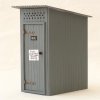
The sides were made from 2mm plasticard, scribed to represent planking, with the edge of a razor saw dragged along them, to represent wood grain. The corners were reinforced with ¼” square strip wood. The roof was an offcut of 1mm corrugated plastic, left over from the construction of the carriage shed for Goudes Sidings. The door frame is 2 x 1.5 mm plastic strip. The hinges were made from short lengths of wooden cocktail sticks and thin plasticard. The bolt heads are 1mm self adhesive pearl jewels. The door knob was made by filing and sanding a piece of plastic rod, drilled, with a short length of brass wire glued into it.
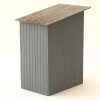
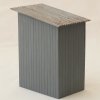
The assembled structure, prior to priming
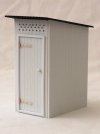
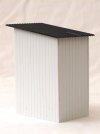
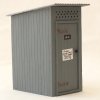
The model after spraying with plastic primer
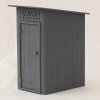
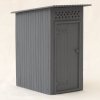
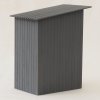
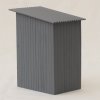
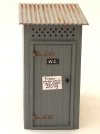
The finished model
David
The sides were made from 2mm plasticard, scribed to represent planking, with the edge of a razor saw dragged along them, to represent wood grain. The corners were reinforced with ¼” square strip wood. The roof was an offcut of 1mm corrugated plastic, left over from the construction of the carriage shed for Goudes Sidings. The door frame is 2 x 1.5 mm plastic strip. The hinges were made from short lengths of wooden cocktail sticks and thin plasticard. The bolt heads are 1mm self adhesive pearl jewels. The door knob was made by filing and sanding a piece of plastic rod, drilled, with a short length of brass wire glued into it.
The assembled structure, prior to priming
The model after spraying with plastic primer
The finished model
David