AsorA Bahn

Yes that should be true and how to properly answer on a public forum without over sharing?
So for better or worse here goes.

I haven't mentioned it before because I don't like to talk about it much, but I was pretty badly hurt in a explosion at work many years ago.
The outcome of that is working with my hands and arms can be very difficult, often frustrating, always uncomfortable and way too often very painful.

A lot of the building of this railway whilst being very challenging, rewarding and incredibly satisfying to have done.
It just wasn't fun whilst I was doing it and for many days afterwards too.
I am very glad I pushed myself to do it thou as what has been done brings me a lot of joy now and hopefully will for a lot of years to come.

So working on the railway now is mainly just fun, rewarding, satisfying and challenging.
The challenges now aren't so demanding and I don't have to push my physical abilities so much to overcome them.
Hope that explains things, without writing a novel.:)
Sorry to hear about your past accident, but thanks for your honesty, that just makes your achievements all the more remarkable. A dedicated and motivated man can achieve a lot. Indeed your line will give you I am sure much joy over the future years, as to see it gives us. Just wish you were not an age away so I could come to see it and help operate to a schedule. Flown to Oz and NZ, never again and certainly not now in a Boeing twin engined jet. When I did those flights in 1987/8 it was all in Jumbo 4 engined jets.
 
Thanks I wasn't sure how much to share, not looking for a pity party.
As far as my injuries go, I count myself very lucky. Having spent a lot of time in and out of hospital, I met an awful lot of way way worse off people.
That gives you some real perspective, gratitude and motivation to do all you can.

Yes it is a shame its so far from here to everywhere just about. We could of had some good fun and I am sure very good chats too.
Having 2 operators, we could run the hourly service each way crossing midway. On my own I will just run 1 hour up and the next hour down, easier for 1 and I don't have nearly enough stock yet for more intensive operation anyway. :)
 
Last edited:
Ok lets leave the past in the past as best we can and get back to what's important, trains and Doggo of course.
IMG_20260201_122127644_HDR.jpg
Took the day off today.
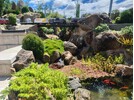
The view of todays freight train, from my favorite seat.
The comets are very active today, we started with 4 now there are 6 maybe there will be a few more soon :D .

IMG_20260201_121902233_HDR.jpg
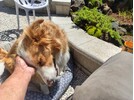
I had a helper today, getting a well deserved ear scratch for his efforts and yes he has a bed for out here kept in the workshop.

IMG_20260201_132735161_HDR.jpg
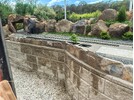
Got a little bit of work done this week, got some small rocks glued in around the bonsai yesterday. The bonsai can just lift out for maintenance.
Plus the grouting done in this bit today. So close to the end, but I run of grout. Oh well there's always next week.

IMG_20260201_164736234_HDR.jpg
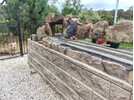
A few dwarf pines, some baby tears and the bit of path from the platform in too, almost finished this corner. Not including signs, signals, catenary and ..... you get it :D
Next will be the tunnel entrance to neaten up and a fence to stop passengers on the platform from falling off the edge of the world.
 
Last edited:
Ok lets leave the past in the past as best we can and get back to what's important, trains and Doggo of course.
View attachment 352636
Took the day off today.
The view of todays freight train, from my favorite seat.
The comets are very active today, we started with 4 now there are 6 maybe there will be a few more soon :D .

View attachment 352637
I had a helper today, getting a well deserved ear scratch for his efforts and yes he has a bed for out here kept in the workshop.

View attachment 352638
Got a little bit of work done this week, got some small rocks glued in around the bonsai yesterday. The bonsai can just lift out for maintenance.
Plus the grouting done in this bit today. So close to the end, but I run of grout. Oh well there's always next week.

View attachment 352643
A few dwarf pines, some baby tears and the bit of path from the platform in too, almost finished this corner. Not including signs, signals, catenary and ..... you get it :D
Next will be the tunnel entrance to neaten up and a fence to stop passengers on the platform from falling off the edge of the world.
Lovely to see Dogo.

We had some issues with a tunnel mouth on the Ruschbahn. Andy in his wisdom had made it out of some old ply that was kicking about. Well I can guess you know what happened and who was detailed to fix it!

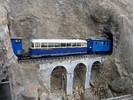
So muggins thought long and hard, solution was to put some protective plastic down on track and ballast, then spray wet the tunnel mouth ply and throw Postcrete at it (wearing neoprene protective gloves of course) another spray of water more Postcrete then leave for a few minutes to repeat the process till a natural ‘cut out of the rock’ tunnel emerged. Benefit of this process is that the concrete mouth will stay in place once the wood has rotted away. Thinking it out further from a build new perspective, some concrete mesh cut to a tunnel profile would make a stronger tunnel mouth using the same process, ply behind still. Seen here with the LLB train passing back to te garage after a days operation. The 2 mouths got the treatment.
LLB RC - 1.jpeg
 
Lovely to see Dogo.

We had some issues with a tunnel mouth on the Ruschbahn. Andy in his wisdom had made it out of some old ply that was kicking about. Well I can guess you know what happened and who was detailed to fix it!

So muggins thought long and hard, solution was to put some protective plastic down on track and ballast, then spray wet the tunnel mouth ply and throw Postcrete at it (wearing neoprene protective gloves of course) another spray of water more Postcrete then leave for a few minutes to repeat the process till a natural ‘cut out of the rock’ tunnel emerged. Benefit of this process is that the concrete mouth will stay in place once the wood has rotted away. Thinking it out further from a build new perspective, some concrete mesh cut to a tunnel profile would make a stronger tunnel mouth using the same process, ply behind still. Seen here with the LLB train passing back to te garage after a days operation. The 2 mouths got the treatment.
View attachment 352652
Looks great, shame the cladding was peeling off the viaduct. Otherwise there is some really great modeling there.
Sounds like I would maybe make a big mess trying that way. It does look good thou.
I was thinking of cutting a portal out of foam detailed like the retraining walls i have made. Cut to match the profile of the rockwork.
I still have a couple of rocks to cement in next to and above tunnel to make planting pockets for even more dwarf conifers.
I will give it some more thought before I proceed, thanks for the info.
 
Last edited:
Looks great, shame the cladding was peeling off the viaduct. Otherwise there is some really great modeling there.
Sounds like I would maybe make a big mess trying that way. It does look good thou.
I was thinking of cutting a portal out of foam detailed like the retraining walls i have made. Cut to match the profile of the rockwork.
I still have a couple of rocks to cement in next to and above tunnel to make planting pockets for even more dwarf conifers.
I will give it some more thought before I proceed, thanks for the info.
Indeed tis a shame about the stonework, was Plastic Sheet stonework that did not last the test of time. The pic was taken within a year or so of Andy’s sad demise and closure of the Ruschbahn. Was likely on my list of fix jobs, would probably have got a similar treatment as the Tunnels but with just a splash of external PVA and one throw of sifted postcrete. Though with the benefit of knowledge your methods, had the Ruschbahn still been in existence we would likely have gone that way.
 
Lovely to see Dogo.

We had some issues with a tunnel mouth on the Ruschbahn. Andy in his wisdom had made it out of some old ply that was kicking about. Well I can guess you know what happened and who was detailed to fix it!

So muggins thought long and hard, solution was to put some protective plastic down on track and ballast, then spray wet the tunnel mouth ply and throw Postcrete at it (wearing neoprene protective gloves of course) another spray of water more Postcrete then leave for a few minutes to repeat the process till a natural ‘cut out of the rock’ tunnel emerged. Benefit of this process is that the concrete mouth will stay in place once the wood has rotted away. Thinking it out further from a build new perspective, some concrete mesh cut to a tunnel profile would make a stronger tunnel mouth using the same process, ply behind still. Seen here with the LLB train passing back to te garage after a days operation. The 2 mouths got the treatment.
View attachment 352652
Looking at that picture again, I really like the catenary wires. The finer gauge droppers joining upper and lower wires looks great and very prototypical to my eyes.
Also I am guessing being soldered at the bottom only would make installation easier.
There seems to be a good tension on the catenary. Looking forward to learning how you tensioned them and allowed for expansion/contraction. How long a sections you worked with. Not having tried I was guessing 3-4m lengths might be manageable and not have too many joins? No idea till I tried thou. Plus how you joined sections of wires and branched off at junctions. Don't want much do I:rofl:.
I think I have a workable installation plan formulated.
I have watched the Ruschbahn video's on youtube many times looking at the fine overhead system. Gives me something useful to do when I can't do other stuff.
 
Looking at that picture again, I really like the catenary wires. The finer gauge droppers joining upper and lower wires looks great and very prototypical to my eyes.
Also I am guessing being soldered at the bottom only would make installation easier.
There seems to be a good tension on the catenary. Looking forward to learning how you tensioned them and allowed for expansion/contraction. How long a sections you worked with. Not having tried I was guessing 3-4m lengths might be manageable and not have too many joins? No idea till I tried thou. Plus how you joined sections of wires and branched off at junctions. Don't want much do I:rofl:.
I think I have a workable installation plan formulated.
I have watched the Ruschbahn video's on youtube many times looking at the fine overhead system. Gives me something useful to do when I can't do other stuff.
Oh much to go at there!
First a plan of how it was going to be done was created and poured over for many hours.

I made the lengths of wire as long as reasonably possible, on the main station the full length of that station no joints. Lots of bendy R1 curves will be tricky for you. That was from the yard by the viaduct to the tunnel the other end of the station. Luckily the plan for the station was quite precise with 2 wires the full lrpength the outer 2 ending at conveniently located poles.

Joins where we had curves involved ‘pull off’ sections where a shorter wire would have a new or existing pole to pass between. Note LGB pans cope happily with one wire over the other.

Tensioning was done with fence tensioners but this not the beast, I wanted to use hidden wires over a wheel at the ends with tins of weights to give a dynamic wire tension so that heat or cold would not make a difference, this rejected by the owner. The wire was in full sun all day in the summer and odd problems ensued, but nothing catastrofic.

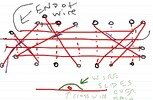
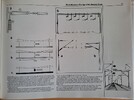
I have tried to give an idea how the system works below, the main wires are in red with mostly track below except where the odd cross wires (dotted) which mostly represent crossovers though in some cases link wires. At the bottom you can see how flexibility has been allowed by the small loop going over a cross wire and soldered to the contact wire. Sortybtis a bit messy, my house in uproar at the moment with the loft entered for a replacement set of roof tiles, Rushchbahn Manual cant be found! I have tried to represent the main station by the lake as well as I can remember.
IMG_9029.jpeg
 
Oh much to go at there!
First a plan of how it was going to be done was created and poured over for many hours.

I made the lengths of wire as long as reasonably possible, on the main station the full length of that station no joints. Lots of bendy R1 curves will be tricky for you. That was from the yard by the viaduct to the tunnel the other end of the station. Luckily the plan for the station was quite precise with 2 wires the full lrpength the outer 2 ending at conveniently located poles.

Joins where we had curves involved ‘pull off’ sections where a shorter wire would have a new or existing pole to pass between. Note LGB pans cope happily with one wire over the other.

Tensioning was done with fence tensioners but this not the beast, I wanted to use hidden wires over a wheel at the ends with tins of weights to give a dynamic wire tension so that heat or cold would not make a difference, this rejected by the owner. The wire was in full sun all day in the summer and odd problems ensued, but nothing catastrofic.

I have tried to give an idea how the system works below, the main wires are in red with mostly track below except where the odd cross wires (dotted) which mostly represent crossovers though in some cases link wires. At the bottom you can see how flexibility has been allowed by the small loop going over a cross wire and soldered to the contact wire. Sortybtis a bit messy, my house in uproar at the moment with the loft entered for a replacement set of roof tiles, Rushchbahn Manual cant be found! I have tried to represent the main station by the lake as well as I can remember.
View attachment 352706
Excellent, thanks very much I appreciate it.
 
Had some fun garage time here and there over the last few weeks and I have been playing around trying to workout a cheap, not too difficult to make and also a reasonably decent looking mast for the catenary system.
LGB masts are out of the question as they are $60- $80 per mast here. They look great thou.
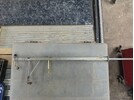
First protype, needs a few mods.
IMG_20260207_195327939_HDR.jpg
Materials used,
10mm steel square rod for the mast. Cheap and easy to get, not as good looking as a ally H beam.
5mm round steel rod for cross bar. I have this already.
2mm round steel rod for diagonal support. Cheap
5mm brass rod for insulator supports. Easy to work with
7mm brass rod for the insulators. Easy to work with
1.65mm copper wire for hooks. Had this
base 1.5mm tinplate. Offcuts
Cost per mast $6-8, if I had to buy it all. Probably be around $5 including paint.
The steel bits are welded in place, brass/copper bits soft soldered together and the bars are threaded into the mast.

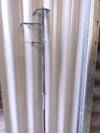
IMG_20260207_195623636_HDR.jpg
Given a spray of cold gal paint.
The base of this one is drilled for a 8mm rod to be hammered into the ground, this way a longer rod can be hammered in till its secure and trimmed to size. The mast then slipped over the rod.
Others masts will have a 100mm longer base and turned round to 8mm where there is concrete blocks to drill into.
For any going on a base board they will be turned round and threaded.

IMG_20260207_195844652_HDR.jpg
Doesn't look too bad in place, if you can pretend the square bar is a H beam :rofl:.
Needs the insulators painted black and a foam "concrete block" base added.
Somewhere I have some sheets of scale plastic bolt heads, 4 on each base would be a nice detail.
The masts will hold a catenary wire and support wire.
As well as a earthing wire at the back of the pole and 2 feeder wires at the top.
The extra wires are for looks and maybe they will give the actual catenary wires some protection from knocks?


Some changes to the next one.
For looks,
Make the mast 30mm taller, so there's a bigger gap from the crossbar to the upper cable support.
Make the crossbar 100mm instead of the 80mm it is now, doesn't quite look right and the masts will be further from the track centre.
Drill the diagonal support into the mast instead of welding it and make the angle less.
Make the catenary wire horizontal support 5mm bar 20mm shorter and have a longer wire, again doesn't look quite right.
Make the upper cable support 10mm shorter and heat the bar to get a tighter bend, again it doesn't quite look right.

For ease of construction,
Use a smaller dia. copper wire, say 1mm for hooks, these ones don't bend round easily.
Make collars on the insulators, now they are drilled and the wire goes right through them into the support bar and they are soldered together and in place.
That's fiddley to do, a soldered tight fitting collar would be stronger and easier to do.

Any ideas or thoughts feel free to share them.
 
Last edited:
Had some fun garage time here and there over the last few week and I have been playing around trying to workout a cheap, not too difficult to make and also a reasonably decent looking mast for the catenary system.
LGB masts are out of the question as they are $60- $80 per mast here. They look great thou.
First protype, needs a few mods.
View attachment 352869
Materials used,
10mm steel square rod for the mast. Cheap and easy to get, not as good looking as a ally H beam.
5mm round steel rod for cross bar. I have this already.
2mm round steel rod for diagonal support. Cheap
5mm brass rod for insulator supports. Easy to work with
7mm brass rod for the insulators. Easy to work with
1.65mm copper wire for hooks. Had this
base 1.5mm tinplate. Offcuts
Cost per mast $6-8, if I had to buy it all. Probably be around $5 including paint.
The steel bits are welded in place, brass/copper bits soft soldered together and the bars are threaded into the mast.

View attachment 352870
Given a spray of cold gal paint.
The base of this one is drilled for a 8mm rod to be hammered into the ground, this way a longer rod can be hammered in till its secure and trimmed to size. The mast then slipped over the rod.
Others masts will have a 100mm longer base and turned round to 8mm where there is concrete blocks to drill into.
For any going on a base board they will be turned round and threaded.

View attachment 352871
Doesn't look too bad in place, if you can pretend the square bar is a H beam :rofl:.
Needs the insulators painted black and a foam "concrete block" base added.
Somewhere I have some sheets of scale plastic bolt heads, 4 on each base would be a nice detail.
The masts will hold a catenary wire and support wire.
As well as a earthing wire at the back of the pole and 2 feeder wires at the top.
The extra wires are for looks and maybe they will give the actual catenary wires some protection from knocks?


Some changes to the next one.
For looks,
Make the mast 30mm taller, so there's a bigger gap from the crossbar to the upper cable support.
Make the crossbar 100mm instead of the 80mm it is now, doesn't quite look right and the masts will be further from the track centre.
Drill the diagonal support into the mast instead of welding it and make the angle less.
Make the catenary wire horizontal support 5mm bar 20mm shorter and have a longer wire, again doesn't look quite right.
Make the upper cable support 10mm shorter and heat the bar to get a tighter bend, again it doesn't quite look right.

For ease of construction,
Use a smaller dia. copper wire, say 1mm for hooks, these ones don't bend round easily.
Make collars on the insulators, now they are drilled and the wire goes right through them into the support bar and they are soldered together and in place.
That's fiddley to do, a soldered tight fitting collar would be stronger and easier to do.

Any ideas or thoughts feel free to share them.

Very nice, I am sure you have been perusing the build of overhead elsewhere from the Ruschbahn. Just in case here is the link again, your prototype not dissimilar to Andrew’s. He well we used round poles and I see no reason why you could not use some in sundry places to say represent older overhead not yet renewed to modern standards.
 
Very nice, I am sure you have been perusing the build of overhead elsewhere from the Ruschbahn. Just in case here is the link again, your prototype not dissimilar to Andrew’s. He well we used round poles and I see no reason why you could not use some in sundry places to say represent older overhead not yet renewed to modern standards.
Yeah I have read through the Rushbahn threads multiple times, very good for inspiration and ideas.
The 10mm square rod kind of looks like the shape of a square H beam to me and only costs $27 for 6m, 10mm round bar is $22 for 6m so 33 cents per mast difference.
Any extra lathe work needed to make bases round, isn't really work to me:).

I Will be trying your idea of weights and pulleys for tensioning the cat wires, should be fun to try to make.
 
Last edited:
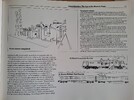
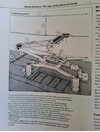
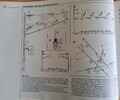
A few diagrams of British Rail overhead equipment from a series that was run in Rail News which was the BR Staff newspaper, eventually they were made available in 2 books on general sale by Ian Allen.
20260207_133846.jpg
20260207_133717.jpg
20260207_133754.jpg
20260207_133802.jpg
Hope they help
 
This is like what I was trying to model.

Screenshot 2026-02-08 080406.png
They have the insulators differently on the RHB, This one has a double lower cable support I was going for just a single lower arm, like on the pole to the left.
Looking at the types of supports, there are very many different variations used.

On some bends there are just insulators on the pole. The double wires are nearly horizontal and not vertical like normal.
Screenshot 2026-02-08 083328.png
Others the support arms reach over past the cat wire and pull it to the side the pole is not on.
Screenshot 2026-02-08 084022.png
Screenshot 2026-02-08 083612.png
2 different types.

The feeder cable supports can be many different ways too.
Screenshot 2026-02-08 083809.png
These insulators point up, previous photos show short arms to the side and the insulators hanging down.
This is a shorter post too, that could be an advantage to not getting damaged. A bit easier to step over if needed.
This is an older style post, no bolted base plate, the next one down is newer type with a steel base plate.
Some have the single supply cable just on a insulator sticking up from the top of the pole.

Screenshot 2026-02-08 110320.png
Here's how they tension the cables, 2 cables terminating at this pole.
I will try to make something similar looking to this.
A stainless steel fishing trace or some picture hanging brass braid should work for the cable around the pulleys down to the weights.
I think the weights will have to be wider and longer to get enough mass, some testing will be in order when the overhead is in.
I do have plenty of lead to cast a weight or different thickness steel rods to try out.

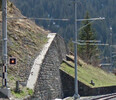
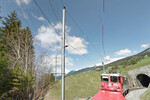
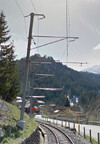
These are screenshots from google earth from just half a km of track leading into Langwies station.

Not sure which type I like best, I might make a few different types and see what they look like on the railway.
Looking at the above shots, you don't even have to put the posts in vertical to be prototypical:rofl:.
Which ever way I go, any workshop time is time well spent:).
 
Last edited:
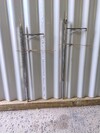
Ok some more progress made on the masts. Mk2 version.
IMG_20260210_164915587_HDR.jpg
The bits before assembly, steel parts mig welded , brass /copper to be soft soldered together.
Made a mistake on this one, the 5mm brass rod should of been threaded into the post, except I drilled a 5mm hole in the post :rolleyes:.
Oh well this one can be glued in.

IMG_20260210_171803979_HDR.jpg
Assembled before painting. 2 different base types for different spots.
Threaded one is to go through the baseboard supports and be held on with a nut.
The other is to go into the 100mm Besser blocks I use as the track base. I turned it down to 8mm but newer ones will be 10mm, stronger and quicker to make.
A lot will need the separate round rod for the base as I will not know deep they will need to be smacked into the ground until I try.
With a separate base rod I can smack in a long 8mm rod then cut it to the right length and drop the finished mast on top.

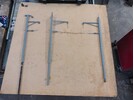
IMG_20260210_173222302_HDR.jpg
Mk1 on the left, Mk2 centre and right, all painted.
I like the Mk2 version much better, the original will not go to waste and can be used in a siding somewhere after I cut the top off.
I made the insulators narrower and longer, with a smaller spacing on the fins.
1mm copper wire for the tie hooks instead of the 1.6mm, should make for a neater support of cables.
The crossbar is longer and the brace has less of a angle, I worked out a neater way to weld them together too.
I changed the top feeder cable supports too, looks better to me and they are much quicker to make.

Edit. I am a dope, on the middle mast I see I have welded the top insulator support 90' out. Oh well a few minutes with the cut off wheel in the grinder an a zip back together the right way this time. :rofl: :rofl:

On the whole quite fun to make and if I make the bits in batches they shouldn't take too long to make enough to get a section of catenary in.
Next challenge will be to make the long multi track crossing support frames they have at stations.
I have an idea to try out with ally channel which I hope should look ok, and keep with the theme of being affordable.

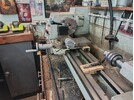
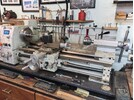
Everything was slowed down by a lathe failure, something is shot in the headstock gearbox for the leadscrew and carriage drive, plus the pinion gear was bent and its bearing broken on the carriage gearbox. Still not sure what happened. The carriage was hardly able to be moved by the handwheel.


IMG_20260209_135656545_HDR.jpg
Using the lathe to repair its self with the leadscrew, drive shaft and carriage gearbox removed.
The carriage is bolted to the bed and machining a new bearing with the top slide and tailstock only. The carriage pinion after some heating and smacking with a wooden mallet with the straight section in the vice.
Amazingly I got it from 1.37mm out to 0.12mm out in 2 goes, close enough to straight for me.


IMG_20260209_161911362_HDR.jpg
New bearing in the carriage gearbox ready to reassemble, that took 3 goes to get right:rofl:.

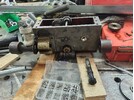
IMG_20260209_181423301_HDR.jpg
All back together and usable again. No drive to the leadscrew or carriage drive so manual drive only.
The headstockdrive gearbox is to the bottom left and is a real PITA to pull apart and get back together right. I had to do it when I first got it 10 years ago.
That can wait till winter time when I have days to waste and nothing better to do.
 
Last edited:
Back
Top Bottom