
You are using an out of date browser. It may not display this or other websites correctly.
You should upgrade or use an alternative browser.
You should upgrade or use an alternative browser.
Show us your Track Diagrams
- Thread starter duncan1_9_8_4
- Start date



steamskip
www.railprintuk.co.uk

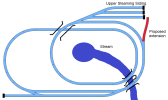
The Southwestern Frontier Railway, Based in Hertfordshire, UK here seen in its latest incarnation, Loco sheds and workshops are in the top RIght hand corner , Port faciltys and unloading point in the bottom right , the "Mountain" terminus and "Mines" are in the Bottom left.
Attachments

duncan1_9_8_4
Garden Railway Operator/Real Life Signalman
Well this proved a popular thread! Not been on here for a small while. Theres some brilliant and clever layouts, out there. Thanks everyone, so far.

GAP
G Scale Model Trains, 1:1 Sugar Cane Trains

This is the track plans for my layouts (not to scale).
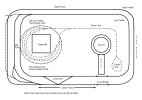
The sugar mill and farms loops will be a standalone layout with an interchange loop running around it, the track will be code 250 while the mainline is code 332.
This give the impression of a lighter guage sugar cane railway track compared to the mainline.
In Aust cane railways are 2 Ft guage while the mainline in 3 Ft 6 inch in this state.
The sugar mill and farms loops will be a standalone layout with an interchange loop running around it, the track will be code 250 while the mainline is code 332.
This give the impression of a lighter guage sugar cane railway track compared to the mainline.
In Aust cane railways are 2 Ft guage while the mainline in 3 Ft 6 inch in this state.

David K
Registered

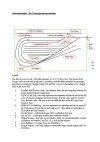
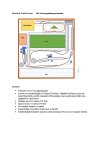
Here you'll find the track diagram for my layout and shadow station. The line is based on the RhB and is called Die Unterengadinergartenbahn (Lower Engadin Garden Railway). The line comprises 221 feet of mainline, a 45-foot spur, 5 tunnels, 2 bridges and 1 viaduct. Ardez is the featured station. Enjoy!
Attachments

Jasper
Hey, I'm only being creative here!

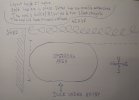
I'm not winning the prize for GSC's smallest layout, but I'm close. Measured at track center, it is 4x6 feet.
Most of the railway, or tramway, is on wooden poles. There's a 5x2 feet wooden rack by the shed, that the track lies on top of. The rack has storage space, e.g. water tight boxes that have proven to be not so water tight.
The dashed lines along the shed are possible short spurs that can hold a wagon.
The East Line on the other hand can be a serious project, but I haven't yet brought this up with the relevant authorities.
Most of the railway, or tramway, is on wooden poles. There's a 5x2 feet wooden rack by the shed, that the track lies on top of. The rack has storage space, e.g. water tight boxes that have proven to be not so water tight.
The dashed lines along the shed are possible short spurs that can hold a wagon.
The East Line on the other hand can be a serious project, but I haven't yet brought this up with the relevant authorities.
Last edited:

idlemarvel
Neither idle nor a marvel
Nice and simple and good height.Here's my modest attempt. I hope y'all can read my handwriting.
Edit: better pic
View attachment 281261
If I might add, you will soon get fed up of "ducking under" so I would recommend a lift-out or even better but note difficult hinged section.
Jasper
Hey, I'm only being creative here!
It will be a truss bridge of some sort eventually. I considered making it a lift-out, and haven't ruled it out fully, but I know myself well enough: ducking will always remind me that "I can still do this" so it'll help me not feel old.If I might add, you will soon get fed up of "ducking under" so I would recommend a lift-out or even better but note difficult hinged section.
That's the way I am.
Last edited:
GAP
G Scale Model Trains, 1:1 Sugar Cane Trains
When you get to the stage of ducking under is for the birds, this is how I did my lift up bridge.It will be a truss bridge of some sort eventually. I considered making it a lift-out, and haven't ruled it out fully, but I know myself well enough: ducking will always remind me that "I can still do this" so it'll help me not feel old.
That's the way I am.

4. Stage 2- May 2020 Lift Up Bridge Work Begins
To allow access to the inside of the loop I decided to build a lift up bridge to go over an opening left in a lattice fence that forms the...
 ringbalin-light-railway.blogspot.com
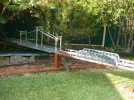
It now works fine and I can walk through with a wheelbarrow without a heap of mucking about.
On my previous layout I had a lift out bridge (RHS in picture) but found it to be a bit of a pain.

rentren
LGB - Viafier Retica Wälderbähnle Rheinbähnle

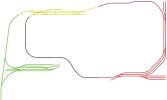
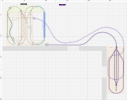
The spring addition (digital; mauve colors) will be added to last summer's job (roughly 12ft square layout; see 'Ramosch' built below a deck; analog).
The new run (about 160ft or 48m) includes a loop under the deck (below 'Ramosch') follows the house wall to swing around a corner to a former firewood storage area to 'Aschera' station. The new station at this time is a simple 3-way switch affaire and positioned above another turn loop of the new run.
Analog and digital layouts have no electric nor track connection (I want to be very sure not to cause electrical mayhem). The visual intersection is to be a shortened version of the Trisanna bridge (oblong blue box in diagram) at Schloss Wiesberg, Tyrol. Very interesting Trisanna engineering materials here.
While the mighty bridge is from the normal gauge Arlberg railway, my rolling stock models narrow gauge ('Ramosch' with Zillertalbahn items, 'Aschera' with RhB ones). The wide curves are to be supported by pillars 3ft to 4ft high and of a variety of constructions. The taller ones nearer to the house wall, the shorter ones integrating also some hanging plants (sm arrows indicate descent around 2.5%).
The new run (about 160ft or 48m) includes a loop under the deck (below 'Ramosch') follows the house wall to swing around a corner to a former firewood storage area to 'Aschera' station. The new station at this time is a simple 3-way switch affaire and positioned above another turn loop of the new run.
Analog and digital layouts have no electric nor track connection (I want to be very sure not to cause electrical mayhem). The visual intersection is to be a shortened version of the Trisanna bridge (oblong blue box in diagram) at Schloss Wiesberg, Tyrol. Very interesting Trisanna engineering materials here.
While the mighty bridge is from the normal gauge Arlberg railway, my rolling stock models narrow gauge ('Ramosch' with Zillertalbahn items, 'Aschera' with RhB ones). The wide curves are to be supported by pillars 3ft to 4ft high and of a variety of constructions. The taller ones nearer to the house wall, the shorter ones integrating also some hanging plants (sm arrows indicate descent around 2.5%).

David1226
Registered
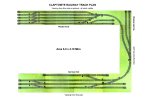
Claptowte Railway Track Plan
I have been modelling in G Scale for about thirty years now. It was always my intention to build an exhibition layout, the management having ruled out the garden as a suitable space for a railway. In the past, I have built, in collaboration with others, several layouts in smaller scales, predominately O-16.5, as my preference has always been for Narrow Gauge. I always enjoyed the interaction with the public, at shows. I have always admired the weight and heft of the larger 16mm and G Scales. About 35 years ago, I had an enforced absence from any modelling, due to work commitments, when I got back to it, about thirty years ago, I decided to take the plunge into G Scale.
My O-16.5 modelling had been freelance British, done on the cheap, scratch building almost everything. When I started in G Scale, there were no ready to run British outline models, only US or European, my only option was to buy second hand items cheaply enough to be able to take a razor saw and scalpel to them, in order to Anglicise them, in a freelance way, and create my own railway identity. Accordingly, all of my models are pretty much unique, I have nothing that is how it was when it left the factory. For me the layout is very much a means of displaying the models, rather than creating a detailed scenic layout.
I lost my driving licence about nine years ago, due to the onset of glaucoma, which has pretty much scuppered the idea of attending exhibitions with a layout. Having been modelling rolling stock, railway structures and lineside accessories, for many years, the number of models that I needed to display meant that the design of the layout kept getting larger, in order to accommodate the growing number of models. The increasing size of the track plan meant that the only space that I had, in which to erect the layout, was in the garden. This dictated the final shape, size and design, if I was ever going to build a layout on which to run and display my models. The models were built very much for indoor display and are not weatherproof, if I want to erect the layout in the garden, I will have to follow the weather forecasts very closely.
I do have a couple of friends who currently have vans, so it is not impossible that one day I could take it to a show. So I guess you could call it an exhibition layout, with a small chance of it ever attending an exhibition, or, an indoor layout that can only be erected outdoors. The pleasure that I have had creating the models, over the past thirty years, is beyond measure.
The final track plan is an end to end, fiddle yard to terminus, built as a 'U' shape, with the station area and associated sidings, down one leg, and the fiddle yard down the opposite leg, with the two areas connected by a curve across the bottom. Track power is by LGB MTS III. Points are moved by Mk1 Gerfingerpoken. The signals are non operating items added for scenic interest only.
I have taken photographs of the 10 individual boards, that make up the layout, and stitched them together using Microsoft Paint. The track plan below is the composite photograph of the actual boards, not a track plan drawing tool.
There is a huge amount of work to finish things off, platforms to build, a couple more buildings to assemble and paint, as well as the carriage shed to house the Christmas Special Wagon, but as they say, no model railway is never really finished.
David
I have been modelling in G Scale for about thirty years now. It was always my intention to build an exhibition layout, the management having ruled out the garden as a suitable space for a railway. In the past, I have built, in collaboration with others, several layouts in smaller scales, predominately O-16.5, as my preference has always been for Narrow Gauge. I always enjoyed the interaction with the public, at shows. I have always admired the weight and heft of the larger 16mm and G Scales. About 35 years ago, I had an enforced absence from any modelling, due to work commitments, when I got back to it, about thirty years ago, I decided to take the plunge into G Scale.
My O-16.5 modelling had been freelance British, done on the cheap, scratch building almost everything. When I started in G Scale, there were no ready to run British outline models, only US or European, my only option was to buy second hand items cheaply enough to be able to take a razor saw and scalpel to them, in order to Anglicise them, in a freelance way, and create my own railway identity. Accordingly, all of my models are pretty much unique, I have nothing that is how it was when it left the factory. For me the layout is very much a means of displaying the models, rather than creating a detailed scenic layout.
I lost my driving licence about nine years ago, due to the onset of glaucoma, which has pretty much scuppered the idea of attending exhibitions with a layout. Having been modelling rolling stock, railway structures and lineside accessories, for many years, the number of models that I needed to display meant that the design of the layout kept getting larger, in order to accommodate the growing number of models. The increasing size of the track plan meant that the only space that I had, in which to erect the layout, was in the garden. This dictated the final shape, size and design, if I was ever going to build a layout on which to run and display my models. The models were built very much for indoor display and are not weatherproof, if I want to erect the layout in the garden, I will have to follow the weather forecasts very closely.
I do have a couple of friends who currently have vans, so it is not impossible that one day I could take it to a show. So I guess you could call it an exhibition layout, with a small chance of it ever attending an exhibition, or, an indoor layout that can only be erected outdoors. The pleasure that I have had creating the models, over the past thirty years, is beyond measure.
The final track plan is an end to end, fiddle yard to terminus, built as a 'U' shape, with the station area and associated sidings, down one leg, and the fiddle yard down the opposite leg, with the two areas connected by a curve across the bottom. Track power is by LGB MTS III. Points are moved by Mk1 Gerfingerpoken. The signals are non operating items added for scenic interest only.
I have taken photographs of the 10 individual boards, that make up the layout, and stitched them together using Microsoft Paint. The track plan below is the composite photograph of the actual boards, not a track plan drawing tool.
There is a huge amount of work to finish things off, platforms to build, a couple more buildings to assemble and paint, as well as the carriage shed to house the Christmas Special Wagon, but as they say, no model railway is never really finished.
David

FatherMcD
Registered

Hopefully some vans will be available so that the quality of your workmanship can be more widely viewed and appreciated.Claptowte Railway Track Plan
I have been modelling in G Scale for about thirty years now. It was always my intention to build an exhibition layout, the management having ruled out the garden as a suitable space for a railway. In the past, I have built, in collaboration with others, several layouts in smaller scales, predominately O-16.5, as my preference has always been for Narrow Gauge. I always enjoyed the interaction with the public, at shows. I have always admired the weight and heft of the larger 16mm and G Scales. About 35 years ago, I had an enforced absence from any modelling, due to work commitments, when I got back to it, about thirty years ago, I decided to take the plunge into G Scale.
My O-16.5 modelling had been freelance British, done on the cheap, scratch building almost everything. When I started in G Scale, there were no ready to run British outline models, only US or European, my only option was to buy second hand items cheaply enough to be able to take a razor saw and scalpel to them, in order to Anglicise them, in a freelance way, and create my own railway identity. Accordingly, all of my models are pretty much unique, I have nothing that is how it was when it left the factory. For me the layout is very much a means of displaying the models, rather than creating a detailed scenic layout.
I lost my driving licence about nine years ago, due to the onset of glaucoma, which has pretty much scuppered the idea of attending exhibitions with a layout. Having been modelling rolling stock, railway structures and lineside accessories, for many years, the number of models that I needed to display meant that the design of the layout kept getting larger, in order to accommodate the growing number of models. The increasing size of the track plan meant that the only space that I had, in which to erect the layout, was in the garden. This dictated the final shape, size and design, if I was ever going to build a layout on which to run and display my models. The models were built very much for indoor display and are not weatherproof, if I want to erect the layout in the garden, I will have to follow the weather forecasts very closely.
I do have a couple of friends who currently have vans, so it is not impossible that one day I could take it to a show. So I guess you could call it an exhibition layout, with a small chance of it ever attending an exhibition, or, an indoor layout that can only be erected outdoors. The pleasure that I have had creating the models, over the past thirty years, is beyond measure.
The final track plan is an end to end, fiddle yard to terminus, built as a 'U' shape, with the station area and associated sidings, down one leg, and the fiddle yard down the opposite leg, with the two areas connected by a curve across the bottom. Track power is by LGB MTS III. Points are moved by Mk1 Gerfingerpoken. The signals are non operating items added for scenic interest only.
I have taken photographs of the 10 individual boards, that make up the layout, and stitched them together using Microsoft Paint. The track plan below is the composite photograph of the actual boards, not a track plan drawing tool.
There is a huge amount of work to finish things off, platforms to build, a couple more buildings to assemble and paint, as well as the carriage shed to house the Christmas Special Wagon, but as they say, no model railway is never really finished.
View attachment 356918
David

John Carmichael
Registered
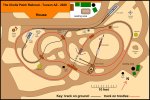
Here's The Cholla Patch Railroad in Tucson AZ.

maxi-model
UK/US/ROW steam narrow gauge railways 1:1
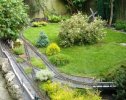
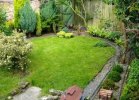
No diagram but will these do ? 

korm kormsen
Registered

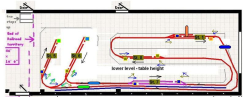
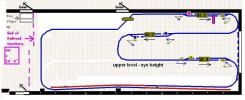

this was the indoors two-level automated layout, i am dismantling now.
while the benchwork, track and electrics were done, the scenics were far from finished.
it was a DC layout, automatised with the (partly homemade) epl system for 8 trains interacting with each other.
ca 150 meters/450 ft. of track.
why did it have to go?
for many small reasons.
one was, that the two levels are something, that works in 0-scale, or smaller, but not in 1:32.
with a height difference of 2 foot/60cm, i saw on the lower level only roofs and on the upper level only wheels.
i needed the whole length of 13meter/46 ft. for the two 6% grades to connect the levels.
i am getting too old, for lying under my layout, or balancing on a stepladder.
the electric system was too complicated for my little grandson and my SIL.
after 20 plus years of broom-free existence the room needs some cleaning.
and, last, not least, during the 8 years of building, i got so many ideas for a new layout, that i have to make another layout.
GAP
G Scale Model Trains, 1:1 Sugar Cane Trains
This is now out of date the left hand end has been completely removed and replaced with line running into my sheds making it a point to point line with yards at either end. The sugar cane line has been completed but with less track and the firepit is no more replaced by a shade tree.This is the track plans for my layouts (not to scale).
The sugar mill and farms loops will be a standalone layout with an interchange loop running around it, the track will be code 250 while the mainline is code 332.
This give the impression of a lighter guage sugar cane railway track compared to the mainline.
In Aust cane railways are 2 Ft guage while the mainline in 3 Ft 6 inch in this state.
View attachment 280515
This shows what has been done
Re-Configuration Construction Logs
The construction of the railway mainline began in August 2019. See Mainline Construction Logs for the construction. I decided to reconfigu...
ringbalin-light-railway.blogspot.com
duncan1_9_8_4
Garden Railway Operator/Real Life Signalman
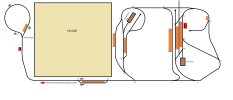
An updated track diagram from The Woodlock
duncan1_9_8_4
Garden Railway Operator/Real Life Signalman
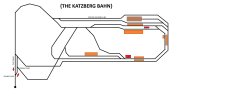
The Katzberg Bahn
Similar threads

- Replies
- 21
- Views
- 1K


- Replies
- 0
- Views
- 327
- Replies
- 8
- Views
- 542

- Replies
- 0
- Views
- 416
