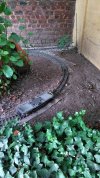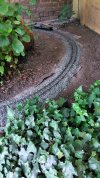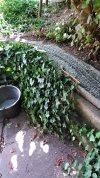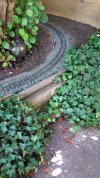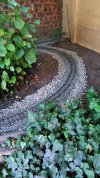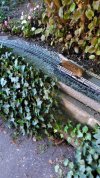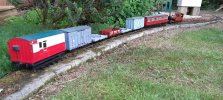
Bernigadine, my garden railway.

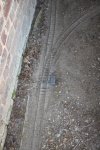
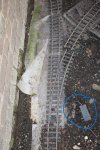
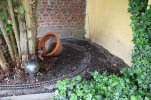
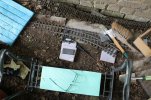
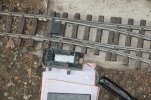
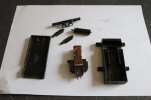
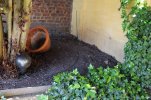
In July, I cleaned the track from the mixture soil/ballast/gravels that had accumulated with the years of kids running on the track. The point leading to the workshop had even been buried. Unfortunately,the motor didn’t last and I’ll have to replace it.
IMG_1267.JPG


IMG_1281.JPG

IMG_1287.JPG

IMG_1292.JPG

IMG_1301.JPG


IMG_1302.JPG

IMG_1305.JPGIMG_1305.JPG


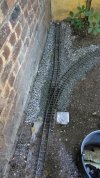
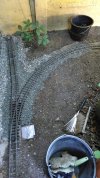
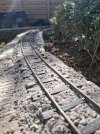
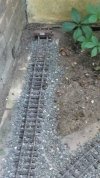
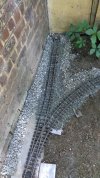
Ithen set about ballasting the track again and adding gravel to markout the ballast bed. Here you can see the different stages.
IMG_20260719_172549.jpg

IMG_20260719_174228.jpg

IMG_20260719_181535.jpg

IMG_20260719_181548.jpg

IMG_20260720_091856.jpg

IMG_20260720_122745.jpg

IMG_20260720_122753.jpg

IMG_20260720_122846.jpg

IMG_20260720_173609.jpg

IMG_20260720_173625.jpg


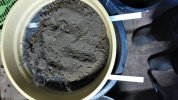
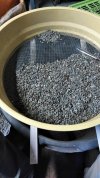
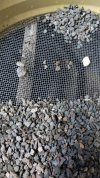
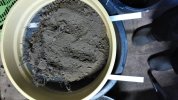
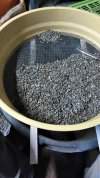
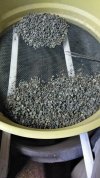
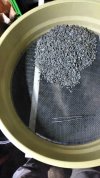
Before ballasting, however, I had to sieve the different types of gravel and

ballast to separate them and remove the soil that had got everywhere,which explains the many hours spent sieving.
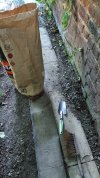
IMG_20260721_121940.jpg

Filling the bags with mixture.

IMG_20260724_173645.jpg

How it looks, coming out of the bag.

IMG_20260802_112450.jpg

Separating the different elements.
 
IMG_20260802_113456.jpg


the different elements : from left to right : gravel, ballast,soil, vegetation and other dirt and finally decorative gravel.

IMG_20260802_112548.jpg


This shows the various containers: a bucket for the gravel, a Royal Canin bag for the ballast, a paper bag for vegetation and other debris, and a paper bag on the right for decorative gravel. The soil is crushed and the resulting powder falls into the large bucket.
 
Brilliant - I have only just found this thread! I love to see someone else working hard on their railway :D
 
Your dedication to the sifting and recycling process of granite chippings is to be much admired. Your line in its resuscitate state looks great. I once went out into the road outside my house, after some resurfacing works was done, to recover some of the loose granite chipping "dressing" they applied. It was lying in the gutters and just the right grade, it would have been a pity if it was wasted. Yes, part of my line's ballasting was sourced that way. Don't ask about the coal loads.
 
I would be very surprised if that point motor is trashed, they are near indestructible so a good clean up and try with power to just the motor bit may prove that. I have had many well rusted and in awful condition, all have been brought back to working order except for possibly one that was really really very badly rusted inside.
 
I am looking forward to seeing your layout progress....
 
As a fellow 'summer of 26 ballaster', I can only praise your dedication in recycling your existing ballast! I removed what remained of the Rowlands Mix* from my line before levelling and repacking the permanent way with a loose mix of postcrete and horticultural grit. Though I say it myself, it compares reasonably well with the line on the Baie de la Somme, to my eyes at least...
20260803_111738.jpg
20260609_181525.jpg
...although their scenery is better!

*Rowlands Mix is a British invention, made up of peat, sand and cement. It looks very much like the ballast on a run-down narrow gauge railway, and moss grows on it really rather well.20220709_211835.jpg
But this becomes a problem if you wish to run trains in the winter, because the moss expands, freezes solid and prevents trains from running!

Apologies for the thread drift...
 
Thanks for your comments, this encourages me to keep going. It's not an easy job because I do it sitting down, leaning over the sieve for hours, and I end up getting discouraged. Actually, it's not really sifting because the job involves sorting through everything on the sieve with tweezers. Mind you, I have lots of kg of the ballast, never used but I did not know what to do with it being dirty.

This ballast is porphyry and is the one used for the TGV lines in France and Belgium and by the belgian railways. It comes from a quarry not far away from home. I went there with my trailer and asked for 300 kg and it was cheep. The gravel comes from a place near Antwerp and was bought in a DYI shop. I was lucky to buy it on promotion and could use the shop van to carry it home. The decorative gravel was bought in a garden centre but I won't use it again. I also used bark at one point, but the blackbird scratches at it so much that it all falls off.

I plan to glue it with the method explained by John Carmichel, but that is for much later.
 
I would be very surprised if that point motor is trashed, they are near indestructible so a good clean up and try with power to just the motor bit may prove that. I have had many well rusted and in awful condition, all have been brought back to working order except for possibly one that was really really very badly rusted inside.
Jon, I have already repaired motors in a poor condition, before my stroke, but this one is worse. I'll try however and follow your advice before buying a new one.
 
Last edited:
IMG_20260724_173645.jpg


Let’s go back to photo 3645, which shows the sieve that has just been loaded. It is 9.00 am. The next photo was taken at 11.24 am. It took more than two hours to start the sorting process, after removing all the leaves, roots, gravel and soil.

IMG_20260802_112450.jpg


The next photo shows the sieve four hours later, that was yesterday at 12h 45.


IMG_20260803_124542.jpg


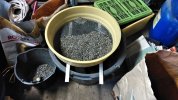
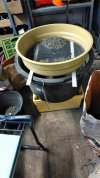
After thinking about how uncomfortable my working position was, I decided to raise the sieve.


I now have a position that’s easier on my back and feet, and which allows me to work much faster once I get started on the sorting.

IMG_20260804_090105.jpg


What remained to be sorted was done in just under four hours, whereas in my previous position it would have taken me more than eight hours.

IMG_20260804_124955.jpg
 
I have one of those plastic Garden trays that is used for potting plants. Around 2ft square, ideal for raised work when sifting can be put on a table, workbench or as I do my raised (3ft6in) Station area.
 
Back
Top Bottom