What happened at your workbench today?

Marking out the catenary gantries at night inside, to machine the next day in the workshop.
View attachment 354408
The fire engine build slowly continues, should be finished by the end of the year. :)
That's where I fall down - marking out :shake: too unskilled, too impatient, too ...................... it never works :rolleyes::rolleyes:

The one and only things that I really successfully marked out was six axle holes in a pair of steel frames for the 2-6-2 wot was pootling round the garden on Sunday afternoon

I managed to get all three pairs of holes in a straight line, the right distance apart and in the same place on each frame ................. at that point I peaked, and have never achieved anything like it since.
 
That's where I fall down - marking out :shake: too unskilled, too impatient, too ...................... it never works :rolleyes::rolleyes:

The one and only things that I really successfully marked out was six axle holes in a pair of steel frames for the 2-6-2 wot was pootling round the garden on Sunday afternoon

I managed to get all three pairs of holes in a straight line, the right distance apart and in the same place on each frame ................. at that point I peaked, and have never achieved anything like it since.
These gantries don't need to be anywhere near as accurate as a loco chassis. Which is very good, as there not.
A bit of inaccuracy in the marking out, a bit in the machining and a bit in the filing to square the slots up:) .
They are a near enough is close enough model, I am not a rivet counter:rofl:.
 
Well, that is two ways to miss the post.....
1. I have some inline 2.1mm x 5.5mm charging Jack's. Bought from a UK supplier, and a third of them are short-circuit.
17743751761638424100340100240141.jpg

2. Add to which, for the first time ever, I have a reverse-wired battery pack..

So two faults, neither obvious, which has caused an order to miss the post today.

They say bad luck comes in there's?

Is the car too long ago, to be the third? :wondering:

PhilP.
 
Some more laser cut plywood kits that I bought last year. Unfortunately I have thrown away the packing and cannot recall the make. They were labelled as ammunition boxes but I cannot imagine what sort of ammunition a box that long would hold, probably spears, but a crate is a crate, is a crate.

View attachment 354345

David
Artillery shells ie really big bullets?
 
Well, that is two ways to miss the post.....
1. I have some inline 2.1mm x 5.5mm charging Jack's. Bought from a UK supplier, and a third of them are short-circuit.
View attachment 354443

2. Add to which, for the first time ever, I have a reverse-wired battery pack..

So two faults, neither obvious, which has caused an order to miss the post today.

They say bad luck comes in there's?

Is the car too long ago, to be the third? :wondering:

PhilP.
While making a battery pack a short time ago I accidentally shorted 2 AA cells I never imagined that a 2950mAHr NiMh cell could provide enough current to make a solder tab glow red. Should give me some run time is the good side.
 
While making a battery pack a short time ago I accidentally shorted 2 AA cells I never imagined that a 2950mAHr NiMh cell could provide enough current to make a solder tab glow red. Should give me some run time is the good side.
The first battery loco I built was 7.2v 3500 mAh and I didn't include a fuse :oops: I used a stereo jack/socket for the charging point, and these make a temporary short circuit as they plug in (and out).

When I went to charge it, smoke started to come out of the loco, the wires were glowing red and the insulation was melting (cause of the smoke) and the battery pack was hot. I didn't have any wire cutters nearby, and was trying to rip the wires out with my fingers. All told, a nasty experience o_O

Surprisingly :emo::emo: I am now quite careful about installing a fuse/breaker/polyswitch :nerd:
 
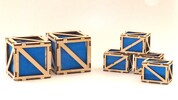
A pic of some more laser cut plywood crates that I bought last year, but only now got around to putting together. Coach & Wagon Works Open Crate (2 per pack) and Small Open Crates (4 per pack). I've never really come across open crates before and have no idea what sort of thing should go in them. I reasoned that, given that the crates are open, and whatever is inside them would be exposed to the elements. whatever that is, should be wrapped. I glued together offcuts of 3.0mm foam board, into cubes, and 'wrapped them' in decorator's masking tape. They should add some interest and a bit of colour, laying around on the Claptowte Railway goods loading dock, at Gernise End Station.

dig 260325001.JPG

David
 
A pic of some more laser cut plywood crates that I bought last year, but only now got around to putting together. Coach & Wagon Works Open Crate (2 per pack) and Small Open Crates (4 per pack). I've never really come across open crates before and have no idea what sort of thing should go in them. I reasoned that, given that the crates are open, and whatever is inside them would be exposed to the elements. whatever that is, should be wrapped. I glued together offcuts of 3.0mm foam board, into cubes, and 'wrapped them' in decorator's masking tape. They should add some interest and a bit of colour, laying around on the Claptowte Railway goods loading dock, at Gernise End Station.

View attachment 354501

David
Delivery for Monsieur Klein!
 
That will be the other green wire, then?
:) ;)

PhilP.
On a course in the military to learn how to give a lesson (the subject and its accuracy was immaterial; it was the planning and presentation of the lesson that was being assessed) one member gave a lesson on electricity.
He started out by asking how many knew and understood how a car battery was wired and the electricity in it worked.
When he got a 100% response he then went onto describe house wiring.
He asked if everyone knew about the 3 wires use in a house of red, black and green.
When he got a positive response his next next step was to explain that the green wire is known as the common.
Next a description was of how the green the red wire went to all heating appliances
This was followed by a description of how the green and the black went to all the cooling appliances.
His conclusion was "and that is how electricity works in the home".
Interesting concept; there was a disclaimer after the lesson that this was not how it worked and members should not try this at home.
 
On a course in the military to learn how to give a lesson (the subject and its accuracy was immaterial; it was the planning and presentation of the lesson that was being assessed) one member gave a lesson on electricity.
He started out by asking how many knew and understood how a car battery was wired and the electricity in it worked.
When he got a 100% response he then went onto describe house wiring.
He asked if everyone knew about the 3 wires use in a house of red, black and green.
When he got a positive response his next next step was to explain that the green wire is known as the common.
Next a description was of how the green the red wire went to all heating appliances
This was followed by a description of how the green and the black went to all the cooling appliances.
His conclusion was "and that is how electricity works in the home".
Interesting concept; there was a disclaimer after the lesson that this was not how it worked and members should not try this at home.
Yes, in terms of G scale locomotive wiring, and especially the Bachmann Fn3 C-19. and in particular one specimen that had been fitted with a MLS sound card ............. it is rumoured that an electronics wizard of this parish found an example that had an awful lot of green wiring :wasntme::wasntme::wasntme:
 
Yes, in terms of G scale locomotive wiring, and especially the Bachmann Fn3 C-19. and in particular one specimen that had been fitted with a MLS sound card ............. it is rumoured that an electronics wizard of this parish found an example that had an awful lot of green wiring :wasntme::wasntme::wasntme:
:envy::p

PhilP.
 
On a course in the military to learn how to give a lesson (the subject and its accuracy was immaterial; it was the planning and presentation of the lesson that was being assessed) one member gave a lesson on electricity.
He started out by asking how many knew and understood how a car battery was wired and the electricity in it worked.
When he got a 100% response he then went onto describe house wiring.
He asked if everyone knew about the 3 wires use in a house of red, black and green.
When he got a positive response his next next step was to explain that the green wire is known as the common.
Next a description was of how the green the red wire went to all heating appliances
This was followed by a description of how the green and the black went to all the cooling appliances.
His conclusion was "and that is how electricity works in the home".
Interesting concept; there was a disclaimer after the lesson that this was not how it worked and members should not try this at home.
A colleague of mine had a daughter who bought an ex-army barracks house and asked him to rewire it. Apparently every wire in the place was red.
 
Alan Coren wrote a vrry funny spoof account of how electricity worked which would have been quite convincing to someone who was unfamiliar with electricity, positing that there were two types of electricity which came in along two of the plug wires and then mixed to make things work. I forget the details (did you realise that?) and for years have been unable to trace the article concerned.
 
Back
Top Bottom