Train jittering .

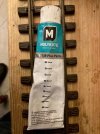
When your track is level and derailing is still a problem, may the reason of the derailing are sudden stop and start movements of your loco and wagons caused by bad electric pick up of your loco. To solve this you first have to check all electric rail connections by using a current a measurement device. Such a device has a possibility to check connectivity of a joint by making a beeping noise when connection is ok. If connections are bad than my advice is to clean the railconnectors and reinstall them using Molycote copper grease (=still active at 300 degrees and rain resistant!) see picture below . This will prevent any rail connectivity problems for at least ten years (= my experience so far) and save you a lot of money !

One other problem can be a bad straight parallel alignment of the 2 axes of the wagons, causing large friction forces when the wagons are pushed instead of pulled.
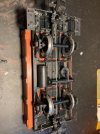
You can solve this by applying a thin stainless steel wire that acts as a long spring between the two axes of a wagon. You have to horizontally drill a small hole in both axes holders and put the ends of this wire in there. The spring wire brings the axes parallel when entering a straight section or when when pushing the wagons in case of sudden stop or running backwards. See picture below

Finally I recommend to install steel wheels with electricity pick up elements to provide your wagons with electricity to be used for lights. If you connect this electricity source between each wagon and connect it at the back of your Steinz loco, this loco will run always smoothly, even when the loco itself has a bad or no contact at difficult spots such as at points and crossings.

You can read more of these practical solutions in our book: "Our Model Garden Railway" at Amazon.
I wish you succes and a lot of fun with you new Steinz Garden Railway!
 

Attachments

  • kopervet Molycote.jpg
    kopervet Molycote.jpg
    289.1 KB · Views: 8
  • Onderkant wagon met 2 enkele assen met richtveer.jpg
    Onderkant wagon met 2 enkele assen met richtveer.jpg
    85 KB · Views: 9
Hi Josh, Gerard,
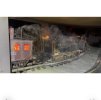
another cheap but good idea is to add a power buffer as shown below.
They basically store extra power they capture from the track and when it detects a drop in supply to your decoder (assuming you are on DCC digital) it gives power to the loco to get over the dirty bit or the bad track joint.

AS you can see its a little battery pack.

They start at about £30. If you contact James at Gartenbahn Supllies ( details below) he can help you. He's a lovely man and not pushy at all, just tries to solve your problems.

James
Gartenbahn Supplies Limited
www.GartenBahnSupplies.co.uk

gartenbahnsupplies@gmail.com

Gerard is totally correct on the copper grease I use a spray version which I put in before connecting the rails. Dont know if as good as the Molycote he suggests which looks like a paste and may be less messy . Also Gerard sounds like hes got lots more experiance tham me , its only last year I started building my garden railroad ( i say railraod as mine is in the western American theme.).....and there are lots of my early questions on here.

Which I can say were all solved step by step by the folk in this crazy gang . So a huge thank you to you all.

Im only running two locos from an old MTS ( multi train system) by LGB. I picked it up with transformer and controller for £100.... and though well if i learn my mistakes on this I can get to understand which newer system would fit later in the project.

Newest HUGE lesson. One day I didn't check the track before moving anything (school boy error ) I had left a metal hinge crossing both rail heads where I had been working up the line on a bridge...... boom blew the MTS . So currently ( no pun intended ) Its in hospital at my brothers whos going through it step by step.
He thinks it can be resolved and likes the challenge and it had already been to a chap who had said no chance its dead.
I may be able to get another for about £50 but cant find one at the mo so as im not running and building at the mo I can wait.

Also given a sort of entry Massoth is about £1200 I will have to wait a while.

Love the wire spring idea, will look at this if I get similar problems, just one question are you using flexi track or all fixed production rails?

Many happy train miles await,

Chris.


Screenshot 2026-08-18 at 10.11.36.png
 
All very good advice - just one little correction (with my Pedant Hat firmly on), a power buffer isn't a battery pack - it's a bank of capacitors (with, as you said, enough storage for a few seconds' worth of power, usually enough to get a loco over a bad spot on the track).

Taking my Pedant Hat off now... :D

Jon.
 
. See told you these chaps know their stuff… and I’m learning… noted Pedant hat
So capacitors act like a little battery? What is the difference is it it sort of power aware ?

I don’t have one yet but I’m definitely thinking of it … but not finished my full loop yet as building an extension which has stopped HS1 - 4 in its tracks for a while
I’ve used a few of those brass clamp connectors through the station points and they seem very good
I’m building the station from 3:10 to Yuma …
Chris …
Hey actual question
What do you connect these power boost capacitor banks to?
Is it the decoder or the pick up connection to the motor x
 
Chris,

Think of a battery as a fuel tank. - Stores 'fuel' charge for a long time.

Think of a capacitor as a bucket.. The fuel is contained, but will slowly 'evaporate' discharge, over a much shorter period of time.

PhilP.
 
Ahh brilliant that’s amazing.
What’s the advantage of it slowly loosing its fuel? Is it so it lasts longer as a battery has a certain life of charges?

Oh and is it connected to the decoder or the motor ?

Sorry prob stupid question… can ring my brother so I don’t get dull…
 
A battery is designed to hold the charge by converting the charging current in a chemical reaction.
This works the other way round, when you pull current from the battery.

Capacitors tend to be used to 'smooth out' lumps and bumps in the supply.
They store the charge differently, react more quickly to changes, but due to how they are made and other circuitry connected to them, tend to slowly 'leak' away the charge. - To continue the 'bucket' analogy, think of a weepy seam on the bucket..
:nerd:

PhilP.
 
Oh I see,
so if the Capacitors in the loco have been off ,say the night or two days, do they take long to recharge?
So we can run smooth very quickly?

Its all a learning day..... trying to get my nerd qualification sorted as I need to know these things x

Chris
 
The Powercap is designed for


garden railway locomotives with


a maximum current consumption


of 1A to 3A (depending on the


version, see technical data) or for


sound modules.

Ok so what is the average power consuption?
Amp is diferent to Volts.... the track is at 20V is that right? And the locos and other items consume at AMPs .....
how does it add up in that how can I tell how much my loco consumes...... sorry.
 
Looks like 0.7amp on the flat average load ... so I should be ok with power cap 200... max load 1.0A
or dont risk it go powercap 900 max load 1.5A
?

8151301 or 8151311.... Massoth

thanks
PhilP
 
Not an exact science..

Dirty track, so l-o-n-g breaks, needs a bigger 'bucket'.

You have small engines, so small should suffice.
But,
You also have sound, so the middle one might be 'better'.
However,
You have small engines, so bigger might not fit.

They connect to the decoder. It can then control them when programming the decoder. - They can interfere with this.

A big loco, with a big power-buffer.. You can lift it off the track, and have it halfway into the box before the buffer gets drained enough for the sound to stop.

PhilP.
 
Oh I see,
so if the Capacitors in the loco have been off ,say the night or two days, do they take long to recharge?
So we can run smooth very quickly?

Its all a learning day..... trying to get my nerd qualification sorted as I need to know these things x

Chris

The Caps in the power buffer will charge up in seconds once connected to track power - so almost as soon as you've put your loco on the rails they will be full and ready to go. Just think of them as a very short-term power storage method - they will charge up, hold that charge until called upon (when your loco hits a spot of bad track and stops receiving power), at which point they will discharge giving the loco a burst of stored power to get over the dirty spot - then they quickly charge up again waiting for the next time they are needed. It's an electrical equivalent to reaching down and giving the loco a little push with your hand!

You need to choose one with enough current capacity (amps) for the highest current that your loco's motor(s) should draw... an LGB Buehler motor in good condition really shouldn't be drawing more than 0.3-0.5 amps under normal loads, though this will increase a bit if it's got a long train behind it and/or is having to tackle gradients. If it is drawing significantly more than this, then the motor may well be worn and possibly needing replacement. Obviously a twin-motor loco will be drawing roughly twice the current in total.

As usual, all advice freely offered and worth just what you paid for it! ;)

Jon.
 
Not an exact science..

Dirty track, so l-o-n-g breaks, needs a bigger 'bucket'.

You have small engines, so small should suffice.
But,
You also have sound, so the middle one might be 'better'.
However,
You have small engines, so bigger might not fit.

They connect to the decoder. It can then control them when programming the decoder. - They can interfere with this.

A big loco, with a big power-buffer.. You can lift it off the track, and have it halfway into the box before the buffer gets drained enough for the sound to stop.

PhilP.
Hi

Given the power caps are only
8151301 eMOTION Powercap 200 (ex Nano) £ 30
8151311 eMOTION Powercap 900 £ 40
8151331 eMOTION Powercap 900mfx £ 34

£40 is not much and more than capible. I think I can house it and if not It an go in the tender I guess.
My decoder is 8154001
eMotion 2.5A ..... so maybe best to go 900.
Oh PhilP I dont have sound but there is SWIFT out put so I can add it .... as I hope to add paced steam effect which is done via the sound output Im told.

Not sure what the 900mfx item is but about to call James.
 
MFX is the Märklin system for their decoders.
 
The 900mfx is only for LGB mfx equipped locomotives (brand new, latest models) as it has a different connection and less circuitry (because the necessary is built into their circuits already).

SO james tells me. x
 
Interesting from James, for a new chap like myself ... and really what you have said sort of.

Calculating the requirement is not an exact science but I wouldn't think your motor is actually continuously drawing 2A. In the Stainz, there is not much room in most models so the 900 fits quite well. It also comes down to the track conditions as to really how much extra boost you need. In reality, unless the continuity is very poor, you don't need much to get the loco over a small rough patch. It should be treated as a little extra help, not instead of good track maintenance and electrical functionality.

I'm sold.... defo will fit one when the the extension is finished.

Another dull question : So my potting table has been raised to allow a lowr deck loco shed. Its dry.
Do you always take your locos inside or is this good enough in summer autumn. ?

Thanks Chris
 

Attachments

  • Pot shed engine shed.jpg
    Pot shed engine shed.jpg
    115.6 KB · Views: 7
Personally speaking I would always bring locos indoors (or at least into a dry, secure shed), especially DCC ones with lots of onboard electronics - you don't want any condensation forming in them, and of course there is always the question of security!
Rolling stock can generally stay outside in reasonable conditions, again as long as you're happy that your garden is secure and safe from "undesirables"...

Jon.
 
Always take locos indoors....
 
Ok thanks... well as there are only two I will. May make a small lock plastic crate to drive into and lift inside. With some of those silicone damp bags in.
Funny I had always thought they were made for outside so would be ok under cover.
 
Back
Top Bottom