Raising the track

joshpaul1

Registered
Country flag
Hello all,

I have a flat garden and want to raise my track to meet my bridge , when I do it the whole track raises . Is there a flexible track that bends upwards ? Or other solutions.

Kind regards
Josh
 
Hello all,

I have a flat garden and want to raise my track to meet my bridge , when I do it the whole track raises . Is there a flexible track that bends upwards ? Or other solutions.

Kind regards
Josh
There is no flexible track that bends up as far as I know.
You would need to cut the rail foot to get that to happen which would weaken the rail.
You need to raise the approach track in a gradual incline not a sharp angle which would cause all sorts of problems.
The way I have done it is lift the track put it onto a bridge and build up under the track where it raises up, this gives a natural incline.
Have a look at how bridge approaches to high bridges are done in your local area for a guide.
 
https://www.onlytrains.com/pier.htm?srsltid=AfmBOoqumRyLs9PhEJJjX_l99uqL88DmyPq3g6dIQuMzF3Pnm3JodORK This link shows the LGB bridge pier system. This gives an idea of the amount of incline that can be acceptable when building a bridge approach, depending on the clearance you require beneath it from the level you have started from. This can be replaced by an embankment made from earth or another material. The LGB track as has natural tendency to twist that can be used to ease this inclination process when using a curved approach. I make use of this in the approaches to both bridges shown below. My garden is on an incline, front to rear and there is a transition through around 130° in one approach you see and 90° in the other, both are hidden here. Max

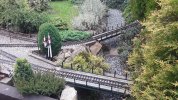
With the upper track's loop, the bridge is approched through a hidden 130° curve on a decline from the level rear of garden. The exit and remaining 50° is still on a decline to meet the level trackbed at the front face of garden. The lower loop crossing the bridge, likewise is approached on a similar decline but on a 90° curve and is already straight going over that bridge but still on a slight decline while crossing and meeting the level front of garden. Both loops' curves are 4ft radius. At both the hidden approaches and the upper loops curved bridge exits the tracks natural ability to twist is taken advantage of.
20170813_190201.jpg
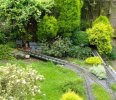
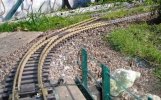
A veiw of the same from a different angle. And a shot to show the loop that is still curving on a decline to meet the level area of the garden. All the transitions are managed by carefully applied ballast (potting grit here) to keep the track level or induce an amount of cant into the railhead as the curve progresses. I hope any of this of any help or make sense.
Layout W.JPG new track 005.JPG
 
want to raise my track to meet my bridge

how high is(?), or will be(?) your bridge?

if you want to run "normal" trains (length-wise) you'll need about 1 metre to raise the track one, or one and a half centimetre.
so, if you would want to make a "figure-eight" layout, there would have to be at least about 16 metres between "on the bridge" and "under the bridge". - on both loops.

upwards-bend:
with the little grades possible for traction, there is no need for upwards bending.
the LGB railjoiners are flexible enough to absorb about 1% percent of grade difference.
so placing two 15 cm long straights at the foot and at the top of a grade give you all the grade, your trains can manage.

 
If you are looking for the LGB track piers I have several boxes in my garage.
 
LGB track being brass will bend upwards quite readily with care. But you certainly do not want much of a bend as it is likely that trains may ‘ground’ if you do too much and pickup sliders could miss the rails.
 
Back
Top Bottom