Experience Connecting LGB Hall Effect Sensors to MLS Boards?

FatherMcD

Registered
Country flag
I have a couple of older LGB locos (21252 & 2219S) with older sound cards as well as several Aristo-Craft slope-back tenders with sound cards. They all have Hall Effect sensors to trigger the chuff. At first I had hoped to utilized the LGB sound cards because they actually have a fairly decent sound system. However, after trying to figure out how to interface the sound cards with modern Battery/RC systems, I have decided that I'm better off spending less time and more money to use MyLocoSound (MLS) cards. I was given advice on how to connect the Hall Sensors to the MLS card, but am hoping someone has had some positive experience with this setup before I risk my MLS card. TIA.
 
May be worth your while to have a look at @ge_rik ’s blog. Not sure if he has his MLS linked but if anyone has the way it will be him or perhaps @Moonraker can help.
 
May be worth your while to have a look at @ge_rik ’s blog. Not sure if he has his MLS linked but if anyone has the way it will be him or perhaps @Moonraker can help.
I've not used hall effect sensors but usually rely on the MLS card's voltage sensing to control the chuff rate. I have one loco with an electro mechanical trigger for the chuffs (using a Bachmann Lyn motor block). It works and provides synched chuffs but, to be honest, to my ear it sounds a bit too stacatto compared with the voltage triggered chuffs.

However, theoretically, it should be straightforward connecting a hall effect sensor to a MLS card. All the card needs is the trigger port (7) to be connected to ground via the sensor or a NO reed switch would do the job. The trickiest bit would be mounting the magnets on the axle. I came across this on Printables which looks useful -
Rik
 
I've not used hall effect sensors but usually rely on the MLS card's voltage sensing to control the chuff rate. I have one loco with an electro mechanical trigger for the chuffs (using a Bachmann Lyn motor block). It works and provides synched chuffs but, to be honest, to my ear it sounds a bit too stacatto compared with the voltage triggered chuffs.

However, theoretically, it should be straightforward connecting a hall effect sensor to a MLS card. All the card needs is the trigger port (7) to be connected to ground via the sensor or a NO reed switch would do the job. The trickiest bit would be mounting the magnets on the axle. I came across this on Printables which looks useful -
Rik
Superb, wish he could manage one for TT120!
 
I have a couple of older LGB locos (21252 & 2219S) with older sound cards as well as several Aristo-Craft slope-back tenders with sound cards. They all have Hall Effect sensors to trigger the chuff. At first I had hoped to utilized the LGB sound cards because they actually have a fairly decent sound system. However, after trying to figure out how to interface the sound cards with modern Battery/RC systems, I have decided that I'm better off spending less time and more money to use MyLocoSound (MLS) cards. I was given advice on how to connect the Hall Sensors to the MLS card, but am hoping someone has had some positive experience with this setup before I risk my MLS card. TIA.
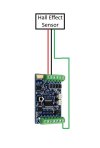
The attached diagram shows how a hall effect sensor is connected to MyLocoSound soundcards. The sensor has three connections:
The supply voltage to the sensor is labelled V or + and is connected to the B+ terminal.
The ground is labelled G or - and is connected to the B- terminal.
The third connection is the signal output when a magnet passes and is connected to the F7 terminal.

The ones we use are labelled V, G and S.
Just make sure that the sensor voltage rating is equal to or more than your battery voltage.
Hall Effect sensors are more robust than reed switches but a little more complicated to install. There is no risk to the MLS card.

Regards
Peter Lucas
MyLocoSound
 

Attachments

  • Hall Effect Chuff Sensor.jpg
    Hall Effect Chuff Sensor.jpg
    30.9 KB · Views: 4
The attached diagram shows how a hall effect sensor is connected to MyLocoSound soundcards. The sensor has three connections:
The supply voltage to the sensor is labelled V or + and is connected to the B+ terminal.
The ground is labelled G or - and is connected to the B- terminal.
The third connection is the signal output when a magnet passes and is connected to the F7 terminal.

The ones we use are labelled V, G and S.
Just make sure that the sensor voltage rating is equal to or more than your battery voltage.
Hall Effect sensors are more robust than reed switches but a little more complicated to install. There is no risk to the MLS card.

Regards
Peter Lucas
MyLocoSound
Well learn something every day, I reckon that may be a better bet than the LGB EPL track sensor for firing point motors that I use with Auxiliary Switches to use as relays, I go that way cos I understand the tech. Also useful to know as I may with my MLS cards get round to using a Hall Effect rather than the programming on a rolling road that I have done to mine, though I have to say that method works very well after watching Rik’s explanation in YouTube.
 
Back
Top Bottom