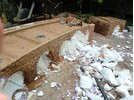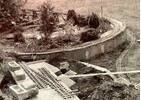
3m long concrete viaduct - "XPS foam" mould

Its definitely just a section where the concrete wasnt mixed properly, as I peel off the front its a lot tougher and no crumbling sections. I got someone to help me with the pour for the second section and he told me to let the dry ingredients mix for a bit before adding water. I was just bunging everything in at once and letting it mix, so its likely the short section I poured alone has lumps that arent properly mixed in.
Because I used a very fine 6mm gravel (the same one I use for ballast) the ratios were:
1-and-a-half bucket cement
2 bucket 6mm gravel
2 bucket sharp sand
2 cups 'buff' and 1 cup 'brown' cement dye powder (this produces a light brown sandstone-y shade)

The front - much nicer see:
View attachment 342904
Not quite sure why you were putting in gravel?

Mixing should have been done all in one go but another way I have used is to have a central removable section so that you create the outside to be seen faces, then add a mix with gravel in the centre with possibly a few bits of rod to give strength then pull out the separating bits andcomplete the top surface mix. This the central bit could have gravel.

A mix of 1 part cement to 3 parts sharpe or even building sand including your colour option will give you nice clean detail, in the middle a mix of 1 cement 3 parts sharpe sand and possibly 2 parts gravel works nicely.
 
Looks really good, even the first part with a few missing brick faces looks just like some old walls around here.
Will be great to see the viaduct installed and a train running over it.
 
Thomas, what an enormous effort and what a result! Fantastic. If you don't mind i like to bring in a few hopefully helping remarks about concrete building.
1 Concrete develops shrinkage cracks as a result of the hardening process.
2 During the hardening process (about a month!) , concrete must be kept wet and therefore not allowed to dry quickly!
3 Shrinkage cracks cause damage later on as a result of rainwater penetrating the concrete and expanding during frost.
4 Concrete is porous. The ratio of water to cement determines the porosity. Porous concrete is highly susceptible to frost damage later on. It is therefore advisable to add a water-repellent agent to the concrete.
4 To minimize problems caused by shrinkage, you should also reinforce the concrete model. In your case, I would use galvanized chicken wire and apply it to the inside walls of the mold. In addition, also a few roughened concrete steel wires are needed in the longitudinal direction of your model to prevent it from breaking into pieces later.
5 An important point when making the mold is that the bricks at the surface must be shaped so that they can be removed from the mold without sticking. I think the latter is particularly challenging.

Good luck with your brave attempt to cast a concrete viaduct. However, given the above, I think it is not without reason that most viaducts are made as a single, non-reusable model from polystyrene sheets in which the grooves between the bricks are made with a soldering iron and the bricks are then roughened with a steel brush and than painted.
 
Thomas, what an enormous effort and what a result! Fantastic. If you don't mind i like to bring in a few hopefully helping remarks about concrete building.
1 Concrete develops shrinkage cracks as a result of the hardening process.
2 During the hardening process (about a month!) , concrete must be kept wet and therefore not allowed to dry quickly!
3 Shrinkage cracks cause damage later on as a result of rainwater penetrating the concrete and expanding during frost.
4 Concrete is porous. The ratio of water to cement determines the porosity. Porous concrete is highly susceptible to frost damage later on. It is therefore advisable to add a water-repellent agent to the concrete.
4 To minimize problems caused by shrinkage, you should also reinforce the concrete model. In your case, I would use galvanized chicken wire and apply it to the inside walls of the mold. In addition, also a few roughened concrete steel wires are needed in the longitudinal direction of your model to prevent it from breaking into pieces later.
5 An important point when making the mold is that the bricks at the surface must be shaped so that they can be removed from the mold without sticking. I think the latter is particularly challenging.

Good luck with your brave attempt to cast a concrete viaduct. However, given the above, I think it is not without reason that most viaducts are made as a single, non-reusable model from polystyrene sheets in which the grooves between the bricks are made with a soldering iron and the bricks are then roughened with a steel brush and than painted.
OK so I should probably be spraying with a hose for the next month or so?

It's already reinforced. I didn't mention it but it has rebar in the trackbed and cage like bits in the piers.

I haven't used a water repellant additive. I'd planned to give it a thin render type coating to fill cracks that frost might get into, and then some sort of water repellant finish of the type used for stamped concrete driveways.

Part of the problem is the Internet is swamped with conflicting advice from experts and companies and manufacturers. In the end I've taken most of my advice (colouring, mix ratios) from someone who does imprinted driveways, because they live in the same village.

This is all too late to help me but hopefully it will help others. I'm going to try this method of mould making again(because it's quick and looks nice) *but* paint the entire mould inner with a few mm of urethane rubber. To cast tunnel mouths and a platform if it works. Than well know if the viaduct could have been done that way too.

Current state of chipping at the mould:
 

Attachments

  • 20250522_150937.jpg
    20250522_150937.jpg
    896.5 KB · Views: 0
Thomas,
You're absolutely right: so many people so many different advices!
Best is to follow the practical advice from your local friends and connections and discuss with them
what to do with all the other advices.
Indeed keep the concrete structure wet for a few weeks to enhance the hardening process.
Your result so far is fantastic! Well done!
 
Ive been busy on with the enormous task of adding coping to the top of the >50m of stone walling that makes up my layout, and had wanted to show this off when fully complete, but it'll be another few weeks till my MVL bridge arrives to complete it, plus the rockery/tunnel project (to fill the shadiest corner of the garden that only weeds would grow in otherwise) that you can see behind the viaduct will be another week or so, having ran out of big bits of free sandstone for now - plenty on Marketplace for me to go grab when I get a free evening though.

So here we are now - Ive done a little patch repair on the one bit of missing detail on the long section (dont worry, its identical ratio mix, so will dry light brown). Im thinking I may well 'grout' it with a darker shade to really make the pattern stand out, but I need to research 'external grouts' that would work on this, theres probably some sort of 'pool grout' type product out there in a very dark grey I can test on a hidden section. Theres some dark sections on it to be wire-brushed up, this is where the most stubborn bits of styrene had to be burned out with a weed-burner!
20250614_125221[1].jpg
 
Ive been busy on with the enormous task of adding coping to the top of the >50m of stone walling that makes up my layout, and had wanted to show this off when fully complete, but it'll be another few weeks till my MVL bridge arrives to complete it, plus the rockery/tunnel project (to fill the shadiest corner of the garden that only weeds would grow in otherwise) that you can see behind the viaduct will be another week or so, having ran out of big bits of free sandstone for now - plenty on Marketplace for me to go grab when I get a free evening though.

So here we are now - Ive done a little patch repair on the one bit of missing detail on the long section (dont worry, its identical ratio mix, so will dry light brown). Im thinking I may well 'grout' it with a darker shade to really make the pattern stand out, but I need to research 'external grouts' that would work on this, theres probably some sort of 'pool grout' type product out there in a very dark grey I can test on a hidden section. Theres some dark sections on it to be wire-brushed up, this is where the most stubborn bits of styrene had to be burned out with a weed-burner!
View attachment 343963
What may work is black concrete dye, just slap a loose mix on then quickly wipe it off with some old foam leaving residue in the mortar lines. Just try a small area at the back first!
 
Well done! Great Garden Railway!

Gerard (Bart)
check my book "Our Model Garden Railway " at Amazon
 
This is a really cool project, I intend on replicating it. I think I have the solution to a few of the issue. First the texture. There are two options and both can be used. First you need to use a concrete release agent on your forms. The powdered style would work better for this application. If you use a darker color relase you get dark colors in the negative spaces that will give a good color variegation. Next the form liners. Since you have the 3d model of the viaduct you could create a negative of a brick texture that you apply to the 3d model. Export that as stl file and print it in segments. Then you can glue that to the inside of your forms. That combined with the release agent will give you an awesome look. Ohh also you would have greatly benefited from a Makita battery powered concrete vibrator. I think the mix design also needs some tweaking. I use a set of admixture that is add to a regular bag of sand topping mix that would flow better and prevent all the pocketing.

Not trying to dis your method. I just have years of experience of specialty concrete work.
 
This is a really cool project, I intend on replicating it. I think I have the solution to a few of the issue. First the texture. There are two options and both can be used. First you need to use a concrete release agent on your forms. The powdered style would work better for this application. If you use a darker color relase you get dark colors in the negative spaces that will give a good color variegation. Next the form liners. Since you have the 3d model of the viaduct you could create a negative of a brick texture that you apply to the 3d model. Export that as stl file and print it in segments. Then you can glue that to the inside of your forms. That combined with the release agent will give you an awesome look. Ohh also you would have greatly benefited from a Makita battery powered concrete vibrator. I think the mix design also needs some tweaking. I use a set of admixture that is add to a regular bag of sand topping mix that would flow better and prevent all the pocketing.

Not trying to dis your method. I just have years of experience of specialty concrete work.
For reference:

  • I absolutely SLATHERED it in mould release agent. A wax type marketed as for polystyrene forms for concrete. It was on there, I brushed an entire tin into that mould. It still didnt do much: the sheer amount of recesses meant it was on so tight it broke apart however you tried to remove it. Powder would have been the same, surely?

    Perhaps If Id painted it with a few layers of two part rubber which I used for making moulds elsewhere on my layout (platform sections and tunnel entrances) I'd have been able to pull it off easier. I think that would be worth experimenting with if I ever find the time, or if anyone else wanted to try this method.

  • Printing form liners? Well... : box of 10mm xps underfloor foam and a soldering iron =£30ish and about two evenings wearing a mask for the fumes. 3D printing the texture to get the same visual look =over £150ish of filament and at least two weeks of printing it in sections, plus I dont own a printer so would have to pay someone even more. Sure maybe I'd have been able to salvage some of the printed panels for future re-use but 'cool tech' doesnt always mean 'best choice for the job', not for a 3.5metre long object.

  • I used a concrete vibrator - a heavy duty construction one hired from the same place as the mixer and ran off the same site inverter. My issues were from me not mixing properly due to inexperience, and the one long crack on the front is where vibrating caused all the thinner concrete to sink down the mould to fill gaps (and flow out the very small gaps at the bottom), leaving an area that was largely gravelly concrete. I could have avoided it like I said by screeding in a thinner layer first, or (you'd probably know?) by pouring-vibrating-pouring-vibrating layers at a time rather than one massive pour?

  • Admixture doesnt change flow does it? All advice I read/watched/was given in store was it changes workability (set time) and adds water/frost protection. Mix I could definitely have improved: a mix with no gravel just sharp sand would have been easier to pull up the sides of the mould and do an initial layer to catch the detail, and then a more gravel filled mix to fill. Everything I read/watched/was told in store said concrete with no gravel = no real strength, fine for a platform section, not so much for a bridge me and my boys frequently walk on.
If you have speciality Concrete knowledge, one thing I am interested in is the potential of using fibre-reinforced-cement to make buildings with, asseming I could make the walls say 15-25mm thick?? I was hoping I could make a single mould of a terraced house and cast it multiple times to make a street.
 
Over the years I have done a few concrete walls, I made them using a cut car rubber mat in the bottom of a bought square block mould. I made them on the sandcastle method with slightly damp mix that stayed together when ejected from the mould into paving slabs covered in plastic. Leaving to dry overnight they were fit to use next day. I tended to do as many as I had space for in an evening. You can see some of them here, I should have taken more time to join them better without gaps. This was from my old line in Luton demised 2000 though I did make more of the walls for my line in Hemel after I started that line.
IMG_6048.jpeg
 
Ive been busy on with the enormous task of adding coping to the top of the >50m of stone walling that makes up my layout, and had wanted to show this off when fully complete, but it'll be another few weeks till my MVL bridge arrives to complete it, plus the rockery/tunnel project (to fill the shadiest corner of the garden that only weeds would grow in otherwise) that you can see behind the viaduct will be another week or so, having ran out of big bits of free sandstone for now - plenty on Marketplace for me to go grab when I get a free evening though.

So here we are now - Ive done a little patch repair on the one bit of missing detail on the long section (dont worry, its identical ratio mix, so will dry light brown). Im thinking I may well 'grout' it with a darker shade to really make the pattern stand out, but I need to research 'external grouts' that would work on this, theres probably some sort of 'pool grout' type product out there in a very dark grey I can test on a hidden section. Theres some dark sections on it to be wire-brushed up, this is where the most stubborn bits of styrene had to be burned out with a weed-burner!
View attachment 343963
That looks incredible. The planning and hard work paid off.
 
Back
Top Bottom