What happened at your workbench today?

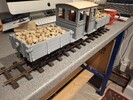
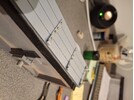
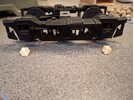
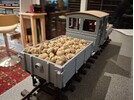
Work has continued on No.23. As the real thing has overhead power, there's not much room for batteries and RC under the superstructure, so having measured the Strikalite battery pack I made up two plywood panels and added stone loads to them. The batteries will fit under one, and the RC PCB will live beneath the other. The original was used for shifting mine waste, albeit for airfield construction, so it fits the back story of a Glen Auldyn branch line having been built to serve a number of small mines...
I've also applied paint, which is a fairly straightforward process, i.e. a rattlecan of grey primer from Halfwits: even the ironwork was grey.
20260109_200817.jpg20260109_200733.jpg20260109_200510.jpg
The next job will be adding details, including a trolley pole, and fitting the batteries and RC. I'm going to try the Piko key fob system that I took out of  Mona in the first instance.
 
Work has continued on No.23. As the real thing has overhead power, there's not much room for batteries and RC under the superstructure, so having measured the Strikalite battery pack I made up two plywood panels and added stone loads to them. The batteries will fit under one, and the RC PCB will live beneath the other. The original was used for shifting mine waste, albeit for airfield construction, so it fits the back story of a Glen Auldyn branch line having been built to serve a number of small mines...
I've also applied paint, which is a fairly straightforward process, i.e. a rattlecan of grey primer from Halfwits: even the ironwork was grey.
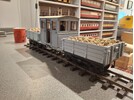
View attachment 351866View attachment 351867View attachment 351868
The next job will be adding details, including a trolley pole, and fitting the batteries and RC. I'm going to try the Piko key fob system that I took out of  Mona in the first instance.
I say, has that chap got a ticket to drive electric locos?
 
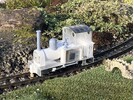
The 45 mm gauge Nancy out for a run, though it does seem light (weight), but with battery and electronics not much room for added weight:

IMG_3124.jpeg

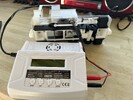
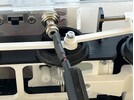
Slight error with the charging point, placed it in the same position as with the 32 mm gauge loco, didn't take into account the extra width. But with the charging plug casing removed, I could just get it to fit.

IMG_3122.jpeg

IMG_3123.jpeg
 
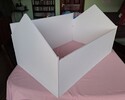
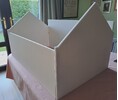
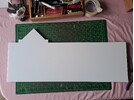
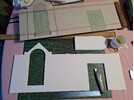
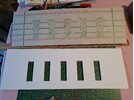
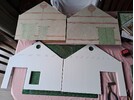
Having cut the foamboard to size (except for one side) and given them a bath to remove the outer card, a trial fit on the table.
20260110_151052.jpg
20260110_151004.jpg
I need to double check on the width of the side door and surround before I cut the hight. What is interesting is with soaking the card, it comes away easily and leaves the glue, which seems like pva behind, hopefully it won't effect the scribing or painting, not that there's much as the goods shed was/is white!
 
The 45 mm gauge Nancy out for a run, though it does seem light (weight), but with battery and electronics not much room for added weight:

View attachment 351895

Slight error with the charging point, placed it in the same position as with the 32 mm gauge loco, didn't take into account the extra width. But with the charging plug casing removed, I could just get it to fit.

View attachment 351896

View attachment 351897
Yes, I have one that charges like that - the socket carefully mounted in a cab that isn't quite big enough :oops:

Now weight, wait for it, it looks as if there are some locations for dobbing in a bit of lead shot underneath - I used to go to a 'huntin' shootin' and fishin' shop for mine. It's not real lead now but still should not be glued using PVA - epoxy works ok, but does run and dribble through even the tiniest of holes before it sets.

The big issue is, how much weight do you add before you put that drive mechanism under strain - a constant problem in our scale :nod::nod:
 
Now for the diamond dubble:
1768244845925.png
1768244861610.png

1768244876705.png

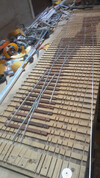
Tomorrow I’ll be lining everything out, an extra step I didn’t expect, but necessary to make the track production‑wise more efficient and accurate!

As some of you may remember, I’m planning to build Amsterdam Central in G‑scale…. and yes, it’s going to be 32 meters long.

Tomorrow I’ll start by lining out and gluing the aluminium strips. I still need to figure out the best order of operations, and I’ll also have to apply masking tape before adding the putty.

My idea is to use one, two, or maybe even three “rails” to keep the sleepers/ties aligned and accurate.
Then I’ll apply the putty into the slots after cutting and bending the rails.
Once that’s done, I’ll remove the temporary rails that kept everything in place and repeat the process for the rails that kept the sleepers/ties in check

This workflow may still change; it’s all a work in progress as I try to develop a production‑friendly method.
 
But at least I finally have the measurements needed for what the locomotives from different brands require.

Like I originally planned, I started out aiming for a museum‑grade, fully prototypical setup… but that simply isn’t doable in a garden environment or when using more “budget‑friendly” locomotives.
So compromises had to be made.

And yes, this whole project is meant for outdoor use, not for a museum‑style indoor layout.

I will share my findings in my main topic, donnt worry, just please be patient...

With best regards Igor
 
So No.23 was going to be a quick and dirty kitbash to produce something roughly akin to the prototype, wasn't it?
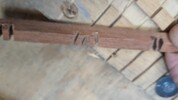
So why did I buy 12" of ⅜ brass hex bar to turn up some axlebox covers, and 100 ¹/¹⁶ rivets (and the corresponding drill bit) to detail the hinges?
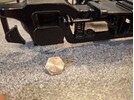
20260112_202404.jpg
20260112_204131.jpg
20260112_204158.jpg
Why do I always do this?

Oh, and I've got 11½" of ⅜ brass hex bar left over, if anyone needs some...
 
Last edited:
So No.23 was going to be a quick and dirty kitbash to produce something roughly akin to the prototype, wasn't it?
So why did I buy 12" of ⅜ brass hex bar to turn up some axlebox covers, and 100 ¹/¹⁶ rivets (and the corresponding drill bit) to detail the hinges?
View attachment 351990
View attachment 351991
View attachment 351992
Why do I always do this?

Oh, and I've got 11½" of ⅜ brass hex bar left over, if anyone needs some...
But where are the crooks for the hinge bands?
 
So No.23 was going to be a quick and dirty kitbash to produce something roughly akin to the prototype, wasn't it?
So why did I buy 12" of ⅜ brass hex bar to turn up some axlebox covers, and 100 ¹/¹⁶ rivets (and the corresponding drill bit) to detail the hinges?
View attachment 351990
View attachment 351991
View attachment 351992
Why do I always do this?

Oh, and I've got 11½" of ⅜ brass hex bar left over, if anyone needs some...
I must admit to cheating with rivets, I use nail art dots. From normal viewing theyre fine ( but even better in the dark TBH)
 
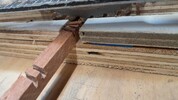
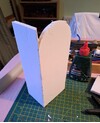
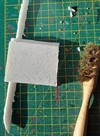
Following on, I have done a trial joint which with some tidying up will be ok, glued together with wood glue and I shall try the Hot glue gun on it to add some reinforcement brackets and run a bead down the inside.
20260116_082635.jpg
I was minded to just keep the white finish as is, however, watching the marvellous miniatures yesterday, they did a rendered finish using grouting powder sprinkled onto glue a painted white, hmmm, how much time do I have till Stoneleigh? :think:
 
Following on, I have done a trial joint which with some tidying up will be ok, glued together with wood glue and I shall try the Hot glue gun on it to add some reinforcement brackets and run a bead down the inside.
View attachment 352083
I was minded to just keep the white finish as is, however, watching the marvellous miniatures yesterday, they did a rendered finish using grouting powder sprinkled onto glue a painted white, hmmm, how much time do I have till Stoneleigh? :think:
Or maybe a tester pot of Sandtex masonry paint (fine)?
 
Following on, I have done a trial joint which with some tidying up will be ok, glued together with wood glue and I shall try the Hot glue gun on it to add some reinforcement brackets and run a bead down the inside.
View attachment 352083
I was minded to just keep the white finish as is, however, watching the marvellous miniatures yesterday, they did a rendered finish using grouting powder sprinkled onto glue a painted white, hmmm, how much time do I have till Stoneleigh? :think:
Or to throw another way in. I have seen great results on youtude by people using a skim coat of spack filla. You can sand it and its a porous so takes washes well.
 
Back
Top Bottom