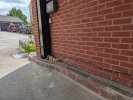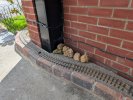
The Woodlock Line

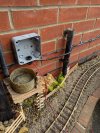
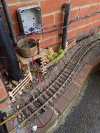
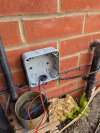
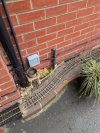
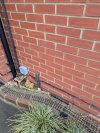
In between the heavy downpours, I've reconnected the power feed into the new extension, meaning that there are now 4 independent feed wires direct from the CS3, putting less reliance on power going through the railway to the far ends of the line. Though railclapmps were the biggest improvement to date, this now adds even more resilience.
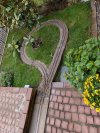
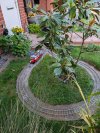
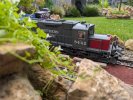
PXL_20260513_143034034.jpgPXL_20260513_142808820.jpgPXL_20260513_142142104.jpgPXL_20260513_144152937.jpgPXL_20260513_144149418.jpgPXL_20260513_145220599.jpgPXL_20260513_145225169.MP.jpgPXL_20260513_145229837.jpg
 
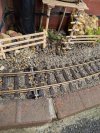
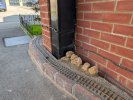
Goong to chisel some drainage channels into the 'ballast' so that floods don't occur again.
Floods like that won't stop you running - did you see that 3mm layout in one of the Great Model Railway competition episodes where they ran a model of a Dutch train in a flooded dyke, complete with floodgates ? :clap::clap:

The train kept running when half-submerged.
 
The train kept running when half-submerged.
many years ago i saw a short video, of a Stainz running completely submerged.
they explained, that is was made possible by using distilled water.
(explaining, that not the water conducts electricity, but salts soluted in the water)
 
many years ago i saw a short video, of a Stainz running completely submerged.
they explained, that is was made possible by using distilled water.
(explaining, that not the water conducts electricity, but salts soluted in the water)
Not recommended for live steam though! TBH water is a really poor conductor of electricity, putting a heater into bath water probably won't do much damage, apart from to the heater, (RCD aside) unless you've used plenty of bath salts or bubnle bath. (Please don't try to confirm this, there's always the exception that proves the rules)
 
What kind of temperature swings do you get? Where I am (Chicago) the combination of cold winter and hot summers puts too much stress on the expansion/contraction of rails and postcrete for the roadbed would result in kinks, warps, and broken ties. I use 7/16" crushed gravel as the roadbed and let track float. It locks it down pretty good when top-dressed over the rails but allows for movement with the temp fluctuations.
 
From not much less than 32 in the winter to occasionally just over 90, F of course do not do C or Kelvin for that matter. Scotland can get colder in the Winter as can extreme snow and high winds effect the rest of UK.
 
i started with LGB in Hamburg, at about 50° north, now i live at 21° south.
both locations have one thing in common: the expansion and contraction of LGB brass-rail for temperature differences of (roughly) 30°C/60+°F is at about 2 to 2.5mm/ 1 tenth of an inch per foot only.
trial and error over half a century brought me to the opinion, that most of the track-expansion problems come from perfectionism.

the main culprits (from my point of view) are:
1) too long pieces of track (take a five foot/1.5m piece of track = you get a max expansion/contraction of 0.5"/12mm)
2) floating track. (specially in curves the track gets pushed outside in heat, but not drawn inside in cold)
3) well screwed/nailed/cemented track (if the track can't push sideways, it pushes up and/or something breaks)

my personal solution(s):
1) short pieces of track. (max. 2ft/600mm) to keep the movements under 1/5" or 5mm.
2) when track laying at median temperatures - holding a creditcard between railends, when showing together.
3) each piece of track gets ONE nail (plywood-central) or long spike (outside on ground) on ONE end. - so each connection is fixed on one side and flexible on the other.

that way, i need other imperfections for derailments and other niceties. (visitors, cattle, horses and Rottweilers come to mind)

lucky me - due to availability and prices most of my near 500ft. of track are re-bent R1 curves of only 1ft. each.

did i mention, that i like the "clickety-clack" of the rail gaps?
 
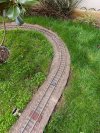
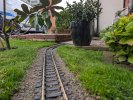
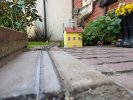
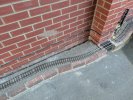
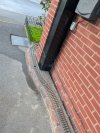
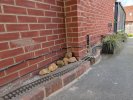
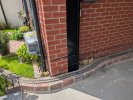
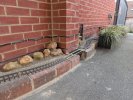
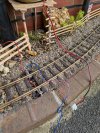
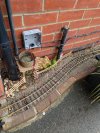
Well, while we've been away, the grass has gone wild, and maybe getting ready for its first cut. But it's also soaking. Tidied the drainage channels out a bit more with hammer and chisel.

Regards the postcrete, there are joints in the rail, and it's in the shade after dinner time, so I guess time will tell. Should be ok.

PXL_20260519_100704819.jpgPXL_20260519_100700415.jpgPXL_20260519_100644127.jpg
 
Well, while we've been away, the grass has gone wild, and maybe getting ready for its first cut. But it's also soaking. Tidied the drainage channels out a bit more with hammer and chisel.

Regards the postcrete, there are joints in the rail, and it's in the shade after dinner time, so I guess time will tell. Should be ok.

View attachment 356565View attachment 356566View attachment 356567
This means a 1 metre brass bar will expand by about 0.18mm to 0.2mm if the temperature increases by100 degrees C. Crudely ten times the rate that concrete expands, and also remember that the concrete remains cooler in the ground.

That's what AI is telling me so probably needs checking, but doesn't sound like much to worry about - 5 metres will expand by 1 mm
 
Last edited:
a 1 metre brass bar will expand by about 0.18mm to 0.2mm text if the temperature increases by100 degrees C. ...
- 5 metres will expand by 1 mm
...That's what AI is telling me so probably needs checking, ..

:wait: could you ask the A.I. if that is in continental mm? :wondering:

my estimated guess: "the expansion and contraction of LGB brass-rail for temperature differences of (roughly) 30°C/60+°F is at about 2 to 2.5mm/ 1 tenth of an inch per foot" - would come up to 32 - 40 mm over five metres.

i know, i know - i'm not as learned as an A.I. - but i got the ability, to observe raw data. (in this case for 48 years)

:think::tmi:

edit: found this in the german wikipedia:
Linearer thermischer Ausdehnungskoeffizient18,5·10−6/K bei 20 °C (CuZn30)

Anybody, who can "translate" these numbers?


Last edited:
:wait: could you ask the A.I. if that is in continental mm? :wondering:

my estimated guess: "the expansion and contraction of LGB brass-rail for temperature differences of (roughly) 30°C/60+°F is at about 2 to 2.5mm/ 1 tenth of an inch per foot" - would come up to 32 - 40 mm over five metres.

i know, i know - i'm not as learned as an A.I. - but i got the ability, to observe raw data. (in this case for 48 years)

:think::tmi:

edit: found this in the german wikipedia:
Linearer thermischer Ausdehnungskoeffizient18,5·10−6/K bei 20 °C (CuZn30)

Anybody, who can "translate" these numbers?



I only summarised the AI info - google 'coefficient of expansion of brass'.

The crucial aspect is how it compares to the coefficient of expansion of concrete.
 
Back
Top Bottom