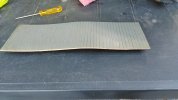
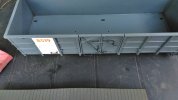
The base plate of my Gondola is warped.

railaddict

Registered
Country flag
As you can see on the photograph, the base plate of my Gondola 8519 of the RhB is warped. Does anyone have a way of straightening it out?

I was wondering if putting it in boiling water would help but maybe someone has another solution.

IMG_20260912_180611.jpgIMG_20260912_180638.jpg
 
No. I bought it second hand. One of the mounting brackets is broken, and I think it was already warping. That might be why I’d put some gravel in there – I probably thought it would help straighten it out.
 
I would be tempted to put some small screws in to pull it down, very small screws can be obtained from Amazon, drill and counter sink then fill over when flat with some filler, Davids Isopon is a suitable grey so may work just fine.
 
I would try with hair dryer, on a wooden workbench
In moving hair dryer a lot, to avoid plastic becomes too hot at the same place.

With hair dryer, it is not too hot ( like could be heat gun )
It depends also on the distance between the hair dryer and the base plate.
Then adapt temperature of hair dryer ( don't use maximal temperature ) and distance

You need to stop frequently , to check how plastic reacts.
Heat and stop, touch plastic, heat and stop, touch plastic ( it can be hot )...
You have to be patient, patient and not try to heat up quickly.

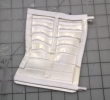
I straightened out this way some Playmobil, for instance wagon roofs that were warping.
Go slowly and stop if you don't feel at easy.

Sometimes this deformation comes from to stay under sun during summer in a room like a green house
It is to say that hair dryer does not need to be very hot....

Do not try with lighter.

When I was younger :), I was in too much of a hurry, with heat gun,
I twisted this door.
But it was my first try, and it it was very bad plastic.
Normally Playmobil or LGB plastic is stronger...


1789752617201.png

Hot water is really good idea
but , in my case, it is easier for me to stop hair dryer than to remove roof from hot water...

 
The problem with applying heat is the chance of overheating depending what type of plastic you have.
So I would not use a hairdry blower since the temperature varies too much depending on the position of the blower relative to the workpiece.
Using hot water seems to me a good controlled way to start, apply heat up to 100 degrees celcius (Boiling water).
As for the way how to apply the hot water on the workpiece three remarks, based on the idea that the goal of the operation is to make the back side flexible/deformable while the front side stays strong/stiff. This enables the backside to stretch or crimp in order to get back into the original flat shape of the workpiece:
1 Do not heat the top side with the nice wooden imprint, but only heat the back side.
2 Put the piece on a flat bottom and add some weight on it while spreading this weight by using three or more long stiff (aluminium) bars
3 Start with a mild temperature en when there is no result increase temperature step by step.
It may be helpfull to put the part with an upheave over a counterfitting shape round surface and push the workpiece gently and shortly onto this round shape, so overstretching it a little bit.
When even boiling hot water doesn't do the job than may be you can turn into heated olive-oil to apply higher temperatures.
Looking forward to your results!
 
Last edited:
If you have access to a 3D printer, you could place it on the heated print bed for a short while. A means of heating it uniformly without over heating it.

Rik
No, I don't have a 3D printer but thanks for the suggestion. I'll probably go to the warm water solution.
Immerse in very hot (not boiling) water, then quickly weight it down with books, bricks or whatever...?

Jon.
I would try with hair dryer, on a wooden workbench
In moving hair dryer a lot, to avoid plastic becomes too hot at the same place.

With hair dryer, it is not too hot ( like could be heat gun )
It depends also on the distance between the hair dryer and the base plate.
Then adapt temperature of hair dryer ( don't use maximal temperature ) and distance

You need to stop frequently , to check how plastic reacts.
Heat and stop, touch plastic, heat and stop, touch plastic ( it can be hot )...
You have to be patient, patient and not try to heat up quickly.

I straightened out this way some Playmobil, for instance wagon roofs that were warping.
Go slowly and stop if you don't feel at easy.

Sometimes this deformation comes from to stay under sun during summer in a room like a green house
It is to say that hair dryer does not need to be very hot....

Do not try with lighter.

When I was younger :), I was in too much of a hurry, with heat gun,
I twisted this door.
But it was my first try, and it it was very bad plastic.
Normally Playmobil or LGB plastic is stronger...


View attachment 361190

Hot water is really good idea
but , in my case, it is easier for me to stop hair dryer than to remove roof from hot water...
The problem with applying heat is the chance of overheating depending what type of plastic you have.
So I would not use a hairdry blower since the temperature varies too much depending on the position of the blower relative to the workpiece.
Using hot water seems to me a good controlled way to start, apply heat up to 100 degrees celcius (Boiling water).
As for the way how to apply the hot water on the workpiece three remarks, based on the idea that the goal of the operation is to make the back side flexible/deformable while the front side stays strong/stiff. This enables the backside to stretch or crimp in order to get back into the original flat shape of the workpiece:
1 Do not heat the top side with the nice wooden imprint, but only heat the back side.
2 Put the piece on a flat bottom and add some weight on it while spreading this weight by using three or more long stiff (aluminium) bars
3 Start with a mild temperature en when there is no result increase temperature step by step.
It may be helpfull to put the part with an upheave over a counterfitting shape round surface and push the workpiece gently and shortly onto this round shape, so overstretching it a little bit.
When even boiling hot water doesn't do the job than may be you can turn into heated olive-oil to apply higher temperatures.
Looking forward to your results!
Many thanks for your suggestion. I shall have to find a container in which to place the plate and the water. The suggestion to go step by step with the temperature of the water seems to be the best one.
 
Last edited:
Do you get those thin wooden coffee stirrers in Belgium, as we do in the UK?

Then you could make a new, more realistic wooden floor.

You could even stain the wood, with, er, coffee....
 
Do you get those thin wooden coffee stirrers in Belgium, as we do in the UK?

Then you could make a new, more realistic wooden floor.

You could even stain the wood, with, er, coffee....
Not to my knowledge. Here if you order a coffee in a pub or coffeeshop, you get a spoon and at home we also use spoons (not of wood).
 
Not to my knowledge. Here if you order a coffee in a pub or coffeeshop, you get a spoon and at home we also use spoons (not of wood).
Us Brits must seem to be so unsophisticated to you sauve Europeans!

Lollipop sticks to stir coffee indeed....
 
Not to my knowledge. Here if you order a coffee in a pub or coffeeshop, you get a spoon and at home we also use spoons (not of wood).
What no Costa or Starbucks who's denizens supply the street cleaners with plenty of wooden stirrers to sweep up? You lucky, lucky people. Whens the next train?
 
You can but new wooden coffee stirrers, by the thousand, from Amazon or eBay.

David
 
Looking again at the base plate, is it ply? If so likely to be an after purchase fit that has inevitably warped. F suggestion et some Plastic Sheet if you can say slightly thinner than the ply, scribe planks (both sides will stop warping) then use a bit of broken hacksaw blade to get some wood detail on. Colour as you wish.
 
What no Costa or Starbucks who's denizens supply the street cleaners with plenty of wooden stirrers to sweep up? You lucky, lucky people. Whens the next train?
We have Starbucks coffeeshops, but not where I live, a small town. So it could be that in Brussels, for instance, the street cleaners have to sweep up wooden stirrers. One of my daughers-in-law come sometimes with a coffee she bought from the service-station but she drinks it with a straw.
 
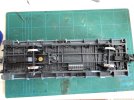
Ok been looking at an original, the base plate is held by 6 grey clips shown by where the 3 galvanized nails (in place 1 side to indicate where clips come through and clip to the inside of the frame) are seen on one side.image.jpg
 
Ok been looking at an original, the base plate is held by 6 grey clips shown by where the 3 galvanized nails (in place 1 side to indicate where clips come through and clip to the inside of the frame) are seen on one side.
Yes, Jon, there’s a clip missing from my plate – it’s the one on the left in your photo.
 
Back
Top Bottom