You are using an out of date browser. It may not display this or other websites correctly.
You should upgrade or use an alternative browser.
You should upgrade or use an alternative browser.
Rack gradient
- Thread starter scook
- Start date


Chris Vernell
Three score and nineteen

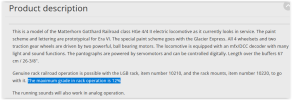
Did a spot of Googling for "LGB rack locomotive gradient" and came up with this: LGB rack locomotives can reliably climb steep gradients, often recommended up to 15% (1 in 6.6) on straight track when using dedicated LGB cogwheel track. While standard adhesion (non-rack) models struggle above 4-5%, rack systems allow for much steeper operation, with some setups working at 12% grades.
I have no personal experience.
I have no personal experience.

stevedenver
Registered

Lgb indicated 20%. As i recall, this was in the 1988 catalogue. Perhaps 1990…There was a diagram of using shorty track sections, bent, to get into the grade.
What Chris wrote is better.
My experience has been, too steep results in short, or very short, trains, buffers that climb over each other, more difficult transition from level to incline, and, curves , on incline make all of the above worse, not to mention trying to keep the curves level, and not torqued. Or simply, the train being pushed over and off the curve. Best kept level.
Initially, i loved the drama of a steeper incline. I have 2 electric locos and the ballenberg.
I recall a Great American Train Store lgb store layout which had a marvelous, lovely, in store display rack layout. From memory, 6 ft rise across 30ft. 1 electric rack with 1 OBB style coach. Swiss style catenary and light signals. Very dramatic. Very noisy rack clackity. Ran on an LGB pendulum.alas, i digress.
In my experience, even 2 shorty 2 axel euro starter coaches create quite a load on steep grades. All you need to do is push the cars by hand to realize how heavy these can get.
Change these to the 4 axel, longer, heavier OBB styled coaches, eg, Schoellenbahn, Zillertall, Zugspitz liveried versions really dramatically increase the load. So do the 3 axel swiss rack coaches. In my experience, a 3 car 3 axel train on a 10-15% grade is a huge load.
And….these heavier trains create the necessity of longer rack sections in the grade transition lead sections, ie the level sections . Otherwise, depending upon which end of the train the loco is on, the train can either cause the loco to slide (downgrade) , or fail to engage to short a rack sections, ie the train, as it enters the grade causes loss of traction (ie it ‘stalls’)due to the incline before loco can get over the rack. Also, the heavier the train, the more pronounced is the herky jerky tooth-into- rack movement of the loco, not to mention wear. Remember, at some amount of grade and load combination, there is essentially no wheel adhesion and the only force is the rack and large loco rack gear. So, literally, each single tooth of the rack gear, as it engages the rack, is carrying the entire train load…yoiks! Too much, and the gear will simply be forced up and out.
So, depending on your train length, curves, etc, moderation is a consideration. Dead straight, should make things easier.
Hope this is useful.
What Chris wrote is better.
My experience has been, too steep results in short, or very short, trains, buffers that climb over each other, more difficult transition from level to incline, and, curves , on incline make all of the above worse, not to mention trying to keep the curves level, and not torqued. Or simply, the train being pushed over and off the curve. Best kept level.
Initially, i loved the drama of a steeper incline. I have 2 electric locos and the ballenberg.
I recall a Great American Train Store lgb store layout which had a marvelous, lovely, in store display rack layout. From memory, 6 ft rise across 30ft. 1 electric rack with 1 OBB style coach. Swiss style catenary and light signals. Very dramatic. Very noisy rack clackity. Ran on an LGB pendulum.alas, i digress.
In my experience, even 2 shorty 2 axel euro starter coaches create quite a load on steep grades. All you need to do is push the cars by hand to realize how heavy these can get.
Change these to the 4 axel, longer, heavier OBB styled coaches, eg, Schoellenbahn, Zillertall, Zugspitz liveried versions really dramatically increase the load. So do the 3 axel swiss rack coaches. In my experience, a 3 car 3 axel train on a 10-15% grade is a huge load.
And….these heavier trains create the necessity of longer rack sections in the grade transition lead sections, ie the level sections . Otherwise, depending upon which end of the train the loco is on, the train can either cause the loco to slide (downgrade) , or fail to engage to short a rack sections, ie the train, as it enters the grade causes loss of traction (ie it ‘stalls’)due to the incline before loco can get over the rack. Also, the heavier the train, the more pronounced is the herky jerky tooth-into- rack movement of the loco, not to mention wear. Remember, at some amount of grade and load combination, there is essentially no wheel adhesion and the only force is the rack and large loco rack gear. So, literally, each single tooth of the rack gear, as it engages the rack, is carrying the entire train load…yoiks! Too much, and the gear will simply be forced up and out.
So, depending on your train length, curves, etc, moderation is a consideration. Dead straight, should make things easier.
Hope this is useful.
Last edited:


SevenOfDiamonds
Registered

what’s the recommended % of gradient for an lgb rack line?
Our rack section will be exhibited at the Astolat Model Railway Exhibition at the Spectrum Leisure Centre in Guildford in three weeks' time (Sunday 12th July) so I'll try to remember to measure the gradient, and report back. I have pictures of it at the Exeter Garden Railway Show in October 2023 . . .
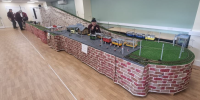
. . . and at the London Festival of Railway Modelling in March 2024 . . .

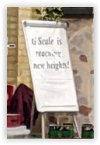 (sorry for the pun!)
. . . but have never thought to take any measurements. As you can see, the top station (Bledlow Ridge) is over 6 feet off the ground (making it the tallest layout on the exhibition circuit?), so over 4 feet above the level part of the line.
Cheers
David

FatherMcD
Registered
Also, the transitions. The lower one looks fairly gradual, but the upper one looks somewhat abrupt.Our rack section will be exhibited at the Astolat Model Railway Exhibition at the Spectrum Leisure Centre in Guildford in three weeks' time (Sunday 12th July) so I'll try to remember to measure the gradient, and report back. I have pictures of it at the Exeter Garden Railway Show in October 2023 . . .
View attachment 357765
. . . and at the London Festival of Railway Modelling in March 2024 . . .
View attachment 357766View attachment 357768(sorry for the pun!)
. . . but have never thought to take any measurements. As you can see, the top station (Bledlow Ridge) is over 6 feet off the ground (making it the tallest layout on the exhibition circuit?), so over 4 feet above the level part of the line.
Cheers
David

I well remember the first time I saw that setup, Cheetam Hill in Manchester at their model Tram Bus running day. Amazing and something very different.Our rack section will be exhibited at the Astolat Model Railway Exhibition at the Spectrum Leisure Centre in Guildford in three weeks' time (Sunday 12th July) so I'll try to remember to measure the gradient, and report back. I have pictures of it at the Exeter Garden Railway Show in October 2023 . . .
View attachment 357765
. . . and at the London Festival of Railway Modelling in March 2024 . . .
View attachment 357766View attachment 357768(sorry for the pun!)
. . . but have never thought to take any measurements. As you can see, the top station (Bledlow Ridge) is over 6 feet off the ground (making it the tallest layout on the exhibition circuit?), so over 4 feet above the level part of the line.
Cheers
David

DickyC
(BZB Mountain Railway)
25% = 1m ACROSS and 25cm UP.. here is a picture and explaination of my set up, think the loco on full straight would be find at 30%
BZB (BRADYEISCHE ZIGSPITZBAHN)
BZB (BRADYEISCHE ZIGSPITZBAHN)

OBBherr
Registered
When my FO rack loco blew up (internal short) Paul at P&S when he fixed it, commented that it was one of LGB's most powerful locos.
Presumably in the light of #stevedenver's comment above this is necessary. I have had no problem with that loco or my Ballenberg pushing 2 coaches up my rack line. Sorry can't remember what the incline is.
Presumably in the light of #stevedenver's comment above this is necessary. I have had no problem with that loco or my Ballenberg pushing 2 coaches up my rack line. Sorry can't remember what the incline is.

andyspencer
Registered
I don't have the figures to hand, but noted that the new LGB HGe4/4 locos are not able to climb as steep as the HGe2/2 box cabs and the Ballenburg steam locos, so bare that in mind. The transition from level to uphill needs to be smooth as well.
SevenOfDiamonds
Registered
I don't have the figures to hand, but noted that the new LGB HGe4/4 locos are not able to climb as steep as the HGe2/2 box cabs and the Ballenburg steam locos


Software Tools
Registered

but noted that the new LGB HGe4/4 locos are not able to climb as steep as the HGe2/2 box cabs and the Ballenburg steam locos,
Larger locos mean longer trains (and often longer coaches). The vertical geometry of any rack rail system is somewhat tricky so larger locos and longer coaches pretty much automatically have an impact on maximum grade in both prototype and model forms.
Also, in model rack rail systems the changes vertical curvatures are often somewhat dramatic compared to any prototype rack rail system.
The suggested gradient is best observed, even keeping to that it is not unknown for heavy trains to cause the loops of couplings to over ride, this can cause potential buffer locking and derailments if you have any curves on the rack. This can occur going either up or down the gradient with the loco at the down hill end of the train as it would be following normal (but not exclusive) prototype practice.It it due a weaker loco or just new guidance to make the loco gears last longer in service?
I’m sure the loco could physical go up a steeper grade with suitable transition gradients,
Unfortunately I don’t own any rack locos to do testing with
Dan


Similar threads


- Replies
- 3
- Views
- 759