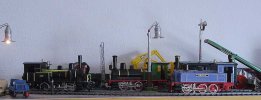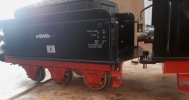
Märklin 55001 Br 89 "Malvine"

ol_hogger

Registered
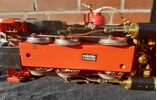
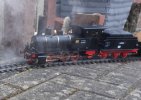
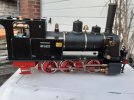
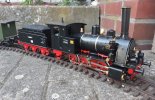
Found a new baby.
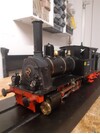
20260403_210511.jpg

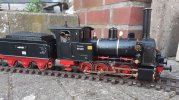
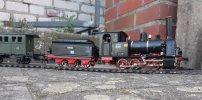
She may look funny half tank, half tender locomotive.

Indeed the prototype worked the lines in the former bog lands of the Oder river's left bank. Bog water is no good for boilers, therefore they took along a tender full of better water, chemically treated as duly indicated by warning labels on the sides, in order to avoid the neccessity of topping up at intermediate stations.

There is a novel by Theodor Fontane which unrolls in that very region. - I will name her 'Malvine' after the character of a moody and snappy housemaid.

Sold by the son of the late owner she had not run for years. I was told that while he used to run a large indoor layout, he was not a dedicated life steamer.
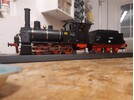
20260403_210427.jpg

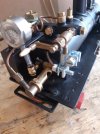
This is a Regner in a skin, therefore I could borrow spares from my other engines.

First came the top-up valve which made the cold water boiler test a straightforward operation: Fill to the brim, plug the safety valve flange, and pump your bottle.

Next I decided to replace the old spring and ball safety valve with the current, (and known) article.

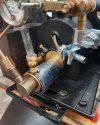
The gas filler valve was stiff. I took it out, moistened the O-rings with a drop of steam oil, worked it a couple of times and reassembled. Filling now worked. (I hold no grunge against this valve, although there may be better solutions.)

The gas control valve needed its packing retightened, and the nozzle wanted to be back-flushed.
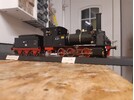
20260403_210358.jpg

I put the kettle on, and meanwhile did the oiling round. Having emptied out the boiler so as to flush out possible lime, I refilled it with the proper amount of freshly boiled water.

Safety and filler valve installed (the latter neatly fits onto the water gauge and underneath the cab roof), I put her on blocks, then tried the gas valve, and after the sputtering had ended put a light to the chimney. A long flame resulted, and I quickly reduced gas until the flame plopped back and the hiss became a sonorous roar.

When pressure had come up I opened the regulator, gave the wheels a series of flips until she would run on her own - which she did !

All in all quite the usual routine after the winter break.

(I should mention that I unhooked the rod from the RC-servo to be in full manual mode for simplicity.)

These are the items I changed or added:

- top up valve
- current safety valve
- front wheels without adhesion bandages
- bell

Next steps will be:

- repacking of oiler valve
- checking and adjusting valve timing
- further cosmetic embellishments
- trying RC (my first)

Happy steaming !
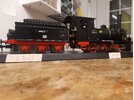
20260403_210313.jpg
 
Last edited:
Nice interesting beastie, not sure getting things going with pre boiled water the best for fittings. Better to let things warm through gradually, the real thing with a few minor exceptions does this. Also is your home water soft or hard with lots of lime? Again best to use another source of water if it is hard, I use water from my dehumidifier best if you have one but some here filter rain water which if done properly is ok. Beware of so called ‘ionised’ water as its method can sometimes involve some nasty chemicals again not good for your boiler and fittings.
 
Water discussions are vain and endless. I did comment at various occasions, e.g. : What water do you use?

Let's better drop it !

In Germany, sometimes preheated water from a stationary boiler was used to speed up the process.
 
Last edited:
Water discussions are vain and endless. I did comment at various occasions. Let's better drop it !

In Germany, sometimes preheated water from a stationary boiler was used to speed up the process.
Just be careful! Filtered rain water is my choice. Mind you the water here is so hard we use axes to cut it as it comes out of the taps
Yes the stationary boiler trick was used here too at large depots. Joe Brown (of Joe Brown and his Bruvvers fame, an English skiffle band from the 50's) describes working out of one of the London depots in his autobiography. Worth reading for that one chapter!
 
Seems you will never know your loco unless you have to (partly) dismantle it.

When attending to the valve timing I noticed that Marvine's cylinders were wobbly.
20260406_174101.jpg
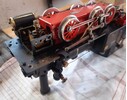
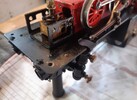
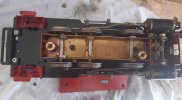
You will note that Märklin's construction is following their Maxi principles: boxshape frames for the axles underneath a solid footplate to which (alas as opposed to being fixed to the frames proper) cylinders and buffer beams are bolted.

20260406_174945~2.jpg

Underneath the smokebox you can spot the hex heads of the cylinder bolts, which were the fulcrum for the wobble, and which I duly tightened. (There are two more towards the back of the smokebox.)

20260406_174216.jpg

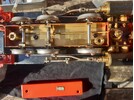
With the bottom cover off you can look at the hornblocks. Note the spring for the center axle. I would have preferred, though, to have the driven wheelset fixed in reference to the cylinders instead, and the outer wheels sprung.

Then there is the RC actuating wire, and two threaded tubes which accept the bolts to fix the loco to the transportation plank.

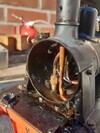
And here is the cab of pretty much standard layout sporting a neat Regner builder plate. The gas tank extends into the port side bunker.

20260406_174648.jpg

Happy steaming !
 
Last edited:
Well observed.

The hornblocks are free to rotate unless resting on the spring (center axle) - or being supported by the coverplate, for that matter.

The front wheelset is from another (electrical) loco, therefore a bit different, note the disks on the inside of the wheels where the contact feeler would reach; the shade of its red paint, too. Or faded from the sunlight.
 
Last edited:
The wobble had caused some steam leakage at the disk valve which controls both direction and quantity of steam to the cylinders. Regner's assembly instructions speak of precision fit to be tight against live steam of 3 bar (or 42 lbs) and advises lubing well before inserting the steam pipes. Alas, the double O-rings were fatigued and tightness was but all gone.

20260409_172847.jpg

I took off the cylinders, dropped another O-ring inside the bore hoping it would get squeezed enough when re-assembling the motor unit.

Cylinders are held by this rather flimsy U-shaped bracket further weakened by generous apertures through which the steam pipes pass.

20260409_172803.jpg

Cylinders installed I applied a provisional stay so as to close the "U" and form a box shape.

20260409_180229.jpg

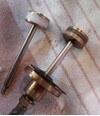
And earlier, while accessible, I pulled one piston to check whether it would still be soldered fast to the rod. Surprise : It is held by a nut and appears to be an early attempt to use a solid ring of teflon instead of a packing made from twisted tape. See it side by side with a more recent teflon piston.

20260409_173558.jpg

Happy steaming !
 
In order to fix the leak I had to replace the O-rings. (After cleaning the grooves by scraping out the hardened and possibly burnt remnants of the original rings.)

Besides there were more traces of molten plastic and blistered paint: telltale signs of frequent smokebox fires which may have persisted unnoticed with the locomltive underway.

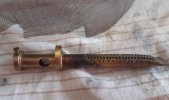
So as to improve control and stability of flame I drilled an extra row of holes at either side of the poker burner. I added an inside cover made from a half-pipe shaped piece of wire mesh. Re -inserting the poker I took care to make its front section touch the bottom of the fire-tube for some heat conduction and more head space for the flames.

20260416_174918.jpg

In gernan-language forums this was recommended as the "Friedl" modification (after the late Austrian custom builder and author of many a good piece of advice.)

Happy steaming !

20260420_114408.jpg
 
In order to fix the leak I had to replace the O-rings. (After cleaning the grooves by scraping out the hardened and possibly burnt remnants of the original rings.)

Besides there were more traces of molten plastic and blistered paint: telltale signs of frequent smokebox fires which may have persisted unnoticed with the locomltive underway.

So as to improve control and stability of flame I drilled an extra row of holes at either side of the poker burner. I added an inside cover made from a half-pipe shaped piece of wire mesh. Re -inserting the poker I took care to make its front section touch the bottom of the fire-tube for some heat conduction and more head space for the flames.

View attachment 355436

In gernan-language forums this was recommended as the "Friedl" modification (after the late Austrian custom builder and author of many a good piece of advice.)

Happy steaming !

View attachment 355435
I assume the changes made the expected improvements?
 
No miracles, I should say, but it surely helped.

Heating up and steam production is quite alright, but I am still unhappy with pulling power. Guess there remain some more steam leaks.

I couldn't get in touch with Regner yet for to order more O-rings, teflon pistons, and the wider water glass. Update: Awaiting delivery.
 
Last edited:
Even before those parts had arrived another boiler test showed water spray inside the fire tube in the front section where there are two cross tubes.

Fortunately, Regner had a replacement boiler sitting on their shelf. Spot the difference !

20260510_203306.jpg

As with other Regners of this boiler layout, hooking the steam line to the regulator valve is the point of no return: The connector will not allow the pipe to be pulled out from the front yet its crimp ring cannot be removed once set. I had to saw it off which made the pipe too short for reconnecting.

I love to work with things at hand: In my drawer I found some heavy gauge silicon tubing and matching garden hose clamps ...

20260510_114805.jpg

With burner and boiler working fine now, let's turn to the cylinders next.

Happy steaming !
 
Last edited:
Mavine appeared unhappy with wind, more so than Else and Paul.

I don't propagate that we should run our little beasts when it is blowing a gale, rather they should enjoy a soft summer breeze as much as we do.

Being a tender engine, there is no shelter to the rear of the cab which is annoying to the engine crew as much as to the gas flame.

I formed a baffle riding loosely astride the burner flange so as to shield, yet not choke the air holes. (You may want to look up #13 above for comparison.)

20260617_173134.jpg

I'd say this seemed to help ...
(with)
Happy steaming !
 
Last edited:
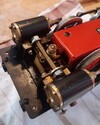
When you run out of ideas for functional improvements, vanity will strike starting you think of embellishments.

20260624_204738.jpg

Compared to her (electric) Maxi sisters Mavine always appeared a bit naked around the waistline.

Maxifamjly.jpg

Borrowing the spares I installed imitation springs so as to fill the gap.

They are bolted to a shallow box which I meant to represent the upper edge of the water tank that was suspended inside the frames of the real loco.

This patent of Krauss' in Munich gave rise to quite a genealogy of tank engines since it increased tank capacity maintaining low center of gravity and unobstructed view from the cab.

20260624_204645.jpg

This made for efficient little engines which could be more productive than obsolete road locomotives relegated to shunting and secondary services.

I am no expert, yet I assume the preference for inside distribution prohibited its use on the other side of the water ?

Happy handsome steaming !

20260624_204622.jpg
 
Last edited:
When you run out of ideas for functional improvements, vanity will strike starting you think of embellishments.

View attachment 358019

Compared to her (electric) Maxi sisters Mavine always appeared a bit naked around the waistline. Borrowing the spares I installed imitation springs so as to fill the gap.

They are bolted to a shallow box which I meant to represent the upper edge of the water tank that was suspended inside the frames of the real loco.

This patent of Krauss' in Munich gave rise to quite a genealogy of tank engines since it increased tank capacity maintaining low center of gravity and unobstructed view from the cab.

View attachment 358020

This made for efficient little engines which could be more productive than obsolete road locomotives relegated to shunting and secondary services.

I am no expert, yet I assume the preference for inside distribution prohibited its use on the other side of the water ?

Happy handsome steaming !

View attachment 358018
Well tanks were not unknown in Britain.
 
Borrows made a selection of Well Tanks and of course there were the very well known Beattie ones famed for their longevity at Wadebridge in Cornwall, plus others.
 
Thank you for the keywords and examples. I am fascinated how they managed to accommodate inside steam chests and their motion.

Let's not forget the ubiquitious little Koppels around the world - which actually were rebadged Krauss well tanks.
 
Back to practical improvements.

20260701_152740.jpg

If you should wish to compare this underside view to the pics in #5, you will notice that the RC equipment has been removed entirely. In order to accomodate the purpose-made servo motor mount, the tender coupling bracket would ride rather high. High enough indeed, that frequently the tender would lean on the locomotive (much like a semi-trailer) derailing its front wheels.

Thus, I took the RC out until I shall think of a better way to install it. This I am most likely to save for that rainy day when I won't be able to chase my trains anymore ...

20260701_152807.jpg

I lowered the coupling bracket using extra nuts as spacers.

20260701_153350.jpg

I assume this will allow ample tilting movement of tender vs. engine.

20260701_152835.jpg

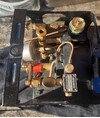
This aperture towards the front allowed the actuation rod to pass from the servo to the rotary valve. It, as well, allowed oil and condensate to enter the box frame where a nasty slime accumulated. Must remember to clean before winter lay-off !

Happy steaming !
 
Last edited:
Back
Top Bottom