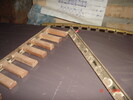
LGB on Playmobil tracks ?

pe... whot?

but you are wrong - partly.
for hidden track, like in tunnels or shadow storage it is easier to just nail the rails to a baseboard.
but where visible, it is better, to pre-bend the rails, then glue the middle parts of the ties, throw the track on the dirt, anchor with some 2 or 3 inch nails, and connect the track with screws or pop-rivets.

it's the old game:
wanna save money, pay in effort and time.

My apologies for dragging this out. I'm not understanding your method, entirely. If your track is being laid on the ground, what is the middle portion of the ties being glued to ? How stable would the track be even with 2 or 3 inch nails driven into the earth. I presume the screws or pop rivets are used at the fish plates ?
 
If your track is being laid on the ground, what is the middle portion of the ties being glued to ?
the small ends of the "middle ties" were glued to the sides of the i-beam rails (see, where the spots are)

blech5.JPG

just to keep the gauge of 45mm (in curves 46mm) fixed.
(and because that was not100%, my recommendation to hammer some nails from the outside through the rails into the heads of the "middle ties")

How stable would the track be even with 2 or 3 inch nails driven into the earth.
as many Brits here would say: good enough for guverment work...

that was in the first time of my ranch. more than 15 miles from the next E-grid, only electricity for house-lights and my toys from old 12V DC batteries, recharged by a pump-motor through an old truck-lightmashine.
i was young (twenties), ignorant and very confident. the word impossible didn't exist. only the question: how can i ?...

I presume the screws or pop rivets are used at the fish plates ?
right. holes made by crank-drill. (because 12V short-cirquit-soldering or welding was an annoying and sometimes hurtful process)

maybe, i should have mentioned, that the outdoor layout was in the '80ies, pre electricity, pre digital photography, pre telefone and pre dial-up.
the pics are from my later, first american indoor layout. (early '90ies to early '00 years)

My apologies for dragging this out.
i'm afraid, that any apology should be from my side. but english isn't my first language, so that i can not express myself as precisely, as i would like to.
 
the small ends of the "middle ties" were glued to the sides of the i-beam rails (see, where the spots are)

View attachment 352615

just to keep the gauge of 45mm (in curves 46mm) fixed.
(and because that was not100%, my recommendation to hammer some nails from the outside through the rails into the heads of the "middle ties")


as many Brits here would say: good enough for guverment work...

that was in the first time of my ranch. more than 15 miles from the next E-grid, only electricity for house-lights and my toys from old 12V DC batteries, recharged by a pump-motor through an old truck-lightmashine.
i was young (twenties), ignorant and very confident. the word impossible didn't exist. only the question: how can i ?...


right. holes made by crank-drill. (because 12V short-cirquit-soldering or welding was an annoying and sometimes hurtful process)

maybe, i should have mentioned, that the outdoor layout was in the '80ies, pre electricity, pre digital photography, pre telefone and pre dial-up.
the pics are from my later, first american indoor layout. (early '90ies to early '00 years)


i'm afraid, that any apology should be from my side. but english isn't my first language, so that i can not express myself as precisely, as i would like to.
No appology required, we all did what we could back then. Many 16mm modeller's used the early Peco 0 gauge track for live steam in the garden predominantly using Archangel and a bit later Mamod live steam varyingly using Meths or what appeared to look like Firelighters for the Mamods. Using what was available, a pal of mine used Hornby 0 Gauge clockwork converted to NG 16mmish to the foot on old Tin Plate track, his logic being cheep and when it rusts out I have plenty in an old box that I can replace it with. Make do and mend being the operative words those days.
 
Many 16mm modeller's used the early Peco 0 gauge track for live steam...
well, applying that standard, looong ago (late '60ies) i had one lonely live steam loco too.
remember the stationary steam engines?
i think, "Wilko" or similar was the name.
one of these i "adapted" to the remnants of a pre WW2 32mm gauge clockwork loco.
that thing broke every speed record - and after a few days the glas-kettle front.

talking about apologies:
Mobi, my apologies for the third thread drift.
 
well, applying that standard, looong ago (late '60ies) i had one lonely live steam loco too.
remember the stationary steam engines?
i think, "Wilko" or similar was the name.
one of these i "adapted" to the remnants of a pre WW2 32mm gauge clockwork loco.
that thing broke every speed record - and after a few days the glas-kettle front.

talking about apologies:
Mobi, my apologies for the third thread drift.
Wilesco, I think; Wilko was a cut price store that sadly went bust in the past couple of years.
 
Back
Top Bottom