LGB 2045 RhB loco review & questions

Mobi

Registered
Country flag
I have recently bought a used RhB Ge 2/4 loco from a well known shop.

In its underside "Made in West Germany" was written. I knew it was an old loco but did not realize it is ~40 years old considering Germany unified in 1990.

I have put a video of it here.


My only other track powered loco is basic Stainz (which I bought new 12 years back). I run analog track with LGB 1 Amp controller. I noticed this RhB loco does not even start moving until I put regulator over 2 mark. Where as Stainz starts moving before 2 mark. I guess its power requirement is higher than Stainz. Also, on max 4 mark, Stainz runs like a horse where as RhB is considerably slower even at max voltage. Is that expected? My controller is the basic one that came with LGB starter set.

I also noticed if I put both Stainz and RhB in the track, Stainz moves but RhB stops! I expected both of them to move. It seems 1 A current is not enough for both locos.

There are 2 holes in front & rear of the loco. If I supply battery power thru wires, the wheels rotate! This means, this loco can be converted to battery power without actually opening and tinkering inside - if I put batteries etc. in an attached wagon.

Is there any ready to use plug to fit into those holes? If yes, what are these plugs called so that I can search on internet and buy.

The loco is very heavy! I ran it for 4 hours continuously and motor block still feels cold to touch where as in Stainz I can feel slight warmth after running for couple of hours.
 
To be expected that the loco will not run so fast as Stainz on a 1 amp controller. But with your line this is a good thing I would have thought. Not surprised either that the controller will not power both machines, that Ge 2/4 will draw quite a bit more power.

As for using the existing plug for power, well yes it will work on an older locomotive like the Ge2/4 you have but it is predominantly to supply lighting power to trailed coaches, noting the board will be an older one the loco as you have found will run. BUT you will also be running power back via that board to the track and if the controller is connected power back through that. Not a good plan, so ensure that the controller is disconnected from the track if you must power the locomotive that way.
 
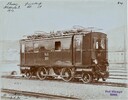
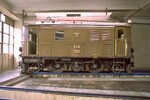
A couple of things here. The 2045 model is running more lights than a Stainz, so that alone will draw more power, which will be noticeable on a 1 Amp power pack. Also your prototype video shows one of the two Ge 2/4 locos that was rebuilt/remotorised with a new drive arrangement for continued use as shunting locos. The diagonal jackshaft (necessary with a high-mounted motor) was replaced with a lower-mounted motor that connects directly to the coupling rods, and one of the pantographs was removed.

IMG_5445.jpegIMG_5444.jpeg
 
Last edited:
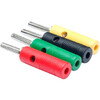
Can someone please advise what plugs will fit on to those sockets? The LGB manual simply says banana plugs but no picture or specification of that.
 
Can someone please advise what plugs will fit on to those sockets? The LGB manual simply says banana plugs but no picture or specification of that.
4 mm banana plugs

1769416968979.png
 
A couple of things here. The 2045 model is running more lights than a Stainz, so that alone will draw more power, which will be noticeable on a 1 Amp power pack. Also your prototype video shows one of the two Ge 2/4 locos that was rebuilt/remotorised with a new drive arrangement for continued use as shunting locos. The diagonal jackshaft (necessary with a high-mounted motor) was replaced with a lower-mounted motor that connects directly to the coupling rods, and one of the pantographs was removed.

View attachment 352414View attachment 352415
Unfortunately your picture shows ‘rods up’ which does not make the drive shaft location clear. However a net picture clearly shows that at some stage this locomotive has indeed been modified as you say. The originals that had this conversion in 1946 were 203/4 becoming 221/2. Thus Mobi’s locomotive as 205 was not one of the modified locomotives as can be further seen by the fact that it has 2 pantographs fitted though only one of them is up. My Loki book as printed shows all of the Ge2/4’s as originally built with that rod poking down from the motor. Of course LGB also produced a few models of the so called Bügeleisen (flat iron) with a central cab. 201/2/6 were subjected to that modification also in 1943 and 1946. These became 211-3 though not in original number order.

Mobi’s lok was originally preserved at Winterthur then moved. It was in the doldrums for 7 years after getting involved in ownership dispute being stored outside and deteriorating considerably. Below tells some of the story.

“The clarification of the ownership of the locomotive Ge 2/4 No. 205 of the Rhaetian Railway (RhB) took no less than seven years. The public prosecutor's office of the canton of Schwyz, the cantonal court of Schwyz and, in the last instance, the Federal Court had to deal with this question until it was finally established that the Zurich University of Applied Sciences (ZHAW) is the owner of the locomotive (the "Südostschweiz" and the "Bündner Tagblatt" reported in their issue of 21. June 2022 about it). Now a donation agreement could be concluded between the ZHAW and the Bahnmuseum Albula Foundation, according to which the ownership of the locomotive has been transferred to the latter. This clears the way for the locomotive to be restored and ultimately given its intended location in front of the Albula Railway Museum in Bergün/Bravuogn. Together with the crocodile locomotive Ge 6/6 I No. 407 of the RhB, it will attract visitors as a witness to bygone times in front of the Albula railway museum.”
Ref:-
Also number detail from Schweers + Wall RHB locomotives 1889-1998 published 1998.
 
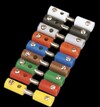
The small plugs (2.5mm) used to be the Marklin H0 gauge standard for a very long time, so they are not hard to find. Brawa still has them available today under a number of different part numbers including BR3058 (black).

IMG_5453.jpeg
 
1770212871316.png
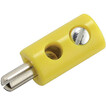
I can now confirm that this 2.6 mm mini jack plug is the item that snugly fits into the loco sockets.

2 mm banana plug was too small & was loose when I inserted.
4 mm banana plug was too big.

When sending battery power via 2.6 jack plug, the locomotive runs fine. Swapping plugs changes running direction. This demonstrates the loco can be converted to battery power without modifying its internals - thus it can be a non-destructive battery conversion and the loco can be run using both track and battery power (of course not at the same time) and battery running requires a trailing wagon.
 
View attachment 352783
I can now confirm that this 2.6 mm mini jack plug is the item that snugly fits into the loco sockets.

2 mm banana plug was too small & was loose when I inserted.
4 mm banana plug was too big.

When sending battery power via 2.6 jack plug, the locomotive runs fine. Swapping plugs changes running direction. This demonstrates the loco can be converted to battery power without modifying its internals - thus it can be a non-destructive battery conversion and the loco can be run using both track and battery power (of course not at the same time) and battery running requires a trailing wagon.
But do remember that NOTHING ELSE must be on, or connected to the track.

Unless the pickups are isolated, you will be feeding power into the track.
This could overload the system you are using to drive the model. It could also damage anything else connected to the track. - I am mainly thinking of expensive DCC Central Stations.
They *should* survive this, but it is not worth the risk.

This is why I advocate using a separate 'bus' (feed) for point-control and lighting.

PhilP.
 
But do remember that NOTHING ELSE must be on, or connected to the track.

Unless the pickups are isolated, you will be feeding power into the track.
This could overload the system you are using to drive the model. It could also damage anything else connected to the track. - I am mainly thinking of expensive DCC Central Stations.
They *should* survive this, but it is not worth the risk.

This is why I advocate using a separate 'bus' (feed) for point-control and lighting.

PhilP.
Indeed so Philip, I think we have both mentioned this. Easy to remove track pickuo in this loco by upendingbit and taking off the bottom plate. Remove the track pickups, take wheels out remive pickup plugs put back together and all ok.
 
Back
Top Bottom