Kirk Lambeth
Registered

Just starting to install a ceiling track. Going to have question on track switching. On concealing wires for track switching. I am still putting backing in for the track. I am just wondering has someone did this?



Thanks for you advice. Being new into this look like I will have to do some research.Hi Kirk, and welcome to the Forum! Another solution would be to use battery powered remote control for your locos. Most locomotives can be converted. It's probably worth seeing if there are other people running large-scale trains in your area, as you could then see what they run. There's no one right way to do things, after all.

Welcome to the Forum Kirk.Thanks , I will check a electronic store or electric wholesaler.
Hi Kirk, and welcome to the Forum! Another solution would be to use battery powered remote control for your locos. Most locomotives can be converted. It's probably worth seeing if there are other people running large-scale trains in your area, as you could then see what they run. There's no one right way to do things, after all.


I do like the use of pneumatic. Do you have any problems' with water in the air? I guess I could or should put a dryer on the air.Welcome from the North Yorkshie coast.

Ah, that's not me, I'm currently using DDC - Direct Digital Control - you want this post:I do like the use of pneumatic. Do you have any problems' with water in the air? I guess I could or should put a dryer on the air.
Hi Kirk, and welcome to the Forum! Another solution would be to use battery powered remote control for your locos. Most locomotives can be converted. It's probably worth seeing if there are other people running large-scale trains in your area, as you could then see what they run. There's no one right way to do things, after all.
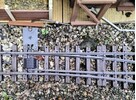
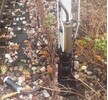
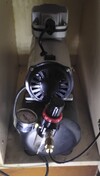
There is a water trap, usually as standard, supplied with compressors, even the small ones. It's a closed system so there should be no issues with condensation. My simple pneumatic system spreads over my garden, to feed all the switches and signals. I've use about 500 ft of piping so far. You do not need a big compressor or receiver tank to run this. The air volume in the system is actually very small, as is the amount exhausted when an actuator is operated. When the compressor is switched on it's all operable in around 30 seconds. I can actually watch the switches move back into my defaults for the layout as it powers up. Depending on how often you move switches the compressor will start up for a short period to bring the receiver tank back up to pressure to keep things at 30 psi. In one place I have got 4 switches that are set to operate in unison at a crossing (my layout is reverse figure 8). Other combinations are used on sidings and passing loops. All that little lot has been down over 10 years, no leaks or issues so far. I use simple QR connectors so I can remove items, if needed, for maintenance. I just pop in a small section of pipe, on the open end of the QR connector, that is capped to stop any condensation going in when doing this. You can see one in bottom left of picture of signal. MaxI do like the use of pneumatic. Do you have any problems' with water in the air? I guess I could or should put a dryer on the air.

 sunsetvalleyrailroad.com


