Bridge over fish pond

There is a way of achieving a single curved span, but it'll take some work and some thinking out.

Basically, at each abutment there will need to be an arm at base level that extends to the same distance as the greatest point of the arc to prevent the overturning movement. The bridge will need to be fixed down to the abutments to stop it kicking up when the weight of the train is in the middle.

As this plan view.
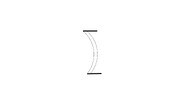
Curved bridge.jpg
 
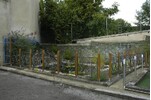
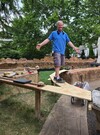
Surely the length of the bridge will reflect on its construction. Having said that my koi pond was 5m x 5m x 1.8m (so a ferry rather than a bridge would be needed) but then the railway was on the other side of the path thank goodness.
The photo is taken from where the railway was later built.

odd and pond railings 016.jpg
 
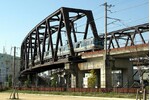
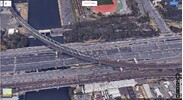
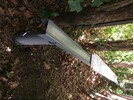
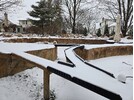
Traditionally, most curved bridges would have been stone/concrete viaducts (eg Glenfinnan) or wooden or steel trestles, but there are exceptions, like these truss girder bridges in Japan.

2fe11ad50a3a4e91f63380d0f868587b9b0f4893_2_690x462.jpeg3ba9453a2e3f0903a5b57baf9c2c2610733a2005_2_1035x568.jpeg

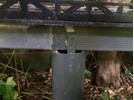
You'll probably need a support in the centre of the curve down into the pond. This could be functional or cosmetic if the ends of the bridge are firmly fixed as Rhinochugger suggests above. I'd suggest a piece of plastic downspout - could be round or square.

Rik
 
Hello Gamecoder,

Here is my step by step building advice for a strong straight viaduct over your pond:
1 Build your bridge from only wheatherproof materials
2 Use reversed U-shape metal cable tray as base construction (up to 3m length enough strength so no problem).
3 Use gray plastic vertical PVC pipes as wide as the metal cable tray as pillars/piers reaching more than 0,6m in the soil (fros damafe preventiont!) at each end outside your vulnerable watertight liner pond construction.
4 Make simple sturdy connections between metal tray and PVC pipes using small metal connectors with holes for the pop-rivets.
5 Beware of putting the flat side of the pop-rivets at the PVC side and put the expanding side at the strong metal side
6 Mount wheather proof TRESPA plate (or alike) on top of the flat side of the metal tray and fix it with pop-rivets.
Now you have a sturdy ever lasting base bridge that looks like a modern high speed train viaduct.
You can now add nice looking side covers and/or "brick"pillars etc. etc. to the viaduct base.

You can find all details in my book "Our Model Garden Railway" chapter 2.3.4 "Simple viaduct of Metal Cable Tray with Rivets
There is also a description how to make a curves in a metal cable tray.
Below some pictures of results. Sorry for the tilted viaduct I can't get it upwards.
See the book on Amazon
 

Attachments

  • connection by Pop-nails.JPG
    connection by Pop-nails.JPG
    65 KB · Views: 0
  • U-profile on top of pipe and TRESPA on top of U-profile both connected with pop-nails.JPG
    U-profile on top of pipe and TRESPA on top of U-profile both connected with pop-nails.JPG
    431 KB · Views: 0
Last edited:
May be you can make a floating pontoonbridge? Each pontoon like a floating bridge .
If you connect the pontoons each pontoon can be connected sturdy with his two neighbours, giving a threefold vertical stability and torque resistance.
 
There is a way of achieving a single curved span, but it'll take some work and some thinking out.

Basically, at each abutment there will need to be an arm at base level that extends to the same distance as the greatest point of the arc to prevent the overturning movement. The bridge will need to be fixed down to the abutments to stop it kicking up when the weight of the train is in the middle.

As this plan view.

View attachment 353123
Great idea! If necessary you can build an additional underwater bridge to support the middle.
 
Last edited:
Im assuming a span of at least 8 feet, .

Im no engineer, but, i would think a ‘V’ or splayed “U” support, ie 2 support legs, like an outrigger, and cross beam , essentially a freestanding table, would provide excellent stability, even if you are trying to extricate a derailment. Good strong T or I beam down the center. Strong enough to support you!
(Captain Bringdown, at your service,lol).

I dont know if you could modify some narrow stainless steel shelving as pillars. Or even, heavy plastic garage type shelving. Sawhorses? Just thinking out loud. Im no metal fabricator. Might not be very attractive.

Straight entry and exit to bridge.
Guard rails. Tall ones. Very sturdy to withstand rolling stock as well as whatever ‘retrieval tools “, ie pole, you might use.
And, the longest possible length of rail to minimize section joints in the bridhe span.
It is inevitable that you will have a derailment.
 
Last edited:
Take a look at this maker, MVL. They made my bridges shown in previous post. Well established buisness. Seems like curved commissions have become popular with them. I should have checked their website earlier :rolleyes: They could probably supply preformed structural elements in CKD form, to your requirements, for shipping. Ally is not the heaviest of materials and CKD will reduce bulk for shipping. If you source the fixings locally you will save weight and possibly further shipping costs. Or just copy from pictures or even get one sent fully assembled. Max See their link here OUR BRIDGES
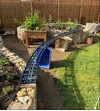
Curved bridge by MVL, lifted from their website, same constuction method as they provided to me over 10 years ago. I estimate this one at 2 metres. I notice the "trackbed" is made from angle not strip to keep the trackage in place. Given this is of a known strength and rigidity to me, this construction type I would estimate it would only need one support. So long as ends are properly anchored. Other more "exteme" types on website page link.

img-1718.jpg
 
Last edited:
Use a deep "undergirder" constuction for the bridge deck. Add side fences or railings incase of mishaps. And check rails to the track. Then use a single pillar to support bridge, on its centreline, where apex of the bridge's curve is. Firmly fix that pillar into a foundation in pond. Ensure good foundations and fixings are provided at bridge's ends into the banks of the pond and linked trackage. Max
Really depends on the radius of the curve and overall span (length) to take into account the possible twisting (torque) when the load is on the portion of curve that is not directly above the support(s). I have a 14 ft. long curved bridge with a single support and have holddown bolts to prevent it from lifting when the locomotive is in he curve between the support.
 
Take a look at this maker. Well established. Seems like curved commissions are popular with them. The made my bridges, I should have checked their website earlier. They could probably supply preformed in CKD for shipping. Ally is not the heaviest materials. Especially if you source the fixings locally. Or just copy from pictures. Max OUR BRIDGES

Curved bridge by MVL, same constuction as they provided to me. I estimate at 2 metres. Other more "exteme" types on website page link.

View attachment 353163
That is a fantastic example @maxi-model :clap::clap:

It shows what is possible, while at the same time illustrating the issues - take the plastic boxes away and what would happen?

So yes, a curved bridge is possible (if a trifle non-prototypical - but when has that stopped us ? :D:D) but there will have to be at least one intermediate support with all that is entailed in building a support in the middle of a pond without damaging the liner.

Thanks for the piccy - cracked it in one >:)>:)>:)>:)
 
As Rik suggested some plastic down spout for supports will work nicely no rusting, see Post #24.

I would suggest that a T construction with the bottom of the T in the base of the pond should protect the liner nicely. Just be sure that the down wards bit is above the bottom of the pond so that none of the load is on the ends. Joining will be a little tricky, I would suggest if you use square plastic down pipe you could use some spare to create a couple of L angles to join the up bit to the bottom bit, use proper brass or stainless security screws for this to avoid rusting.
 
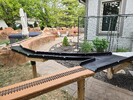
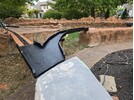
Forgot to mention, the curved bridge I did is a wye, so there are actually 3 bridges. It crosses the walkway to the back yard, so my main criteria was to make it lightweight and portable to where it can be placed in less than 5 min. I cheated in that it has steel tube beams beneath the deck. I can walk across the bridge, which is overkill for supporting a locomotive. I also cheated in that although the rails are on a curve, the bridge is not. Two beams set into pockets and the bridge is plywood with treated lumber guides on the bottom which align the bridge onto the beams. The bridge sections hang on the wall in my garage when I'm not running. Whereas this is not very realistic looking, I went more for practicality knowing I'd need it to be portable.
 

Attachments

  • 20251231_094850.jpg
    20251231_094850.jpg
    893 KB · Views: 0
  • 20250921_154034.jpg
    20250921_154034.jpg
    1,005 KB · Views: 0
  • 20250921_154023.jpg
    20250921_154023.jpg
    989.8 KB · Views: 0
  • 20250810_174715.jpg
    20250810_174715.jpg
    488.4 KB · Views: 0
After reading the responses to the original posters query, I must put my two cents in. The severity of the curve will determine whether or not a curved bridge, without center supports is viable.
 
Back
Top Bottom