Bridge over fish pond

gamecoder.nz

Registered
Country flag
Hi everyone,

I am going to have a curved bridge over a goldfish pond and the pond will be 1.5m deep from the base of the bridge. What could I use to support the bridge over the water?
 
Use a deep "undergirder" constuction for the bridge deck. Add side fences or railings incase of mishaps. And check rails to the track. Then use a single pillar to support bridge, on its centreline, where apex of the bridge's curve is. Firmly fix that pillar into a foundation in pond. Ensure good foundations and fixings are provided at bridge's ends into the banks of the pond and linked trackage. Max
 
Use a deep "undergirder" constuction for the bridge deck. Add side fences or railings incase of mishaps. And check rails to the track. Then use a single pillar to support bridge, on its centreline, where apex of the bridge's curve is. Firmly fix that pillar into a foundation in pond. Ensure good foundations and fixings are provided at bridge's ends into the banks of the pond and linked trackage. Max
Thank you for that. I've tried searching but I can't find an undergirder tall enough. How can I build one?
 
Last edited:
Thank you for that. I've tried searching but I can't find an undergirder tall enough. How can I build one?
Good question. Start with some I beam section aluminium drilled and screwed to a suitable deck material. Both of the bridges on my layout are built to this design, abeight straight and just over a metre. Mine were produced by a UK company, MVL, around 15 years ago. Both are over 1 metre long. I'll post detail shots of one later. Your real issue is building on a curve. The I beam section is the easy bit to curve. Max

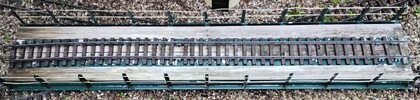
Top veiw of my bridge - wood deck is decoration only, it has no stuctural value. Detail, side stanchions are ally angle with stranded steel cable rails. Couple of strips of ally to mark track support area.
20260213_124434.jpg

Underside of bridge. The strength of the bridge is in those sturdy ally agle (or I beam) side members, I beam section cross beams sitting on them, and those angled transverse beams below the side members to lock it in place. Mix of brass machine screws and riveting to bond. It is over a metre long and will support my heaviest live steam metal loco, an Accucraft K-26 2-8-2 (about a metre too !) With no dicernable deflection. But as Tony Willmore mentions below, if I have understood correctly, as it is curved you will need to place a support pier at its mid point, minimum, supporting its full width. This bridge is built out of basic materials, however, you will need to find a way to create accurate matching curvature in the load bearing side beams. You wilĺ probably need to create a curved deck out of cut sheet acetate, or wood like oak, securely bonded to it. 20260213_124518.jpg
 
Last edited:
Use a deep "undergirder" constuction for the bridge deck. Add side fences or railings incase of mishaps. And check rails to the track. Then use a single pillar to support bridge, on its centreline, where apex of the bridge's curve is. Firmly fix that pillar into a foundation in pond. Ensure good foundations and fixings are provided at bridge's ends into the banks of the pond and linked trackage. Max
What can I build the pillar from?
 
What can I build the pillar from?
You don't need to have a pillar , the bridge supports itself.
IMG_20260127_124933188_HDR.jpg
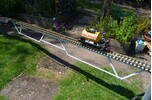
Admittedly its not very prototypical, but it spans a 1.5m gap and is 0.8m off the ground in the middle.
This is a temporary bridge of 2 2x4 timbers (salvaged from large pallets) screwed together side on supported on concrete blocks either end.
With some 6mm rod to stop anything falling off the sides.
I have seen some very nice bridges on youtube made from aluminum profiles pop riveted together spanning bigger gaps.
 
Last edited:
Curved bridges are not really prototypical, as they are almost impossible in pure engineering terms. The weight at the extremity of the arc causes too much turning moment.

As has been said, they really only work with intermediate supports, thus you have, in effect, two or more bridges.

If you look at 1:1 prototype brides with curved track, they are frequently built as wide, flat bridges with straight edges and the track curving across the deck from one side to the other.

Again, putting a support in the middle of a pond can have practical issues in our scale.

My 8ft bridge is built using 2 x Aluminium T-pieces of 50mm depth - as @maxi-model principle, but by using two sections with the leg of the 'T' under each rail, you can reduce the depth of the 'under-girder'. However, on a curve this will be trickier.

For any pillar, you need to think about the base first.

Presumably the pond is already in situ, and therefor wet :oops: How is the pond built? Fibreglass or pond-liner? Whatever you do, you need to ensure that there is no punching effect on the liner, so whatever you use as a base for the pillar needs to be bedded on the liner. Easier said than done, but there are some compounds which can cure under water ............. but probably not cheap.

I'd be tempted to pre-fab the pillar, possibly from Aluminium RHS (Rectangular Hollow Section) and mount a flat plate on the bottom that can be bedded on the pond liner.

 
Base for the pillar is best made using expanded polystyrene, a bit the size of a brick with the brick to sink it will give a good base. Then the pillar can simply as has been said ally angle sitting on the base or two of them.
 
How curved is the bridge?

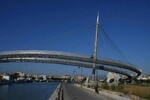
You could have a tower at each end, then suspension wires to the outside (mainly) of the deck.
This would mimic the way the prototype is done.

1770978604301.jpeg
This shows an intermediate tower, and on the outside.

Unless you want the bridge to be capable of taking your weight, it should be possible to fabricate a suitably stiff structure.
You will need substantial foundations, to resist the the turning force, trying to push the outside of the bridge downwards.

PhilP.
 
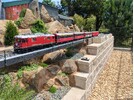
I have a couple of curved bridges on my railway, photos towards the bottom of the page:

 
Hobbs_Viaduct_Photo 2 - Copy.JPG
I built a bridge (admittedly not curved) from aluminium angle and strip bolted together. This makes a very light structure but easily capable of taking live steam locos. The strip is thin enough to bend over a reasonably wide arc. Of course, it would need railings added as pointed out previously (dropping a live steamer into a pond could be quite a spectacle!). It's also quite cheap.
 
Curved bridges are not really prototypical, as they are almost impossible in pure engineering terms. The weight at the extremity of the arc causes too much turning moment.
Barnstaple:
Barnstaple_railway_bridge_%281970s%29.JPG


Good point on oil above. A friend of mine managed to kill his very expensive koi carp by having drain holes in his bridge deck.
 
How curved is the bridge?

You could have a tower at each end, then suspension wires to the outside (mainly) of the deck.
This would mimic the way the prototype is done.

View attachment 353117
This shows an intermediate tower, and on the outside.

Unless you want the bridge to be capable of taking your weight, it should be possible to fabricate a suitably stiff structure.
You will need substantial foundations, to resist the the turning force, trying to push the outside of the bridge downwards.

PhilP.
What is it carrying?
 
View attachment 353118
I built a bridge (admittedly not curved) from aluminium angle and strip bolted together. This makes a very light structure but easily capable of taking live steam locos. The strip is thin enough to bend over a reasonably wide arc. Of course, it would need railings added as pointed out previously (dropping a live steamer into a pond could be quite a spectacle!). It's also quite cheap.
Nice one - throws up another principle. You can use lighter materials when you go higher/lower; it's the Warren girder scenario.

1:1 bridges involve the equation of cost/weight/span, but we don't usually have to worry too much about the difference in material cost between one design and another.
 
Back
Top Bottom