So where the safety valve fits, is it threaded into the base of the saddle (seems not) but into the boiler?
but there is a seal between the base of the valve and the saddle?
but the hole in the saddle looks much larger in diameter? how could that seal around the valve?
so there is a statement that penetrating oil in this area would soak the boiler insulation?
Well if that is true, then that area having steam when the valve lets go would also put steam/moisture into the insulation also, right?
is there a nut inside the boiler, or a threaded fitting soldered to the boiler proper?
Greg, time you got yourself a live steam engine so you could become an expert at that too.

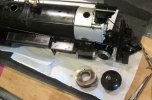
The safety valve is screwed in to a threaded bush which is soldered in to the boiler. The bush is flush (queue for a song?) with the boiler outside, so the boiler can slide in or out of the casing during assembly. Here's a boiler being built - you can clearly see the bushings. There is a fiber or similar washer to seal around the base of the valve.
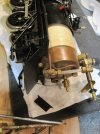
To confirm my statement about the boiler fitting inside the boiler casing, here's the cab of that shay (taken from a review.) The actual boiler, with all the fittings, protrudes from the casing which can be seen under the front cab wall.
The boiler casing has a hole larger than the bush so, when the boiler is in position, you can screw the safety valve in to the bushing through the casing. There is no connection between the valve and the boiler outer casing.
The hole in the casing allows water or other contaminants to soak in to the insulation, but as that is fiberglass (or something similar) it doesn't get hurt. There's a hole in the underside to allow anything to drain out. However, if we're only worrying about condensed steam from the safety, note that the boiler is curved so the water collects at the side of the dome base first, and probably evaporates before too much has soaked in - it's all rather hot in there.