66 suddenly out of my depth

JohninCov

Registered
Country flag
Hi.

I managed to buy Aristocraft 66 yesterday. I've wanted one for ages but took the plunge. Anyway I'm suddenly completely out of my depth. I can't find any solid answers on how to power it. (I know what I'm doing in OO, wiring, soldering etc). So, silly questions. Should it run on DC, if so do I need one of the LGB style transformers. I think it's DCC out of the box and might even be sound fitted, how can i tell? But what's RCC and what do i need to buy? How does battery control work? Is that when you have radio control? Any help gratefully received and sorry for asking obvious questions.

Thanks

John
 
@PhilP has experience of the Class 66 I believe.

Out of the box it will be DC - two wires to the track, but 18-20v. The basic LGB controller for a single loco may not produce enough power for a twin motor Aristocraft loco, so you may need to look at a Gaugemaster transformer/controller if you're planning to stick with track power.

There are RC conversions available - battery power with remote control.
 
Hello John,

Don't panic! (that should really be in big, friendly letters).

The Aristocraft Class 66 is a bit of a beast, but has not been produced for quite some time.

First thing to check:
How worn are the tyres? - You can post photos..

If the wheels are worn through the plating, or worse, have grooves worn into them, it indicates the model has had a hard life.

You can also get a feel for this, from the general condition of the model.

Initially, it will have been DC powered, but could well have been converted to DCC, or battery radio control, of some type.

It has a raft of switches, for motors, lights, sound, smoke, but sound might not be fitted.
If sound is fitted, this does NOT necessarily mean DCC.

You will need a decent transformer / controller to run this. - Especially if the motors are worn.

PhilP.
 
Hi. Thanks for the replies. The loco is as new. Literally never been run. I can buy a gaugemaster controller, thank you. I probably would like to go RC but have to work out the cost benefit of doing so. I've got a DCC Percy and no idea how to RC convert that so I might be stuck with track power for a while. Just to be clear regardless of how DCC or otherwise it is. I can run it on a big gaugemaster controller without frying it, right?
 
Do you have any 45 mm gauged track to run it on ? These large locos are not designed to run on the tight set track curves (2.5' radius) supplied with LGB starter sets and similar. They need wider radius curves, say 4ft + and points with a radius of around 6ft, especially if hauling a train. You need to consider a power controller that can manage a 5 amp output at 18v-25v. That's your starting point.

Prototypical rolling stock to go with it is a bit limited as it is a "bastard" scale, for the UK std gauge model scene, at 1:29. Some was made by its creator Aristocraft, container freight wagons. The, smaller, more typical 1:32 stock for 45mm track might look odd behind it. This loco was a "one off" by a US manufafturer as an experiment hoping to tap in more to the UK and German market. Lovely product with a niche following, that sadly failed as a sales proposition. Pity.

Your best sources for support, apart from here and "G Scale" focused FB pages, is the G Scale Society Home | G-Scale Society or the Gauge 1 Model RailwayAssociation (G1MRA) Home. G1MRA are aimed more at the 1:32/10mm scale standard gauge models but you see of these Class 66 models running on their show layouts.

N.B. "G Scale" is a catch all term that refers to anything that will run on LGB type (and its myriad of clones) 45 mm gauged track system using code 332 (thousands of inches rail height). So, anything from 1:32 -1:13. Bit of a broad church. All the best with your purchace and I hope it sends you off on a new journey in your railway hobby (is it your hobby ?) Max
 
Should be remembered that these locomotives used extensively in Europe. Piko mostly near enough scale and do many wagons with double buffers each end that would look ok even if used in a UK environment plus as mentioned Container Wagons. LGb also has dabbled with double buffered ‘main line’ type wagons so there may also be options here.
 
Should be remembered that these locomotives used extensively in Europe. Piko mostly near enough scale and do many wagons with double buffers each end that would look ok even if used in a UK environment plus as mentioned Container Wagons. LGb also has dabbled with double buffered ‘main line’ type wagons so there may also be options here.
From what I can work out when Piko do replications of standard gauge locos and stock they are c1:26. I used to have one of their lovely Schienenbus with a trailer cars, that scaled about that. I sometimes wish I had kept it. It kept on derailing initially as it had been supplied (NIB) with the wrong electrical pickup shoes, that were supposed to guide the single axle bogie mounts. Instead the just wobbled, all a bit weird. Max
 
Hello John,

Don't panic! (that should really be in big, friendly letters).

The Aristocraft Class 66 is a bit of a beast, but has not been produced for quite some time.

First thing to check:
How worn are the tyres? - You can post photos..

If the wheels are worn through the plating, or worse, have grooves worn into them, it indicates the model has had a hard life.

You can also get a feel for this, from the general condition of the model.

Initially, it will have been DC powered, but could well have been converted to DCC, or battery radio control, of some type.

It has a raft of switches, for motors, lights, sound, smoke, but sound might not be fitted.
If sound is fitted, this does NOT necessarily mean DCC.

You will need a decent transformer / controller to run this. - Especially if the motors are worn.

PhilP.
gota say, if only more traders in all aspects of business were like Phil !
 
I had three of these and a spare chassis - just got one and a chassis left. I think PhilP bought one of them. I found the loco would not run satisfactorily on curves tighter than LGB R3 and as mentioned earlier really need a 5 amp power supply. Many of my locos are DCC and I had anticipated doing a conversion. Never got anywhere with that as I found it too daunting to try and take the thing apart. Still got all the electrics and sound board in the spares box if I ever get the urge to have a go. I only used mine on freight services so limited rolling stock to flats, hoppers and containers. Saw quite a few still in EWS livery in northern France last time I was there.
 
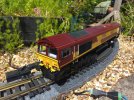
Lots of replies. Thank you. I've got it running this morning on my small track. I've got the track to build a more substantial layout but haven't had the time yet. I bought a gaugemaster LGB controller and it's worked a treat. I don't think it's DCC fitted out of the box as it just made that odd noise that DC engines do on a DCC power supply. I'll keep a eye out for the containers but to be honest will probably run whatever I've got which includes some 3D printed troublesome trucks and some DB flats. One day it'll bring be a beer but not today.
 

Attachments

  • 20260523_112911.jpg
    20260523_112911.jpg
    666.1 KB · Views: 10
Lots of replies. Thank you. I've got it running this morning on my small track. I've got the track to build a more substantial layout but haven't had the time yet. I bought a gaugemaster LGB controller and it's worked a treat. I don't think it's DCC fitted out of the box as it just made that odd noise that DC engines do on a DCC power supply. I'll keep a eye out for the containers but to be honest will probably run whatever I've got which includes some 3D printed troublesome trucks and some DB flats. One day it'll bring be a beer but not today.
Which DCC controller are you using, as you say you are using a DCC power supply!!!
 
Lots of replies. Thank you. I've got it running this morning on my small track. I've got the track to build a more substantial layout but haven't had the time yet. I bought a gaugemaster LGB controller and it's worked a treat. I don't think it's DCC fitted out of the box as it just made that odd noise that DC engines do on a DCC power supply. I'll keep a eye out for the containers but to be honest will probably run whatever I've got which includes some 3D printed troublesome trucks and some DB flats. One day it'll bring be a beer but not today.
It seems with running a DC motor(s) from a dedicated DCC power supply there is a risk either or both can get damaged. A DCC unit does not deliver the current in the way a DC motor requires. You could shorten the life of your class 66 motors. Remember, although seemingly unused, your loco would have been manufactured between 19/17 years ago. Max
 
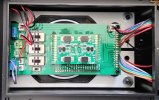
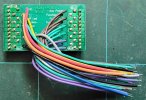
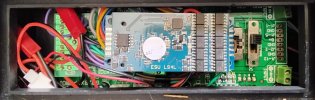
Sorry if I am jumping the gun a bit but this might help with identifiying a few bits. Your Class 66 will have been supplied with an adapter board to simplify fitting a DCC control board, if you want or need to. If your loco is complete, and this board has not already been installed, you be able to find a board that looks a bit like the one in the 2nd picture, loose. Take the roof off the loco and you should see a large PCB in the middle. looks a bit like the one in the 1st picture. That's the DC blanking plate on top of it, remove it (just pulls off) and you can replace it with that board with all the wires, once you have plumbed in your DCC card. Wiring assignations should be in your loco's supplied manual. Last picture. Here's one that has been converted, with an ESU V4 DCC card sitting on top. These are all from Bachmann locos. They used the same main PCB boards and PnP DCC adapters as Aristocraft (wired slightly differently). Bachmann and Aristocraft shared a place of manufacture, and now owner, Kader. Hence the great similarity. Max

How you main board should roughly look, if your loco is still set up "out of the box" for DC operation. The DC blanking plate is the bit with 2009/07/17, yours will have a different date. It just lifts off. Under it is the loco's main PCB, try not to rip that off. Note. Both the DC blanking plate and DCC adapter have, at either end, a different number of connecting pins. Same either end on both boards, so you don't mix up which way round they both fit.
20260523_143924.jpg

This is the bare wired DCC adapter board tha replaces the DC blanking plate. Your wiring assignation should be in a manual with the loco.
20260523_144115.jpg

And here is one of the above installed on a loco's main PCB with an ESU V4 DCC card wired in stacked on top. It could be remote.
20260523_144408.jpg
 
Last edited:
It seems with running a DC motor(s) from a dedicated DCC power supply there is a risk either or both can get damaged. A DCC unit does not deliver the current in the way a DC motor requires. You could shorten the life of your class 66 motors. Remember, although seemingly unused, your loco would have been manufactured between 19/17 years ago. Max
Thanks. I tried for a few seconds and thought better of it.
 
Sorry if I am jumping the gun a bit but this might help with identifiying a few bits. Your Class 66 will have been supplied with an adapter board to simplify fitting a DCC control board, if you want or need to. If your loco is complete, and this board has not already been installed, you be able to find a board that looks a bit like the one in the 2nd picture, loose. Take the roof off the loco and you should see a large PCB in the middle. looks a bit like the one in the 1st picture. That's the DC blanking plate on top of it, remove it (just pulls off) and you can replace it with that board with all the wires, once you have plumbed in your DCC card. Wiring assignations should be in your loco's supplied manual. Last picture. Here's one that has been converted, with an ESU V4 DCC card sitting on top. These are all from Bachmann locos. They used the same main PCB boards and PnP DCC adapters as Aristocraft (wired slightly differently). Bachmann and Aristocraft shared a place of manufacture, and now owner, Kader. Hence the great similarity. Max

How you main board should roughly look, if your loco is still set up "out of the box" for DC operation. The DC blanking plate is the bit with 2009/07/17, yours will have a different date. It just lifts off. Under it is the loco's main PCB, try not to rip that off. Note. Both the DC blanking plate and DCC adapter have, at either end, a different number of connecting pins. Same either end on both boards, so you don't mix up which way round they both fit.
View attachment 356741

This is the bare wired DCC adapter board tha replaces the DC blanking plate. Your wiring assignation should be in a manual with the loco.
View attachment 356742

And here is one of the above installed on a loco's main PCB with an ESU V4 DCC card wired in stacked on top. It could be remote.
View attachment 356743
Thank you that's super helpful. I will go DCC for it at some point. I'll have to work out if it has a speaker fitted. I think it does. If so I'll probably go sound fitted as well. If only to make the horn noise. I'd prefer to go battery powered and remote controlled however I was pleasantly surprised how well it ran on track that's not been cleaned this year (LGB track cleaner arriving on Tuesday).
 
Back
Top Bottom