
You are using an out of date browser. It may not display this or other websites correctly.
You should upgrade or use an alternative browser.
You should upgrade or use an alternative browser.
Why LGB catenary still requires track power?
- Thread starter Mobi
- Start date

HobbitFertang
Registered

So, is the catenary basically all about safety or is the circuitry more reliable?

Gizzy
A gentleman, a scholar, and a railway modeller....
Powered catenary was useful for analogue DC power, when you wanted to control 2 trains on the same track.
But with digital DCC power, the requirement for powered catenary is no longer relevant as several trains can be driven on the same track.
Also, powering overhead on DCC with track power is not recommended....
But with digital DCC power, the requirement for powered catenary is no longer relevant as several trains can be driven on the same track.
Also, powering overhead on DCC with track power is not recommended....

In the model-world, yes but not a lot..So catenary seems worst of both worlds - instead of simply cleaning tracks, you have to clean both track and wires.
Infrequent running is the biggest problem, so you get a microscopic build up of oxidation on surfaces.
As in the real-world, frequent running keeps the catenary clean.
The track will be a bigger problem, as gravity assists in dust settling as well..
Dust and fluff don't scale, and it sticks in the small amount of oil that migrated to the track and on the running surfaces of wheels.
We also don't have several tonnes of contact pressure, to 'squish' this out of the way.
If the contact area, wheel to track, of a full-size train is about the size of a ten pence piece, how tiny are our model contact areas?
PhilP.

Rhinochugger
Retired Oik
Yep, ground conditions can vary the way in which current can be carried - Lightning conductors are a case in point.The info I found said it was also a return in the mountainous areas. As the ground is not good for ground current flow, as well as a ground potential wire for the poles.
Looking at the cables it appears to be the same diameter as the overhead supply cables?
Rhinochugger
Retired Oik
It was available in 00 from Peco as an alternative to central third railOh we never got into Stud Contact!
 I seem to remember

Not forgetting the much higher power on the real thing, these days 25Kv predominates for overhead main line, Trams, 3rd rail and others had different voltages, I do not intend to list all the others. This link pretty well tells the ful story.In the model-world, yes but not a lot..
Infrequent running is the biggest problem, so you get a microscopic build up of oxidation on surfaces.
As in the real-world, frequent running keeps the catenary clean.
The track will be a bigger problem, as gravity assists in dust settling as well..
Dust and fluff don't scale, and it sticks in the small amount of oil that migrated to the track and on the running surfaces of wheels.
We also don't have several tonnes of contact pressure, to 'squish' this out of the way.
If the contact area, wheel to track, of a full-size train is about the size of a ten pence piece, how tiny are our model contact areas?
PhilP.
List of railway electrification systems - Wikipedia
John Randall
Registered
One of the biggest issues with overhead line is seasonal in the form of ice forming on it overnight when no trains have run. The first train of the day is the “ice breaker” and will light up the sky like an arc welder accompanied by an electrical cackle and ozone smell.Also Locomotive pantograph carbon thickness wear limit tolerance is thicker in the winter!
Yup I keep wanting to be at my local station to do a ‘time exposure’ pic of this. One day.One of the biggest issues with overhead line is seasonal in the form of ice forming on it overnight when no trains have run. The first train of the day is the “ice breaker” and will light up the sky like an arc welder accompanied by an electrical cackle and ozone smell.Also Locomotive pantograph carbon thickness wear limit tolerance is thicker in the winter!
playmofire
Registered
Rhinochugger
Retired Oik
Being brought up on the Southern, it's no big thing - on a frosty evening you could see the arcs off the third rail lighting the sky quite regularly - spectacular, yes, but rather everydayYup I keep wanting to be at my local station to do a ‘time exposure’ pic of this. One day.


Brisbane’s commuter system is 25 kV 50 Hz AC overhead dating from 1979 ( it was originally planned to open as an overhead 1500 volt DC system in 1967, using locally built stainless steel commuter passenger carriages, which were eventually loaned to WA for commuter services in Perth) . It rarely sparks , probably due to heat and a relatively high humidity (sub tropical).Being brought up on the Southern, it's no big thing - on a frosty evening you could see the arcs off the third rail lighting the sky quite regularly - spectacular, yes, but rather everyday

maxi-model
UK/US/ROW steam narrow gauge railways 1:1
Even growing up in central London in the '60's (Victoria/St James/Sloan Square stations) I still remember seeing lots of sparks and hearing snaps, crackles and pops on the London UndergrounD. Both subsurface, where there were a lot of open to the elements bits due its steam and build heritage, and tube lines, where the gaps were in the power transmission. Things got more spectacular in my teenage years with a move out to West London, using the neighbouring Turnham Green and Chiswick Park stations to get into town. Everything sparky going on around there. Max
I used to sneak around Turnham Green in the 60’s, had a girl friend that lived nearby. Though South Actin was closer but always used to go from Alperton, not sure why as living Close to Wembley Central via Willesden Junction would have been better.However North London line from Broad Street in those days was a miserable line to use unless you had to, service was pretty rubbish as well.Even growing up in central London in the '60's (Victoria/St James/Sloan Square stations) I still remember seeing lots of sparks and hearing snaps, crackles and pops on the London UndergrounD. Both subsurface, where there were a lot of open to the elements bits due its steam and build heritage, and tube lines, where the gaps were in the power transmission. Things got more spectacular in my teenage years with a move out to West London, using the neighbouring Turnham Green and Chiswick Park stations to get into town. Everything sparky going on around there. Max
maxi-model
UK/US/ROW steam narrow gauge railways 1:1
I used to sneak around Turnham Green in the 60’s, had a girl friend that lived nearby. Though South Actin was closer but always used to go from Alperton, not sure why as living Close to Wembley Central via Willesden Junction would have been better.However North London line from Broad Street in those days was a miserable line to use unless you had to, service was pretty rubbish as well.
Small world. My first job, age 16 in 1972, was working in the model shop Jones Bros on Turnham Green Terrace. You can see which way my life was heading. They also ran a DIY shop and woodyard. Did you ever visit that shop Jon ? I started in 1990 on the idea of a truncated static recreation of Turnham Green station in 1:76. I bought a few of the Harrow Model shop kits and various structure kits to build the station. Never even started building. Sold the HMS kits unbuilt on Ebay 20 years ago but I still have all the structure stuff. Started buying some the amazing OO LU models around now, including 3D printed product. Yes the north London line was grim, thank heavens for the TfL's "Overgound" rebranding of London's disjointed orbital network. Max
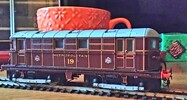
Heljan OO Metropolitan Bo-Bo
No never did the Jones shop as I moved to York in May 72 when you were there, did use then Harrow one on occasion and both the Shops by Harrow in the Hill Station when they were there, mostly for TT3 at the time. Though I started dabbling with N and 009 for a while before moving North and when I got there.Small world. My first job, age 16 in 1972, was working in the model shop Jones Bros on Turnham Green Terrace. You can see which way my life was heading. They also ran a DIY shop and woodyard. Did you ever visit that shop Jon ? I started in 1990 on the idea of a truncated static recreation of Turnham Green station in 1:76. I bought a few of the Harrow Model shop kits and various structure kits to build the station. Never even started building. Sold the HMS kits unbuilt on Ebay 20 years ago but I still have all the structure stuff. Started buying some the amazing OO LU models around now, including 3D printed product. Yes the north London line was grim, thank heavens for the TfL's "Overgound" rebranding of London's disjointed orbital network. Max
Heljan OO Metropolitan Bo-Bo
View attachment 351201
Similar threads


- Replies
- 5
- Views
- 392


- Replies
- 13
- Views
- 1K

