Which track layout to go for?

Mobi

Registered
Country flag
I am planning to expand my outdoor layout from a small loop to a long route.
The dilemma I have got is which layout to choose!

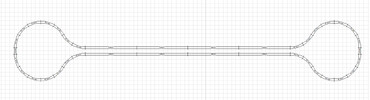
(a) Dog bone type with long parallel tracks in the middle section.

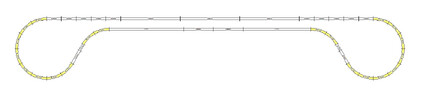
(b) Reverse loop with single line at the middle section and 2 switches at each end to change the direction of trains at each end.

I shall use battery power so no polarity problem to handle.

I have not figured out how long will be straight middle section going to be but it can be 30 to 60 feet (depending on budget).

With (a) there is no chance of derailment but I need twice the length of straight length track section! The track will be laid on grass, on top of bricks.

With (b) I shall save on track length (for straight section) but I am not sure how reliably the trains can shift the points itself over & over again. If it does not, then train will be derailed. As it will be one brick height only from ground, it won't be a massive fall but due to battery power train may continue to run on grass/twigs/pebbles etc.

Of course I can manually operate the switch and that will be good exercise too - though I prefer to set a speed and let it run without much intervention.

From your experience, which is better option? Or is there some even better layout (c) which I have not considered ?
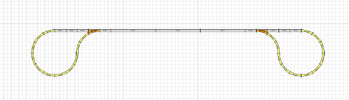
1770573102662.png

1770573085981.png
 
Last edited:
On my last line, I had a reverse loop (I also was battery power) with a sprung point to allow the train to always enter the loop from the same side and then push the point over as it came back round the loop. It took a bit to find the right strength of spring on the point, but it worked pretty well 90% of the time. It need the stock to be of a reasonable weight to push the blade over though. Very light stock may have problems.
 
I run a variant of Plan 2, laid with Peco G45 track. As PhilP PhilP says above, most trains can push against the spring and so they take the loop in the opposite direction each time round. The only exceptions are lighter-weight locomotives fitted with pony trucks, and propelled rolling stock. Even then, a careful application of a silicone lubricant to the base of the point blades/rubbing plates can make enough of a difference.
 
A dog bone gives you the effect of a double track line it that appeals. But uses more track but without the effect of possible point issues! I would also think about maybe a crossiver in the straight plus a couple of sidings to hold spare stock or even a train if you put a passing loop in the middle with 3 points each ebd.
 
Track one will allow multiple locos to run (in the same direction), with less issues. I had something similar to plan 2, and have now changed to your plan 1.
 
The dogbone whilst has extra track to buy , gives you the opportunity to run 2 trains at the same time easily.
To me I thought it was worth the extra track to be able to see 2 trains pass each other on the double track section.
My set up will when expanded will be a big dog bone folded back on its self into a U, with a track off to a terminus station.
I am only running battery R/C.
 
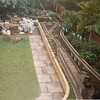
This poor quality photo shows my line under construction in 2004. About 55 feet long. I went for a dog bone (one end of the bone is out of shot at the front) because I thought, maybe wrongly, that sprung points were a derailment waiting to happen. Grit can easily get into the point blades if the track is near ground level. I separated the front and rear tracks by a foot or more and a slight gradient to maintain the single track look, and kept straight track to a minimum; just because trains winding their way through the plants look more narrow gauge to me. It all depends what look you want to achieve. All LGB set track, except the long gentle curving incline at the back which is LGB flexi-track.Scan_20220524 (2) - Copy.jpg
 
Due to us having a small garden now, we have an 'out and back', a variation on your second track layout. We start from the workshop, where there are some sidings, two of which can be used as a run around loop for a loco to get to the other end of it's train. The train travels along a meandering single track next to the garden boundary wall, passing a halt on the way, before coming to a set of points with an over-centre spring, which forms the start of the return loop. The train enters a tunnel mouth, and after going half a circle round a tight curve out of sight, comes back out of another tunnel mouth to rejoin the single track back towards the workshop. The tunnel is under some decking with trap doors 'just in case' and to enable leaves etc. to be swept out. Once the train gets back to the workshop, the loco has to be run around, or sometimes a different loco takes the train out to the other end of the garden, (and the world beyond). A steam tram can propel a few 4 wheel carriages up and down the garden without any trouble, the loco leading on one journey and propelling the next time, and so on, which I think looks nice, and adds interest for watching. Stock does need a little extra weight to change the point at the start of the loop, but it means that, trains do not always go into / out of the same tunnel-mouth each time, so again adds interest. Yes having to run around the train each time at the workshop end does mean the railway has to be driven, and can't be left to run round in circles, but for me it is more interesting to run on. More 'play value' for want of a better term. If I had room I would have added a return loop each end, and may at some point build a return loop inside the workshop, but it would have to be foldable, so I am happy to run, as is for now. At our previous house we had a large garden and so had a large oval track but I found running roundy roundy could get boring after a bit. The garden railway at our MES is an oval so I can run there as well, and the exhibition layout I am part of usually is set up in an oval as it then means it is easier to talk to visitors, but can also be end to end, or out and back, both of which need more concentration. Maybe my summary would be your first layout if you like the more mainline feel, or the second one for a more rural feel, especially if you don't run more than one train at a time. I'm sure others will also offer their views, so I hope this helps. Regards, David.
 
Hello Mobi,
Regarding the constraints caused by too little space for your railway I must inform you about my solution to build a 4 layered bookshelf like storage for your trains wigh a vertical lift between the groundfloor and the 4 shelves. This is also extensively described in my book i mentionned in my previous message in here. So one more reason to buy de book!
 
Single line loop can be easily converted to dog bone loop later like this. I won't be fixing track with something so can always move around a little bit later.

View attachment 352950
I did a conversion to a dog bone with the first layout I built, I used non sprung points either end of a single track before upgrading to the dog bone style configuration.
This time around on one of my layouts I have again used a non sprung point and the trains go around one loop in alternate directions, the other end has manual controlled points.
A heavy use of graphite powder keeps the point blades free moving.
 
Back
Top Bottom