The MRR in the Attic - Blumentritt's Build Thread

i really like, what you showed.

interesting crowd, living in your world.
but i discovered only two Filipinos. due to a shortage of plastic surgeons?
Thank you!

Yes. And lack of time. I started a couple of years ago to alter figures with prototypical straw hats and Philippine style clothing, but was never happy with the results. Will pick that topic up again one day.

For me the more pressing issue is the lack of even a single tree. The next major undertaking will therefore be a massive palm tree production and re-forestation project.
 
more pressing issue is the lack of even a single tree.
i ignore, if you got other trees than palms in the Philippines.
but trees are easy, only time consuming.

tannen08.JPG

tannen09.JPG

tannen10.JPG

and every year, in january, christmas trees are on discount.

or you sacrifice old copper cables:

baumbau01.JPG

baumbau06.JPG

baumbau33.JPG

i trade the how-to for trees against the how-to make straw hats. :p
 
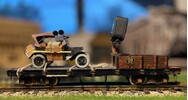
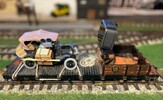
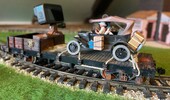
MRR Track Cleaning Car

Track cleaning is a necessity at the MRR not because of oxidation or corrosion - after all, the tracks are all nickel-plated - but because of dust. Not only is dust a general problem in Metro Manila, but also because the room in which the MRR resides serves concurrently as the laundry area. Indeed, the washing machine stays adjacent to San Fernando La Union Station. And worse, clean laundry is put by the maids above the MRR for drying. Unfortunately, to obtain the building permit for the MRR, this compromise begrudgingly had to be accepted.

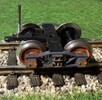
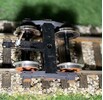
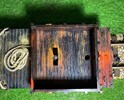
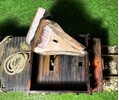
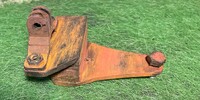
As the track is nickel-plated, a grinding-style track-cleaning locomotive was out of question. Instead, I purchased this track-cleaning devise, which can be put under a car. Schienenreinigungsschuh Spur G Für unterm Wagen (Zum Schrauben)

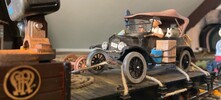
The car itself started it’s life as a second-hand purchased, yellow painted, standard gauge monstrosity. I reduced the wall-height with a dremel and gave it a nice paint job. The installation of the track-cleaning device was quite simple, basically two holes for the screws is all what’s needed. Not too tight, so the device moves freely up and down, and will always be on top of the track.

IMG_7071.jpeg

IMG_7072.jpeg

IMG_7073.jpeg

IMG_7074.jpeg
 
Last edited:
For the normal tracks (straights and curves) we removed the ties. But this was done so we could clean them properly. They were second-hand and must have been in a garden for around a 100 years. I also had some switches the seller threw in as freebees. So I brought them with me to the plating company to discuss the whole process. To my surprise they said there is no need to disassemble. They plated them without problem as complete units.
 
Last edited:
For the normal tracks (straights and curves) we removed the ties. But this was done so we could clean them properly. They were second hand and must have been in a garden for around a 100 years. I also had some switches the seller threw in as freebees. So I brought them with me to the plating company to discuss the whole process. To my surprise they said there is no need to disassemble. They plated them complete without problem as complete units.
That is surprising, and good to know for future reference, just in case I find myself in need of plating some track. :D
 
Back
Top Bottom