
Stainz motor

MichaelF

Registered
Country flag
I'm looking for advice about my Stainz motor. Towards the end of the summer, the loco (now battery powered) proved difficult to start. Often needed a gentle push to get it going. I've taken it carefully apart, checked everything I can think of, and finally lifted out the motor. (picture attached, in case there are different motors in circulation.) Testing this on its own, with current applied to the two contacts emerging from the can, the same problem is occurring - sometimes it starts, sometimes it doesn't. A gentle twist on the worm gets it going. This applies in both directions. Clearly the problem is something inside the motor can, but I'm very reluctant to launch into dismantling it without some expert advice. Or is it a case of leave well alone until I can find a whole new motor?

Thanks, folks.
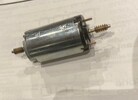
Motor.jpg
 
I'm looking for advice about my Stainz motor. Towards the end of the summer, the loco (now battery powered) proved difficult to start. Often needed a gentle push to get it going. I've taken it carefully apart, checked everything I can think of, and finally lifted out the motor. (picture attached, in case there are different motors in circulation.) Testing this on its own, with current applied to the two contacts emerging from the can, the same problem is occurring - sometimes it starts, sometimes it doesn't. A gentle twist on the worm gets it going. This applies in both directions. Clearly the problem is something inside the motor can, but I'm very reluctant to launch into dismantling it without some expert advice. Or is it a case of leave well alone until I can find a whole new motor?

Thanks, folks.

View attachment 349643
Somewhere in here are details of exactly what you need to do, hope someone will chip in to give to the link as my searching skills computer wise severely lacking.
 
I think your motor has a loose contact to one of the electric magnet coils on the anchor. If this is the case the motor will not start properly because there is one magnet less active.
You can check this by opening te motor house and look for the two brushes that deliver the current to the anchor. The brushes wil deliver the current to one magnet coil of the anchor. The motor will then start to rotate causing the next magnet coil to be connected to the brushes and so on. Check the conductivity for each pair of connections from each coil on the anchor to find wich coil has a break in the line. As soon as uou know which coil is not conducting you can try to find where the wire is broken. If you are lucky is is on top of the coil and you can reconnect. However often the problem is deeper in the coil and cannot be repaired. No problem since you now know how it works! Buy a new motor!
 
From experience of LGB motor failures, most appear to start due to grease breakdown which gets inside the motor and onto the commutator. As mentioned above, there is a how to within the forum on how to strip these motors. You'll need a mini blowtorch to expand the brass worms as they need to come off. I have had some success in reviving them when they are running slower than they should. From what you describe, it sounds like a bad sector on the motor so is probably scrap.
The best solution is a new motor, they are around £60. Part number E126-050. You'll also need a very small amount of plastic safe grease for the brass worms. When refitting the motor to the loco, make sure you have both axles correctly aligned to each other or you'll get binding issues.
 
Back
Top Bottom