Setting up automation

gscalerookie

Registered
Country flag
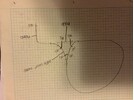
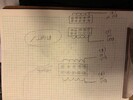
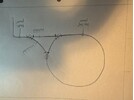
This was the original reverse loop with an oval. Ran great! Then I wanted more as usual so I said let’s do detection. No matter how I hook this up I keep getting a short. I’m using bd2o, ait and nce 10amp system. Could someone be kind enough to show me where to place the the insulation, where the wire for the reverse goes and regular track power.
 

Attachments

  • image.jpg
    image.jpg
    213.1 KB · Views: 0
  • image.jpg
    image.jpg
    239.8 KB · Views: 0
This was the original reverse loop with an oval. Ran great! Then I wanted more as usual so I said let’s do detection. No matter how I hook this up I keep getting a short. I’m using bd2o, ait and nce 10amp system. Could someone be kind enough to show me where to place the the insulation, where the wire for the reverse goes and regular track power.
Using nce ar10 for rev loop
 
This was the original reverse loop with an oval. Ran great! Then I wanted more as usual so I said let’s do detection. No matter how I hook this up I keep getting a short. I’m using bd2o, ait and nce 10amp system. Could someone be kind enough to show me where to place the the insulation, where the wire for the reverse goes and regular track power.
Have a watch of this vid which shows quite clearly how I wired up and isolated a reverce loop using an LGB module, isolations will be the same to prevent your short circuits.
 
Hello Rookie,

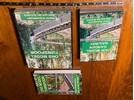
My friend Rainer and I recently wrote a book about this type of issues when running our Model Garden Railway.
Check out this book. There are two chapters specific about reverse loops. One about digital loops and one about analog loops.
You will find a lot of other usefull information to improve running your garden railway!
Use URL:
See attached picture of the different layouts available.
If you mail me your full home and mail addres i can sent you an author copy with 10% discount on the prices mentionned in the URL.

Kind Regards
Gerard van der Schrieck
 

Attachments

  • picture books bottom left A5 paperback glossy right A4 and top A5 Bard cover glossy.jpeg
    picture books bottom left A5 paperback glossy right A4 and top A5 Bard cover glossy.jpeg
    103.8 KB · Views: 0
You need to isolate both rails on block 7, at both ends.

However, you should also make this block longer than your longest train if you have metal wheels on your rolling stock....
 
Hello Rookie,

My friend Rainer and I recently wrote a book about this type of issues when running our Model Garden Railway.
Check out this book. There are two chapters specific about reverse loops. One about digital loops and one about analog loops.
You will find a lot of other usefull information to improve running your garden railway!
Use URL:
See attached picture of the different layouts available.
If you mail me your full home and mail addres i can sent you an author copy with 10% discount on the prices mentionned in the URL.

Kind Regards
Gerard van der Schrieck
Can’t seem to find it in the us
 
You need to isolate both rails on block 7, at both ends.

However, you should also make this block longer than your longest train if you have metal wheels on your rolling stock....
I was under the impression that all blocks had to be isolated in order to hook up the bd20 for block detection?
 
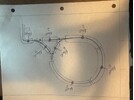
I disconnected the regular track bus at block two and the short went away. Should everything past the first set of irk be powered from the reverse loop bus?
 

Attachments

  • image.jpg
    image.jpg
    436.6 KB · Views: 0
try this:
draw a new plan.
but use two different colors for the two rails.
paint block 2 and block 7 last.
one of these two blocks will have a connection, where color one meets color two and vice versa.
then you'll see the problem.
either block 2 or block 7 needs both rails on both ends separated.
and must be normally dead. only after reversing the current for the whole track you can give current to that block. (per a push button or similar)

best would be to read the LGB manual (page 122 ff) https://kormsen.info/lgb-manual.pdf

and then buy or build the needed components.

it is not, that you are the first, trying to invent the wheel...
once understood, it is a simple thing.
 
try this:
draw a new plan.
but use two different colors for the two rails.
paint block 2 and block 7 last.
one of these two blocks will have a connection, where color one meets color two and vice versa.
then you'll see the problem.
either block 2 or block 7 needs both rails on both ends separated.
and must be normally dead. only after reversing the current for the whole track you can give current to that block. (per a push button or similar)

best would be to read the LGB manual (page 122 ff) https://kormsen.info/lgb-manual.pdf

and then buy or build the needed components.

it is not, that you are the first, trying to invent the wheel...
once understood, it is a simple thing.
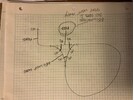
Different colors. Still cross at the same point. What am I missing? I have all the rails separated for nce bd20 block detection
 

Attachments

  • image.jpg
    image.jpg
    313.3 KB · Views: 0
What am I missing?
i'm not sure.

I have all the rails separated for nce bd20 block detection
as i'm not a sparky, but learned to set up the railroad electricity by trial and error, i ignore, what a nce bd20 block detection is.
as far as i understand, block detection, as i made, was isolated blocks and reed switches, that gave free a block when just abandoned by a train.

could it be, that you have one of your blocks connected with different polarity to the controller? (shorting, when the loco has wheels on two different blocks with different polarity?)
 
i'm not sure.


as i'm not a sparky, but learned to set up the railroad electricity by trial and error, i ignore, what a nce bd20 block detection is.
as far as i understand, block detection, as i made, was isolated blocks and reed switches, that gave free a block when just abandoned by a train.

could it be, that you have one of your blocks connected with different polarity to the controller? (shorting, when the loco has wheels on two different blocks with different polarity?)
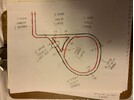
I had the terminal block wired wrong rushing.
 

Attachments

  • image.jpg
    image.jpg
    367.5 KB · Views: 0
Everything should be wired the same until you reach the short which is block seven, where the reverse loop goes
yes. and block seven should be dead, until by automatic or manual first the direction everywhere is reversed and then the train is started.

but take a look into that LGB manual. they describe an easy way to automate the whole affair.
just using two reeds, one doublethrow switch and three or four diodes.
 
I found the simple wiring mistake. I had a terminal block with jumpers on both sides. Duuuhh! Causing the short. All is well now
Well done, perseverance helped. I think I may have gone back to a complete rewire doing everything from starting principles (on the loop section) likely you would have wired that error up correct on the second attempt. But you have learnt a valuable lesson, check and double check and if not right check again as if you were rewiring from scratch.
 
Back
Top Bottom