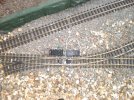
When I first started I screwed down the track, and points, to either wooden battens between log roll (bad idea due to early rot of the log roll!) or to tenalised and 'Cuprinoled' stakes.
I used a lot of flexitrack and altered 'standard' curves using a Massoth trackbender. I did not use conductive paste and gradually some joiners began to lose their conductivity....lesson learned.
Track floating on ballast is fine as long as none of the track is under stress ie..flexitrack. It is best to have this fixed.
As to switches/points, I lay them on the ballast but they are either screwed to the stakes driven into the ground (tenalised and 'cuprinoled' timber).
Filcris plastic stakes are a good, if expensive option.
I have also used hooked metal ground stakes (like the ones used for tents). The hook goes over one sleeper.
If all of the track is of predetermined sizes and the track is joined well (some recommend using clamps for every join) then free floating should be fine.
As the temperature fluctuates, the track expands/contracts and this puts pressure on the joiners so that they can lose or have intermittent conductivity contact over time.
The LGB contact paste is a good idea to help avoid this but this also is where the clamps scenario comes into its own.
*What ever method, it is a good idea to grease or silicon the connections and rail joining bars/wires under the points.*
I use a selection of 2mm to 4mm sized ballast. I did use just 6mm in the past but have tried to go a little more realistic as I re-ballast.
I 'tamed' my garden vac by cutting the corners on the turbine blade. This means that it sucks the leaves but tends to not suck too much ballast!