
You are using an out of date browser. It may not display this or other websites correctly.
You should upgrade or use an alternative browser.
You should upgrade or use an alternative browser.
Power survey
- Thread starter Mobi
- Start date

Rhinochugger
Retired Oik

What is interesting is the high percentage of battery power users.
Way back in the 20s and 30s, when model railways were coming into the garden, a lot were battery powered, but in a different way. Large lead/acid accumulators were used to power the tracks, mainly due to the lack of suitable electrical equipment for transformer/rectifier/speed controller at more than 12 volts.
Way back in the 20s and 30s, when model railways were coming into the garden, a lot were battery powered, but in a different way. Large lead/acid accumulators were used to power the tracks, mainly due to the lack of suitable electrical equipment for transformer/rectifier/speed controller at more than 12 volts.


duncan1_9_8_4
Garden Railway Operator/Real Life Signalman
I'm surprised at the battery powered percentage. I could never bring myself to buy a new LGB locomotive (we all know how much they cost) to 'convert' it.
Rhinochugger
Retired Oik
LGB locos also have skates, which helps with current collection, so the number of LGB locos converted to battery is likely to be less than other makesI'm surprised at the battery powered percentage. I could never bring myself to buy a new LGB locomotive (we all know how much they cost) to 'convert' it.

I understand this, if buying new and not available without a decoder fitted..I'm surprised at the battery powered percentage. I could never bring myself to buy a new LGB locomotive (we all know how much they cost) to 'convert' it.
But I can fit batteries, radio control, and sound for less than the cost of a top-end sound decoder.
You pays your money...
PhilP.
So do I... Probably.Although I ticked both live steam and battery, I have only one live steam loco but I have 30 battery locos.
Rik
Don't tell anybody, though!

PhilP.

maxi-model
UK/US/ROW steam narrow gauge railways 1:1
Ah yes 1920's rectifiers. Just ask Dr Frankenstein the issues he had with his. Could never get a decent jolt from his electrode. MaxWhat is interesting is the high percentage of battery power users.
Way back in the 20s and 30s, when model railways were coming into the garden, a lot were battery powered, but in a different way. Large lead/acid accumulators were used to power the tracks, mainly due to the lack of suitable electrical equipment for transformer/rectifier/speed controller at more than 12 volts.

Mobi
Registered
Do you have a picture of G scale clockwork loco? Never seen one nor knew that they exist.My wife's locos are all clockwork, so you now have one vote in the last box.
Why no one makes them anymore? It would be good for single propelled loco like tram or handcar.

voodoopenguin
Retired
Not really G scale but Gauge 1 running on 45mm.Do you have a picture of G scale clockwork loco? Never seen one nor knew that they exist.
Why no one makes them anymore? It would be good for single propelled loco like tram or handcar.
Paul

That is one drawback to battery power.I'm surprised at the battery powered percentage. I could never bring myself to buy a new LGB locomotive (we all know how much they cost) to 'convert' it.

If you are seriously considering a battery conversion a good old LGB loco would work very well, Wizzy Cranks comes instantly to mind with plenty of space inside. Though Piko diesels work very well too and come out on the cheeper end price wise. Have a look at some of my conversions in the battery thread, oh do not think about converting a Piko Railcar, these are a pig to do.I'm surprised at the battery powered percentage. I could never bring myself to buy a new LGB locomotive (we all know how much they cost) to 'convert' it.
Clockwork was the thing in both 0 and 1 likely others as well in the early days and I am talking pre WW2 and a while aftr. I have just recently put a Tri-Ang 00 clockwork loco for sale via Tony Green Lincoln, dated from around 1950’s and still worked perfectly with Forward/Reverse/Stop/Go control. In later years of clockwork control mechanisms using Telephone Dial mechanisms were produced by clever modellers.Do you have a picture of G scale clockwork loco? Never seen one nor knew that they exist.
Why no one makes them anymore? It would be good for single propelled loco like tram or handcar.
Mobi
Registered
I see that few members indicated both track power & battery.
I can understand when someone uses battery only - no need to ensure track conductivity, so less hassle with track cleaning.
But when you are already happy with track power and conductivity is not a problem, then what benefits you get with battery?
I can understand when someone uses battery only - no need to ensure track conductivity, so less hassle with track cleaning.
But when you are already happy with track power and conductivity is not a problem, then what benefits you get with battery?

Monty
Registered

Track power at home, battery power at the only partly track powered garden railway at Galston Valley where I also run my battery powered 5"g loco.I see that few members indicated both track power & battery.
I can understand when someone uses battery only - no need to ensure track conductivity, so less hassle with track cleaning.
But when you are already happy with track power and conductivity is not a problem, then what benefits you get with battery?
Sorry, no readily available pics.
Ian

viaEstrecha
Spanish metre gauge in G scale (on the cheap)
My analogue garden railway was acceptable under track power, thanks to the miles of cable in conduit, but for me, the big benefit of going RC/battery has been that I am no longer required to stand by the controls, and so can flounce around the garden with the handset, closer to the action. I still have to go back to the panel to work signals and points of course, but for the improved level of 'engagement', conversion to dead rail has been worth the expense and effort.I see that few members indicated both track power & battery.
I can understand when someone uses battery only - no need to ensure track conductivity, so less hassle with track cleaning.
But when you are already happy with track power and conductivity is not a problem, then what benefits you get with battery?
maxi-model
UK/US/ROW steam narrow gauge railways 1:1
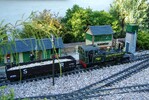
My line has been in existence 22 year. I ran my first battery loco around 15 years ago. It was supposed to be my "lazy day" loco. I was becoming a bit disenamoured with all the faff of cleaning my track before, and sometimes during, running sessions. Likewise live steam locos require a bit of prep and topping up on a run - too labour intensive. Only problem, the intended "lazy" loco quickly developed a gearbox fault that resulted in its stripping its primary gear after a max' 20 hours running. It was a very expensive gearbox that the vendor took 3 years to provide a full replacement, rather than just piecemeal cogs, requiring multiple visits. It it did eventually provide a satisfactory "proof of concept". A 2nd loco, 8 years ago, forced a battery convertion as it was finding every fault in my track's power conductivity, an old Accucraft K-27 with a Sierra sound card fitted, bought 2nd hand. I only really started down the path of finally disconnecting my Crest Train Engineer 5 years ago. Now all locos, railcars and a tram either Battery or Live Stream operation. MaxI see that few members indicated both track power & battery.
I can understand when someone uses battery only - no need to ensure track conductivity, so less hassle with track cleaning.
But when you are already happy with track power and conductivity is not a problem, then what benefits you get with battery?
Lazy days loco #1. In finally fettled form.

ge_rik
British narrow gauge (esp. Southwold and W&LLR)
You could always construct your own from scratch for a lot less.....I'm surprised at the battery powered percentage. I could never bring myself to buy a new LGB locomotive (we all know how much they cost) to 'convert' it.
Rik
Similar threads

- Replies
- 8
- Views
- 197


- Replies
- 25
- Views
- 2K


- Replies
- 3
- Views
- 721
- Replies
- 26
- Views
- 4K
