Greg nice vid of a clearly too hot for us Brits in UK day. One thing I noticed but had not before, at least one of the Locomotives had 2 sets of buffers at each end but none of the Stock that I could see had them. I know that Oz had many Gauges so that ponders my query are you mixing Prototypes up on your lines? No problem so far as I can see Rule 1 and all that.
Jon, I think you are referring to the loco which I think is based on a NSW 19 class. It appears to have buffers and a screw coupling on the front of the loco and a knuckle coupler on the tender. Not being an expert on NSW locos I can't give a precise answer but would probably be accurate.
I can confirm some highly varied practice with couplings in Australia. Put simply, 6 different state networks each run by an individual state government, plus a 7th run by the federal government. On the state-owned networks there are 4 different gauges (2'6", 3'6", 4'8.5" & 5'3"). Couplings varied over time and between broad, standard and narrow gauge. For example, most systems used UK pattern screw or three-link couplings with buffers in the 19th century but shifted to knuckle couplers on the wider gauges and choppers on the narrow gauges during the 20th century (there were exceptions, Tasmania used buffers and screw couplings on its narrow gauge stock).
This is partly because states like South Australia and Victoria on their 5'3" networks were more influenced by American practice after the 1920s and replaced British style couplings and buffers with US pattern knuckles.
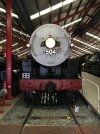
The image I've posted shows a South Australian Railways 5'3" gauge 500 Class 4-8-4 built by Armstrong Whitworth in the 1920s. Originally fitted with buffers (you can still see the holes in the buffer beam), these were soon removed and knuckles substituted.
Today, I think all Aussie locos and rolling stock (non-heritage), regardless of gauge, use knuckles.