Newby with a Question, All of my Live Steam Locos are G Scale..

Rob1962

Happy Steaming.
Country flag
United-States
I have an Accucraft Livesteam Forney G scale
120:3 And a few others such as Accucraft Ruby and a few others,I purchased a G Guage caboos for the above Locos it and it fits on the track, but it is alot Larger than my locos where did I go wrong? When I purchased it all it said was G scale I did not realize there were different size G scale what should I ask for for the above locos? Next time I’m ordering a loco and a side from Accucraft what other freight cars or passenger cars also sell what I’m looking for the Accucraft cars are Big Bucks a tender is $450.00 Below in the background is the Large Caboos in the Background.
Any info on the above would be greatly appreciated by me thank you.

 
Last edited:
I have an Accucraft five steam Farley G scale
120:3 And a few others suck as Accucraft Ruby and a few otheres I purchased a G Guage caboos for the above Locos it and it fits on the track, but it is huge bigger than my locos where did I go wrong? When I purchased it all it said was G scale I did not realize there were different size G scale what should I ask for for the above logos? Next time I’m ordering a logo and aside from Accucraft what other freight cars or passenger cars also sell what I’m looking for the Accucraft cars are Big Bucks a tender is $450.00 Below in the background is the Large Caboos.
Any info on the above would be greatly appreciated by me thank you.

Hello and welcome to the forum Bob.
I believe that the Ruby and the Fairlie locomotives are representive of smaller locomotives used on some narrow gauge railways. The bobber caboose is designed for a 3 foot gauge track whereas the locomotives are designed for smaller gauges.
 
Hi Rob, and welcome to the Forum. As casey jones snr casey jones snr has said, there are many different prototypes, ranging in size from almost miniature railway size right up to massive articulated locos.
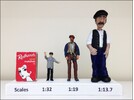
What makes it harder is that many of the manufacturers have a 'rubber ruler' approach and adapt designs to work for them; models may look like they portray a specific loco or piece of rolling stock, but don't. And then, as you've said, you are modelling in 1:20.3 (as am I: welcome to the club!), whereas many models are 1:19. We are working at 15mm/ft, while they are 16mm/ft, which makes quite a difference!

Ultimately all you can do is learn who builds models that work in the scale you are using. Taking a loco or a wagon with you (or memorising their dimensions) when purchasing a new item can help -but this is not possible when buying online, of course...

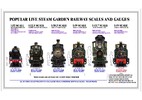
And finally, as much-discussed on here, G Scale is not a specific thing/ratio etc: it is an umbrella term for the larger (garden) scales, and includes (but is not limited to) trains running on 32mm and 45mm gauge track. Yes, it's confusing!
 
Thank you for the quick reply. Yes, I mostly do online. I’d rather new. I just thought there was other manufacturers or online sources that I could buy these exact scale if I told them what size the logo was but like you said that’s not how it works what I could do is maybe make a post who else has the same logo as me and ask him where they bought theirs.
 
Many of the cheepo Chineese figures are quite small of scale to our needs though I have some that look ok inside a coach providing not matched too closely to LGB figures. The 2 guys on the trolley being Bachman I find to be quite large even compared to LGB figures thus I feel their scale closer matches 16mm to the foot. Figures can be a bit of a minefield but with care and using say smaller ones at the front of a scene and larger ones at the back some of the ills can be resolved but not all. Be very careful of the ad ‘G scale’ as it is a totally imprecise scale, in fact not a scale at all.
 
Sometimes I think we should refer to G gauge and not G scale.
Of course this is the same track gauge as gauge 1 or 1:32 in English money or 1:29 scale and 1/32 scale in the USA for standard gauge full sized locos. But most gauge 1 modellers wouldn’t go near the sort of curvature G modellers adopt.
I may be wrong but I think g scale was coined by the originator of LGB perhaps meaning Garden gauge railways.
Many of their earlier models were originally based on I/22.5 scale although subsequently LGB seem to have varied the scale of their narrow gauge locos to make the proportions look similar, whether the prototype ran on 600mm track ; 750mm ; metre gauge or even standard gauge track.
As I understand things most US modellers of narrow gauge trains with prototypes running on 3’ gauge track model at 1/20(ish) scale l, that I’ve heard referred to as F scale.
Then other manufacturers have produced models at a varying ranges of scales between 1/22.5 and 1/29 to complicate matters even further.
All very confusing!
I think the problem is really that of what scale are the models as a ratio (intended to run on 45mm track) and rather than referring to g scale perhaps manufactures should give the scale of the model and indicate if it was prototype based, what track gauge the real thing ran upon.
I’ve a hunch though that many garden railway modellers aren’t too bothered about the above and just run the trains they happen to like.
Personally I model UK standard gauge trains at around 1/24 that run on what’s marketed as g scale track!
Perhaps G Scale should just refer the track.
The locos and rolling stock could then have a desperately an indicative scale ?
 
Rob, I assume you will post this on the USA forums too.

First comment: your live steam loco is very close to flying off on the curves, and you have no protection. If it does come off, it will be expensive to fix. At least fit a strip of wood along the end so it doesn't hit the floor.

Second, you might step back and ignore the advice. Run what looks good to you. It will take a while for you to digest the complexities of scale and gauge.

Finally, just to add to the confusion, your locomotive is a model of a 2 ft gauge Forney. They were very small locomotives, so the caboose in the background of your video is about the right size. Question - what made you think it wasn't? Doesn't it look right to you? What does look right? A standard gauge steam engine and train?

This is a video of the W, W & F, a historic 2' gauge train. See if you like the look! Your engine is modeled on that kind of engine.


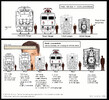
And another version of that scale/gauge diagram. Note the size of the 2 ft gauge loco top right.

Large-scale-scales2-scottychaos.gif
 
Back
Top Bottom