Massoth 4 channel switch Decoder

I have a separate problem. If anyone has some insight, I would greatly appreciate it.

I set up the Decoder to control lights on Switch 2 and 3.

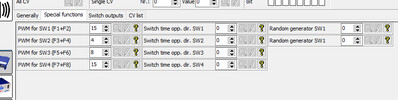
I attempted to reduce the output voltage by using PWM.

Despite setting the PWM set to "4" to output voltage remains at the maximum (the track voltage).

Switch 1 is connected to a track point and that works fine.

Switch 2 is connected to a light and I can turn it on and off but the voltage is full voltage (From volt meter). PWM is 4

Same for switch 3 but PWM is 8

The overall setup is a Dimax 1210Z running DCC. I have 18 volts track power.

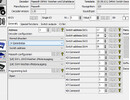
1769727288641.png

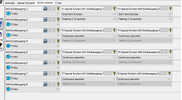
1769727236284.png


1769727216378.png
 
PWM works by altering the mark (on) to space (off) of a 'switch' turning the supply off and on for varying amounts of time.

Your meter is 'seeing' the 'on' voltage, so reporting 'full-track-power'.
You need a different type of meter, to measure the RMS value of a PWM derived voltage.

Putting it crudely:
If you have equal 'off' and 'on' periods, you get half the voltage. - Although for half the time you would 'see' full track voltage, and half the time 0V.

PhilP.
 
You meter is also a very high impedance, so it does not affect the circuit / voltage it is reading.

Try measuring the voltage across the load (bulb) you are powering.

PhilP.
 
I am measuring across the bulb.

What you said in your first response makes sense.

I will do a crude measurement using a small DC motor and assessing the speed at various PWM values.
 
Some Success.

I connected the switch output to a DC motor and I detected speed differences based on different PWM values set. Therefore, I believe the PWM is working.

However, what I saw was that when turning the switch on and off it merely changed the polarity and hence the switch is always on. With a DC motor this is obvious because it simply changes the direction of the motor spin.

Is this the way it is designed? If so, do I need to use a diode if I want to control a conventional light bulb?

The switch works fine when controlling LED lights because changing the polarity turns the light off due to it being a diode.

Is there something in the settings that allows the switch to control a regular DC light bulb (non LED) ?

John
 
Is this the way it is designed?
That is all the is needed to "throw" an LGB EPL point motor (including similar point rotating-magnet motors from other suppliers).. For other types of point motors, such as servo types it may not be optimal...... however the general EPL power control arrangements are generally mimicked by point motors intended for G scale use.

Regrading incandescent light bulbs.... yes, you will need diodes in series with the bulbs.
 
1769727236284.png
You have configured 'continuous operation for both directions of the F3 to F8 outputs. Therefore that will explain why your test motor runs continuously in either direction. Have you wired the lamps across the paired outputs on the decoder as you would for a point? Or are they wired between the + terminal and a single output?

AL
 
That is all the is needed to "throw" an LGB EPL point motor (including similar point rotating-magnet motors from other suppliers).. For other types of point motors, such as servo types it may not be optimal...... however the general EPL power control arrangements are generally mimicked by point motors intended for G scale use.

Regrading incandescent light bulbs.... yes, you will need diodes in series with the bulbs.
I understand the EPLs. I am mostly concerned about the bulbs. Thank you for affirming the need for a diode.
 
You have configured 'continuous operation for both directions of the F3 to F8 outputs. Therefore that will explain why your test motor runs continuously in either direction. Have you wired the lamps across the paired outputs on the decoder as you would for a point? Or are they wired between the + terminal and a single output?

AL

AL,

That part of the configuration puzzled me. I am not sure what I could do to get the result I want.

For example: The SW2 is controlled by the F3 and F4 settings. Based on what you said, I assume one of those, say F3 should be set to Continuous operation and the other, F4 should be set to something else. I don't see an obvious choice that sets it to "off"

Perhaps should F4 be set to "Short term function" with "Flashing 0,25 seconds". Would that yield a single short pulses and then be "off"

The diode solution would work but if I can avoid the diode with above settings, that is preferred.

For wiring have one wire connected to F3 and on to F4. Same for F5 and F6, and F7 and F8.

My understanding of the "+" is that is used only when you have it Loco mode and are controlling the F1-8 ports individually.
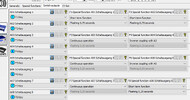
 
AL,

That part of the configuration puzzled me. I am not sure what I could do to get the result I want.

For example: The SW2 is controlled by the F3 and F4 settings. Based on what you said, I assume one of those, say F3 should be set to Continuous operation and the other, F4 should be set to something else. I don't see an obvious choice that sets it to "off"

Perhaps should F4 be set to "Short term function" with "Flashing 0,25 seconds". Would that yield a single short pulses and then be "off"

The diode solution would work but if I can avoid the diode with above settings, that is preferred.

For wiring have one wire connected to F3 and on to F4. Same for F5 and F6, and F7 and F8.

My understanding of the "+" is that is used only when you have it Loco mode and are controlling the F1-8 ports individually.
Regarding the plus, though irrelevant to AC it does help in getting things right between say a double bogied loco to ensure the wires go to the correct side of the decoder in each case, also if followed with the motor the correct orientation between locomotives going the same way wiil…or should be compatible on the handset.
 
Success but a little odd.

I achieved on/off function in two ways.

1. Set one of the coupled ports to "Inverse Coupling"
2. Set one of the couple ports to "Short term function with Flashing 0,25 seconds)

Both achieve a function of "on" (voltage present) and "off" (no voltage)

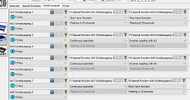
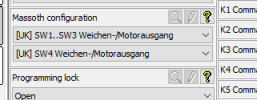
For some reason, this unit has SW4 as a separate configuration and "Inverse coupling" is not an option. Note the second picture below.

FWIW, I want to control some incandescent bulbs and other DC on off/stuff. I also have a bunch of 4.5V LED strings that are powered by 3 AAA batteries. They are a pain in the arse to turn on and off and also the headache of replacing batteries. With PWM at 3, I get exactly 4.55 volts.

Now I can use track power and control all of it with the various voltages needed. The old LGB 55025s did not allow this.

Thanks for everyone's help.

1769869935038.png


Note the separation of SW1....SW3 and SW4


1769870044894.png
 

Attachments

  • 1769869290660.png
    1769869290660.png
    53.4 KB · Views: 0
Last edited:
Glad you have found a solution although I think we may still have things to learn. These modern decoders are ever more capable and can have extra functions that hardly get used because of our lack of understanding of their full capabilities. This thread has highlighted this little known and little used function of the Massoth switch decoder.

My understanding of the "+" is that is used only when you have it Loco mode and are controlling the F1-8 ports individually.
That sounds right although not too obvious from the manual.

Trying to decode the decoder instructions, I'm learning myself!
1769946895773.png

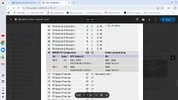
With the screenshot above, it appears that with CV49 you can select the outputs as a switch/motor operation, (this is the default for 3/4 second) or an on/off function. With CV49 you can disable the reversing polarity by adding the value of either 64 or 128 to allow a single direction of power to either Sw1 to Sw3 and/or Sw4. There is an error on that screenshot, it shows the default value as 128. This is incorrect and going to the German page the default is shown as 0.

With the MST (that I don't have) it is a case of drop down menus to select the appropriate setting.

Does that mean that you can wire a switch (or point) to the SW4 output and use the other outputs SW1 to SW3 to switch lights?

AL
 
AL,

I have an email to Frank Noeller at Massoth and hope to hear from him on Monday.

Side note: I highly recommend the MST. IT is both drop downs and direct CV programming. It also provides an excellent way to document settings in decoders of all kinds. You simply save the configuration as file and give it whatever name you want. I have separate files for all my LOCOs, Feedback modules, decoders etc. It is a free tool but does require a PC connection to the Central Station.

Regarding CV49, I am still puzzled as to its precise function. I'll post separately on this.

Regarding what you wrote: "Does that mean that you can wire a switch (or point) to the SW4 output and use the other outputs SW1 to SW3 to switch lights?

Yes that is true but you are not restricted to just that. You can control a Point from any of the four SWs and likewise for an On/Off or Blinking operation from any SW. You can do this in any combination.

From what I have seen:

1. To control a point you used "Short term function" which produces a pulse with duration ranging from 0.25 seconds to 3.75 seconds in 0.25 second increments. 0.25 seconds is enough to activate a Point.

2. To achieve On/Off for SW1,2 or 3, I found by trial and error that "Continuous operation" for 1 connection in a give SW port and "Inverse coupling" for the other connection on same SW port works.
2a. For some reason, SW4 is different and does not allow "Inverse coupling" and so I achieved On/Of by setting one connection of SW4 to "Short term" with 0,25 second duration. Its a workaround. It flip's the polarity and supplies a voltage for 1/4 second and then goes to zero voltage. Not pure but It works.

3. For blinking/flashing lights there are several choices, equal time on and off with intervals between 0.25 and 3.75 seconds or the unequal times on and off
 
Last edited:
Regarding CV49:

Again, I don't fully understand why they have this CV. It seems unnecessary.

It is related to CV29 which sets three things, the most important being whether the overall unit will operate with a Loco address or with a Switch Address.

If it is operating with Switch address, I believe the other two CV29 parameters (Direction and Speed steps ) are meaningless.

Operating with Switch address means you will use the SW connections as SW1, 2, 3 & 4, each controlling a separate device or circuit. For me, I will likely use it as 4 circuits and perhaps connect three buildings to a circuit.

Operating with a Loco address allows you control 8 individual devices or circuits. However you have to use a Loco interface to control lights and I prefer not to do that.

You can use PWM in Loco mode but a single PWM setting applies to two F connections.

I am not sure why CV49 is needed because setting CV29 to Switch/Motor mode implies that CV49 is set to Switch/Motor mode and Setting CV29 to Loco mode implies CV49 is in single function mode. It seems redundant to have to set 49. FWIW, I am using CV29 in switch mode and changing CV49 from Switch to Single simply disables the given SW connections and I get no voltage.

Again, I am hoping to get a reply from Massoth with some clarification.
 
Could it be that CV 49 allows the decoder to become hybrid? With the decoder in switch mode you can configure, using CV 49, the outputs SW!, SW2 and SW3 to operate as 6 individual outputs. You did say that there was no voltage from the outputs with CV 49 configured as single output. But individually, these outputs are all 0 volts therefore any circuit would need to connect to the + terminal.

Were still learning!

See what Massoth has to say.

AL
 
Back
Top Bottom