LGB 22630 Diesel Stubborn to “wake up”

tundracamper

Registered
Country flag
Recently acquired an LGB 22630 SV Ry diesel switcher off eBay. It runs very well, at least until it sits for a while. If it sits on the shelf overnight, it has an odd behavior. When I crank up the track voltage, the lights will come on and it just sits there. If I turn the voltage way up, it sits there for like 5-10 seconds and then lurches into action. After that, it runs normally with no issues. It will even start up at a very slow speed and creep along.

I have swapped out a few Forney motors, which I think are the same motor. However, those engines always sputtered along and never ran well to begin with (after buying on eBay). Before I go off installing a new motor, I wanna know if there is anything else I can check. I have moved the internal switch an bunch, to clean it, and have cleaned the wheels and lubed the gears. So, I’m pretty certain it’s either the motor or any internal electronics. Any suggestions on what to try before buying a new motor?

TIA
 
Does it have sound?

It sounds like it could have a decoder in it.. These need 5-6V to 'wake-up' but the motor will run from a couple of volts, so it will 'do nothing' then lurch into life..

It could also have a stay-alive, which needs to charge, or be set with a fair bit of Inertia?

Turn the control just enough to get full brightness of the lights, then leave it... See if it moves off after a delay?

PhilP.
 
The decoder and phils approach seems most likely.


Plan B:
IF no decoder…..
I have the sumpter and rio grande versions, analog.they run very smoothly, like a new stainz, in fact.
Track nice and clean?

Does the loco have much wear?

And assuming wheels and skates and wheel backs are clean, skates and brushes making contact,
Id guess that the motor commutator/brushes might be worn/oxidized.
(Clean is the key, re wheel tread and back.) sometimes, i must use track cleaner eraser to get rid of stubborn tread dirt. I also use qtips /pipe cleaners and alcohol or LGB smoke fluid for the wheel backs.)

Me, id give the motor commutator a little shot of contact cleaner. It might help….temporarily.
Im guessing the motor is worn.

Fwiw, i have ..7… forneys…!! All analog.
They all run superbly, even the chinese versions.
The only thing i found on the Chinese version is that plunger brushes can get hung up in the brush case. The rim of the cylinder case can have a rough edge that interferes with the brush traveling smoothly and making contact with the wheel backs.

A gentle smoothing of the brush case edge with a fine jewelers file will vastly improve the rear truck electrical pick up.
 
Last edited:
It does not have sound. I have not thought to check if it has a decoder. Like I said, it just sits there and then finally lurches into motion. The voltage is well over 5V. Probably like 12V. Then, after that, it runs just as smoothly as my other engines. I can completely stop it and it will start very slowly and smoothly, just as expected. No other running issues. That is, until it sits a while (e.g. over night).
 
It does not have sound. I have not thought to check if it has a decoder. Like I said, it just sits there and then finally lurches into motion. The voltage is well over 5V. Probably like 12V. Then, after that, it runs just as smoothly as my other engines. I can completely stop it and it will start very slowly and smoothly, just as expected. No other running issues. That is, until it sits a while (e.g. over night).
Sounds very much like there is a decoder and a power-buffer?

PhilP.
 
Do these decoder’s have memory or does the buffer hold power? It has to sit for some time before acting up again.
The buffer holds power..
It keeps things running over slightly dodgy track.

Some can keep things running for around a minute.

PhilP.
 
While I am waiting to get to this, I am curious about this DCC Ready aspect. If it does have a decoder, will it be a simple matter to “unplug?” Some of the DCC videos I see online show a hot-mess of wires.

Still being in the process of what power I will eventually use on my outdoor layout, I am wondering just how many DCC vendors will stick around. Just getting back into trains, I am not at all up to speed on what’s available.
 
While I am waiting to get to this, I am curious about this DCC Ready aspect. If it does have a decoder, will it be a simple matter to “unplug?” Some of the DCC videos I see online show a hot-mess of wires.
I doubt it will be that easy?

Until we know what decoder has been fitted, we are guessing a little, but it was quite common to strip-out the original electronics, and start again.

Still being in the process of what power I will eventually use on my outdoor layout, I am wondering just how many DCC vendors will stick around. Just getting back into trains, I am not at all up to speed on what’s available.
DCC will not disappear, any time soon..

Certain 'flavours' (manufacturers) may disappear, but one of the advantages of DCC is that it is a standard, so different vendors products will work with each other.

PhilP.
 
If it does have a decoder, will it be a simple matter to “unplug?”

If It is using the LGB interface standards, which have varied a bit over time, yes it can be unplugged.... however you may need a jumper plug or a change to switch settings to restore DC only operation. Referring to the user manual for the loco (usually available on line with a bit of web searching) is highly recommended!
 
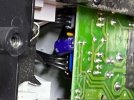
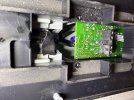
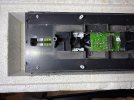
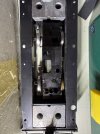
Well, I removed the bottom and was quite surprised in how easy the motor block drops out with the board motor connector. A very nice improvement over previous versions with wires.

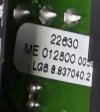
Everything I see looks standard. The front circuit board even has 22630 on the sticker and the wires lock stock. When I had the motor block out, I connected power directly to the motor. It started without issue. However, at really low speeds, the wheels turn like a clock hand, jerking ffrom one position to the next. To me, that says motor. So, I may see if I can figure out how to clean it, since it’s so easy to remove, or just order a new one. On the track it seems to run ok.

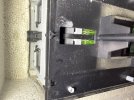
Now I need to figure out how to replace the pickup shoes. They are catching on turnout frogs. It looks like the motor has to come all the way out and the motor pins pushed up. Ugh. Off to search or start another thread.
 

Attachments

  • IMG_2570.jpeg
    IMG_2570.jpeg
    63.1 KB · Views: 12
  • IMG_2568.jpeg
    IMG_2568.jpeg
    539 KB · Views: 12
  • IMG_2567.jpeg
    IMG_2567.jpeg
    955.9 KB · Views: 12
  • IMG_2566.jpeg
    IMG_2566.jpeg
    1.1 MB · Views: 11
  • IMG_2565.jpeg
    IMG_2565.jpeg
    1 MB · Views: 12
  • IMG_2564.jpeg
    IMG_2564.jpeg
    559.6 KB · Views: 12
Well, I removed the bottom and was quite surprised in how easy the motor block drops out with the board motor connector. A very nice improvement over previous versions with wires.

Everything I see looks standard. The front circuit board even has 22630 on the sticker and the wires lock stock. When I had the motor block out, I connected power directly to the motor. It started without issue. However, at really low speeds, the wheels turn like a clock hand, jerking ffrom one position to the next. To me, that says motor. So, I may see if I can figure out how to clean it, since it’s so easy to remove, or just order a new one. On the track it seems to run ok.

Now I need to figure out how to replace the pickup shoes. They are catching on turnout frogs. It looks like the motor has to come all the way out and the motor pins pushed up. Ugh. Off to search or start another thread.
Pickup skates catching frogs a regular problem not necessarily sorted by new ones. They need to be bent upwards a little so that they miss the frogs. Use a set of fine nose to hold tge leg and bend up slightly with a pair of flat nosed ones, a good bit of force needed but ensure you do not put any strain on the plastic holder.
 
Pickup skates catching frogs a regular problem not necessarily sorted by new ones. They need to be bent upwards a little so that they miss the frogs. Use a set of fine nose to hold tge leg and bend up slightly with a pair of flat nosed ones, a good bit of force needed but ensure you do not put any strain on the plastic holder.
Well, I was playing around yesterday and figured out the convoluted process of removing the pickup shoes. So, I just replaced them. The old shoes appear bent down from the outside, which would explain why one was catching on turnout frogs. They were probably bent that way for a reason.

I discovered in that process that the set of wheel brushes nearest the pickup shoes was losing connection when reinstalling the bottom cover (connected when cover off, not when cover on). Those spring bars appear to only install in one orientation. So, I’m gonna try and put a thin shim over that end bending away from the brushes to see if that helps make everything pickup electricity.
 
Well, I was playing around yesterday and figured out the convoluted process of removing the pickup shoes. So, I just replaced them. The old shoes appear bent down from the outside, which would explain why one was catching on turnout frogs. They were probably bent that way for a reason.

I discovered in that process that the set of wheel brushes nearest the pickup shoes was losing connection when reinstalling the bottom cover (connected when cover off, not when cover on). Those spring bars appear to only install in one orientation. So, I’m gonna try and put a thin shim over that end bending away from the brushes to see if that helps make everything pickup electricity.
That certainly would explain your problem, still worthwhile bending them upwards a litte then you gphave some spares.
 
Me, id give the motor commutator a little shot of contact cleaner. It might help….temporarily.
Im guessing the motor is worn.


A gentle smoothing of the brush case edge with a fine jewelers file will vastly improve the rear truck electrical pick up.
Where can I get more info on cleaning the motor commutator? That involve taking motor apart?

As for the rear truck electrical pickup, what “case edge” are you referring to? Not following that nomenclature.

Thx.
 
Back
Top Bottom