LGB 21936 pulling power ?

LGB_Chur_Arosa

Registered
Country flag
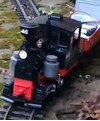
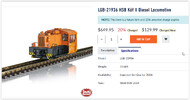
I mostly run RhB electric locomotives but looking for a small switcher to add a bit more fun.... Have not seen and RhB switchers by LGB recently, though the 21936 might be a good fit.... but I am not sure if it can actually pull much with just 2 axels and probably light weight(?) .... I had a 20753 that could barely gain traction when the tracks are wet let alone pull much.... the motor is good but the light weight plastic frame without any metal weights made it a "little engine that couldn't"... wondering if it is the same story either 21936? anyone has this model ?
 
In general, you need to make sure an LGB two axle loco has a traction tyre fitted on one wheel if you intend to do anything other that shunt/switch cars at low speed with it. In my experience, the LGB RhB two axle "Tm" shunting locos are useful for shunting, plus hauling work trains of a few cars.

You can increase adhesion by adding weight, but over-weighting can cause motor failure.
 
I think the earlier versions of this were pretty powerful but of late locomotives by MgB tend to be much lighter. Noting what software says about traction tyres is indeed true, but in my experience they do tend to reduce pickup thus making reliable shunting on other than perfectly clean track and wheels an issue, stalling on points can also be a problem.
 
1770539885985.png
By adding extra weights to the Stainz, it can pull quite bit of long train which it can't do otherwise. In addition to this, I also put small weights in the cab. I removed its traction tyre.
 
thanks, yes all modern LGB 2 axel locomotives do have at least one traction tier and pick up is no issue for me ....but that's not enough in my experience .... you need weight ..... one can add weight but often will impact the visuals so I like the weight to be in the locomotive from factory and hidden . .... thus asking if 21963 has any weights in it, I could not find any specific information .... my LGB 24451 for instance weighs a ton and can pull anything despite being a smaller locomotive, I assume it has some big ballast/weight blocks in it.
 
A new LGB model will not pull as much as an older one.
If only because the weights in the older model are lead. - The newer model, the weights are the same, but an alloy (I believe) of different metals. Less weight, less traction..

The Stainz (model) for example, will pull way more than the prototype. It is more a case of 'us' not using the correct loco for the job. - Tight radius curves, excessive gradients, and sticky axles or bogies.

I aim for around 2.2-2.5kg on smaller loco's.

PhilP.
 
thanks, yes all modern LGB 2 axel locomotives do have at least one traction tier and pick up is no issue for me ....but that's not enough in my experience .... you need weight ..... one can add weight but often will impact the visuals so I like the weight to be in the locomotive from factory and hidden . .... thus asking if 21963 has any weights in it, I could not find any specific information .... my LGB 24451 for instance weighs a ton and can pull anything despite being a smaller locomotive, I assume it has some big ballast/weight blocks in it.
24451 can indeed pull a good load, BUT at the possible cost of the wheels slipping on their axles giving poor lumpy running. We tended to overload these in the Ruschbahn up the gradient into the upper Station, with much slipping noted. This tommy mind showed overloading and eventual wheels slipping on the axles.

My views of most locomotives is to not over expect great feats of haulage particularly on extreme slopes. I tend to stick to 30 axles for maximum loads, most of my trains tend to be a bit less than this. All will go happily up my 1:40 gradients on 4ft radius curves with thus far (touch wood) no slipping out of sync of wheels on axles.

Yes you can put more weight in to get greater haulage, but in time the overload will tell on your locomotive.
 
One other point, if adding extra weight:

NEVER! Go so far that the loco will not slip the wheels if it should stall.

A stalled loco slipping its wheels, will wear through the plating on the tyres eventually..
A stalled loco which stalls the wheels/motor, will damage the motor, and possibly any electronics, if not caught quickly..

PhilP.
 
A new LGB model will not pull as much as an older one.
If only because the weights in the older model are lead. - The newer model, the weights are the same, but an alloy (I believe) of different metals. Less weight, less traction..

The Stainz (model) for example, will pull way more than the prototype. It is more a case of 'us' not using the correct loco for the job. - Tight radius curves, excessive gradients, and sticky axles or bogies.

I aim for around 2.2-2.5kg on smaller loco's.

PhilP.
I think it depends, lead is not safe and illegal to use here in California so they can't use it .... but certainly the 24451 can pull better than the vintage 2045 for example especially at low speed thanks to real-time motor load compensation in MFX mode. Think about it like a modern traction control in a car... I happen to have both of these being an RhB fan....

I still cannot find the official weight of 21936... the searches usually lead to the "Shipping" weight
 
Last edited:
24451 can indeed pull a good load, BUT at the possible cost of the wheels slipping on their axles giving poor lumpy running. We tended to overload these in the Ruschbahn up the gradient into the upper Station, with much slipping noted. This tommy mind showed overloading and eventual wheels slipping on the axles.

My views of most locomotives is to not over expect great feats of haulage particularly on extreme slopes. I tend to stick to 30 axles for maximum loads, most of my trains tend to be a bit less than this. All will go happily up my 1:40 gradients on 4ft radius curves with thus far (touch wood) no slipping out of sync of wheels on axles.

Yes you can put more weight in to get greater haulage, but in time the overload will tell on your locomotive.


Yes gradient is a different matter, my layout is flat, I don't have to worry about slopes fortunately. My 24451 can easily pull several of those "cleaning cars" with thick 3M sanding pads attached even when driving over track magnets and such with lots of friction .... so I am happy with it. never seen wheel slippage on this model so far.

Any ways, my main question was if 21936 comes with factory ballast, as mentioned I do not intend to modify or add weights myself so I don't have to worry about overloading the motor. And for the switcher I won't be hauling more than 5-6 ( less than 20 axels) , mostly smaller cars but I do want it to be able to pull or push the track cleaner car. Indeed that's the primary usage , track cleaning... I can't find any videos of someone opening this model to see if it has any descent weights or not....... There aren't any train shops where I live so testing it unclose is not an option either :(
 
Last edited:
Yes gradient is a different matter, my layout is flat, I don't have to worry about slopes fortunately. My 24451 can easily pull several of those "cleaning cars" with thick 3M sanding pads attached even when driving over track magnets and such with lots of friction .... so I am happy with it. never seen wheel slippage on this model so far.

Any ways, my main question was if 21936 comes with factory ballast, as mentioned I do not intend to modify or add weights myself so I don't have to worry about overloading the motor. And for the switcher I won't be hauling more than 5-6 ( less than 20 axels) , mostly smaller cars but I do want it to be able to pull or push the track cleaner car. Indeed that's the primary usage , track cleaning... I can't find any videos of someone opening this model to see if it has any descent weights or not....... There aren't any train shops where I live so testing it unclose is not an option either :(
You could get an idea of the train to pull using one of these (fishing scales, others will be available):-
Use it to get an idea of the pull weight by dragging the 20 axle stock with the hook in a coupling. Then try with your cleaning setup and you will have a rough idea of the ‘effort’ required by your locomotive.
 
thank you all , so I take no one here actually has a 21963 to tell me how much it weighs .... I will try emailing Marklin and ask them I will share here if I get a response, thanks again
 
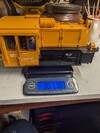
thanks so much that's exactly what I wanted to see! so it has some weight to it, have you ever tried pulling any track cleaning cars with it ?
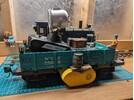
Yes, I have the LGB cleaning bracket that fastens under a wagon. I push that with my "Yard Yeeter" battery rail room out front. The 21936 pushes both just fine. I have also pulled 4 boxcars with the 21936. Never tried to see what the max was. 1000005209.jpg
 
Back
Top Bottom