Hello Fellow Garden Railers? Any South West Wales members/ groups? I'm in Mumbles, Swansea, UK.

TimGDB

Registered
Country flag
I spent a frustrating afternoon on Sunday trying to resurrect my LGB digital garden railway which has not been used at all for 2 years and not frequently for 7-8 years. Unfortunately, some of the locos had been stored in my brick-built shed/workshop which the trains ran into at night and it was not as waterproof as i thought. However, I dont think my 55 series MTS units have been affected and have mainly been in my house over winter but I could not get either my wireless or direct to central station 55015p controllers to do anything other than show S and 3 -'s. Furthermore, some of the instruction booklets had got wet with pages stuck together, so i may not be remembering the quite complicated set-up and operations processes clearly. If anyone can offer advice, preferably by phone or even in person please let me know.
Best wishes,
Tim
 
Hullo Tim,

Welcome to the forum.

Unfortunately I'm not in your lovely part of the world, but I do have experience of MTS 2, although from a while ago. I still have it for my portable layout.

I'll send you a PM with my number....
 
Last edited:
Welcome Tim,
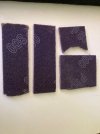
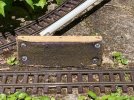
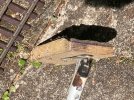
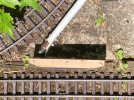
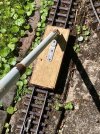
I hope your trains will run smoothly again soon! As for the locos you may be need to put some grease on the moving connecting parts. The track in your garden will probably also be corroded. I used a sort of abrasive spunge with a gray abrasive sprayed on a plastic substrate having an abrasiveness equak to P800 sand paper. I mounted a strip of that material on an elongated piece of wood using 4 screws with wider rings. On the sides of this piece of wood i mounted two elongated guiding thin wooden plates, so the whole thing just fits nice over an LGB track. See pics below. After 3 or 4 pushes up and down the top of your track is cleaned from corrosion just enough to let the electricity pass without any problems and at the same time not having removed all the corrosion dark brown colour.
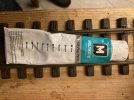
The next problem will be your track connections. If you did not use allready coppergrease (or alike) when starting your railway then its now the time to clean all your railtrack connections and apply s bit of coppergrease on them. This will ensure for many years good connectivity. The best is to use a bit of terpentine to dissolve the grease so it flows more easy into all narrow positions. The great thing of this coppergrease is that it is resistant to extreme temperatures so does not dissappear by the heat of the sun, nor will it be flushed away by heavy rainfall. It stays on the copper surface keeping it as clean as it started!
I hope this will help you getting your trains on track again soon!
 

Attachments

  • abrasive material P800.jpeg
    abrasive material P800.jpeg
    61.1 KB · Views: 1
  • cleaning pad bottom.jpeg
    cleaning pad bottom.jpeg
    121.5 KB · Views: 1
  • cleaning pad front.jpeg
    cleaning pad front.jpeg
    122.6 KB · Views: 1
  • cleaning pad side.jpeg
    cleaning pad side.jpeg
    124.5 KB · Views: 1
  • cleaning pad top.jpeg
    cleaning pad top.jpeg
    129.2 KB · Views: 2
  • Copper grease.jpg
    Copper grease.jpg
    568.5 KB · Views: 2
Track cleaning and connections may certainly be an issue. If I were you I would try all my locomotives on a safe way of holding them upside down with wire or preferably clips to the slider pickups. Once you are happy that the locomotives and controller are ok then it will be to the great outdoors. Oh a d how did you number your loco otives in DCC, do you have an aid memoire?
 
Welcome from a flatter part of the country Tim. Hopefully your engines etc will recover from the shed, and havent succumbed to damp. Hopefully someone will come up trumps with the advice you need.
 
Welcome Tim,
I hope your trains will run smoothly again soon! As for the locos you may be need to put some grease on the moving connecting parts. The track in your garden will probably also be corroded. I used a sort of abrasive spunge with a gray abrasive sprayed on a plastic substrate having an abrasiveness equak to P800 sand paper. I mounted a strip of that material on an elongated piece of wood using 4 screws with wider rings. On the sides of this piece of wood i mounted two elongated guiding thin wooden plates, so the whole thing just fits nice over an LGB track. See pics below. After 3 or 4 pushes up and down the top of your track is cleaned from corrosion just enough to let the electricity pass without any problems and at the same time not having removed all the corrosion dark brown colour.
The next problem will be your track connections. If you did not use allready coppergrease (or alike) when starting your railway then its now the time to clean all your railtrack connections and apply s bit of coppergrease on them. This will ensure for many years good connectivity. The best is to use a bit of terpentine to dissolve the grease so it flows more easy into all narrow positions. The great thing of this coppergrease is that it is resistant to extreme temperatures so does not dissappear by the heat of the sun, nor will it be flushed away by heavy rainfall. It stays on the copper surface keeping it as clean as it started!
I hope this will help you getting your trains on track again soon!
Track cleaning and connections may certainly be an issue. If I were you I would try all my locomotives on a safe way of holding them upside down with wire or preferably clips to the slider pickups. Once you are happy that the locomotives and controller are ok then it will be to the great outdoors. Oh a d how did you number your loco otives in DCC, do you have an aid memoire?
Thanks Dunnyrail, Im OK with the track and used abasic analogue contraoller that cams with a Stainz set to check that. I did indeed write down the call-up nos. for my 15 (!) locos and was initially panicking when I couldn't find the folder in which they were kept, but did eventually. I do use the direct-to-pick-up method learned from servivcing/repairing many Hornby Dublo locos bought at auction and have been successful with many complete non -runners but the machinations of the LGB self-contained cylindrical motor is a different matter!? I have two double-motored locos - Mallet and in tender second motor Rugen - where only one motor is working, any suggestions or web links to how to tinker with these tricky beings?
 
Welcome Tim,
I hope your trains will run smoothly again soon! As for the locos you may be need to put some grease on the moving connecting parts. The track in your garden will probably also be corroded. I used a sort of abrasive spunge with a gray abrasive sprayed on a plastic substrate having an abrasiveness equak to P800 sand paper. I mounted a strip of that material on an elongated piece of wood using 4 screws with wider rings. On the sides of this piece of wood i mounted two elongated guiding thin wooden plates, so the whole thing just fits nice over an LGB track. See pics below. After 3 or 4 pushes up and down the top of your track is cleaned from corrosion just enough to let the electricity pass without any problems and at the same time not having removed all the corrosion dark brown colour.
The next problem will be your track connections. If you did not use allready coppergrease (or alike) when starting your railway then its now the time to clean all your railtrack connections and apply s bit of coppergrease on them. This will ensure for many years good connectivity. The best is to use a bit of terpentine to dissolve the grease so it flows more easy into all narrow positions. The great thing of this coppergrease is that it is resistant to extreme temperatures so does not dissappear by the heat of the sun, nor will it be flushed away by heavy rainfall. It stays on the copper surface keeping it as clean as it started!
I hope this will help you getting your trains on track again soon!
Thanks Gerard, I should have mentioned that i have successfully resuscitated the track mainly using the 'official' LGB track cleaning block, which I bought with my initial substantial LGB purchase, but will lok to replce that with your cleaner when the LGB one is no longer effective. I also have some of the LGB electrolube type grease which I've put on some connectors where there is a bit of a gap, but that has nearly finished so I will definitely purchase some of the coppergrease you kindly recommend.
bet wishes,
Tim
 
Hullo Tim,

Welcome to the forum.

Unfortunately I'm not in your lovely part of the world, but I do have experience of MTS 2, although from a while ago. I still have it for my portable layout.

I'll send you a PM with my number....
Thanks for your kind offer Gizzy, I'm currently in the throw of getting the house ready for family and friends comimg for a long weekend so will call you after that when i have time to set up my MTS and we can hopefully talk throughsome of the issues.
Best wishes,
Tim
 
Thanks Dunnyrail, Im OK with the track and used abasic analogue contraoller that cams with a Stainz set to check that. I did indeed write down the call-up nos. for my 15 (!) locos and was initially panicking when I couldn't find the folder in which they were kept, but did eventually. I do use the direct-to-pick-up method learned from servivcing/repairing many Hornby Dublo locos bought at auction and have been successful with many complete non -runners but the machinations of the LGB self-contained cylindrical motor is a different matter!? I have two double-motored locos - Mallet and in tender second motor Rugen - where only one motor is working, any suggestions or web links to how to tinker with these tricky beings?
A long time back there was a missive about how to repair the motors in our locs, but lost to me in the midst of time and my poor searching abilities. However for double motors my best suggestion is to get 2 new replacements, then the good spare can be used in a single motored loc with a dodgy motor giving you 2 to be looked at if you can find out how, they are resuscitable mostly.
 
Back
Top Bottom