Fosworks OMNI Tx-3 / Strikalite AAA 4.8v 0.900Ah Battery Packs - Charging problems.

newboydave

G scale trains - no surprise there then!</br></br>
Country flag
Hi. I am currently experiencing problems in recharging my loco's battery packs. The loco is a Live Steam Accucraft 'Lawley' (0-6-0) original era model, not the recent model. The RC equipment (Fosworks OMNI Tx-3 ) was fitted in August 2025 ago by 'Amazing Little Trains' and until now has worked perfectly.

I have TWO 'Strikalite' AAA 4.8v 0.900Ah NiMh battery packs (one is proxy 12 months old - the other brand new) and suddenly neither of them will recharge, with either an Axtronic Model Ho440005-XX-D1 charger or with an alternative charger, an 'IMAX B6'.

Previously, I have had no problems with using the Axtronic charger, the IMAX6 message indicates a 'connection break' error when this is connected.

If I connect either of the two Battery Packs to the loco, then switch 'ON' the loco power - none of the servos operate, suggesting a possible problem with the battery packs, the onboard circuit board, or just a problem with the JST lead plugs, but I have never had either of these giving problems previously.

I intend replacing all the JST leads & plugs to see if this shows any improvement but if this fails, has anyone out there any useful suggestions on what the problem may be, or any company who may be able to investigate and sort the problem out. I am in the Greater Manchester area.

Any help would be greatly appreciated!
 
Last edited:
Break the problem down:

I doubt it is your chargers. - Two chargers going faulty, would be very rare..

These are NiMH packs, so they Imax would need more setting up than the smart charger. - Does this self-test when switched on?

My guesses would be:

1. Very flat battery pack, so chargers are saying 'no'.

2. Switch in wrong position. - Do you have three-position switches? Centre-off, one-way to run the loco, other way to charge?

3. Do you have a meter? - Check the voltage you can 'see' on the battery packs.

4. Report back results...

PhilP.
 
By any chance did you forget to switch off the loco's rc/servo/battery unit after a run ? Next time you come back and they are as flat as a pancake, so your smart chargers cannot "see" a voltage to start charging. The batteries might need a little jolt to put a baseline voltage in. Been there and done that one or two times, sometimes after 6 months. See PhilP above for the prescription. Max
 
Break the problem down:

I doubt it is your chargers. - Two chargers going faulty, would be very rare..

These are NiMH packs, so they Imax would need more setting up than the smart charger. - Does this self-test when switched on?

My guesses would be:

1. Very flat battery pack, so chargers are saying 'no'.

2. Switch in wrong position. - Do you have three-position switches? Centre-off, one-way to run the loco, other way to charge?

3. Do you have a meter? - Check the voltage you can 'see' on the battery packs.

4. Report back results...

PhilP.
Hi Philp. Thanks for the reply. The loco only has an 'On & Off' switch. I may have left it 'On' after my most recent run, some weeks ago, but am not sure.
I have put a meter on each pack and : the 'older' pack shows a reading of 1.08, the 'new' pack (purchased last week and quoted as 'already charged but recommemded additional charging) had a reading of 5.08.

The IMAX 6 charger shows the message 'Connection Break' shortly after being switched on. I have recently used this on another battery pack, and got the same message but by changing the position of the battery pack
(not a 'Strikalite battery) switch, the message dissapeared, and charging was completed.

When I use the alternative charger (Axtronic), the red light comes 'On' then goes off, the green light then comes On and goes out. When the charge is completed, the Green light comes back 'On' This normally happens, but on my most recent attempt, the Green light does not come back on, to indicate charging is complete, even after a long period on charge (overnight for example).

You mention a 'short' shock to the battery packs, but I'm not sure what this would actually require on my part - any advice?

Hope all these comments may give you some helpful info.
 
Always switch the smart charger off, before connecting / disconnecting battery packs..
Little tip..

The smart charger will Red/Green Red/Green (self-test) then detect a battery pack, and start charging..
They are a 'gentle' charge, so it can take several hours..

Regarding your (very) flat battery pack.
You need to connect either a power supply. MUST be a similar value to the batteries, not too much more, for a few minutes. - No more than five.
Do NOT leave this, and go do something else. At least every minute, check the pack is not more than warm to the touch. - If it gets hot, stop immediately and disconnect everything.
Let it cool, and check it is cooling.. - If in doubt, put it outside, away from anything combustible.

After the five minutes.. Let the pack cool down. Then try the smart charger again. - This charge might appear quite quick, it might take several hours..
When it finishes, turn off the charger, then disconnect the battery. Give it half an hour, and measure the voltage. - Make a note of it.
Leave it overnight, and measure the voltage again. - It will probably be half to one volt lower..
Charge the battery for a second time. - This could take a while.

This should recover the battery pack. It will never be as good as it was, but should still have a useful life.

PhilP.
 
Always switch the smart charger off, before connecting / disconnecting battery packs..
Little tip..

The smart charger will Red/Green Red/Green (self-test) then detect a battery pack, and start charging..
They are a 'gentle' charge, so it can take several hours..

Regarding your (very) flat battery pack.
You need to connect either a power supply. MUST be a similar value to the batteries, not too much more, for a few minutes. - No more than five.
Do NOT leave this, and go do something else. At least every minute, check the pack is not more than warm to the touch. - If it gets hot, stop immediately and disconnect everything.
Let it cool, and check it is cooling.. - If in doubt, put it outside, away from anything combustible.

After the five minutes.. Let the pack cool down. Then try the smart charger again. - This charge might appear quite quick, it might take several hours..
When it finishes, turn off the charger, then disconnect the battery. Give it half an hour, and measure the voltage. - Make a note of it.
Leave it overnight, and measure the voltage again. - It will probably be half to one volt lower..
Charge the battery for a second time. - This could take a while.

This should recover the battery pack. It will never be as good as it was, but should still have a useful life.

PhilP.
One of the things I have found with Smart Chargers is that the Red light will flash continuously which I assume is a very low battery, I tend to leave it doing that and keep monitoring it every hour or so. Eventually it comes back to normal steady charge mode Red Light on for a full charge.
 
One of the things I have found with Smart Chargers is that the Red light will flash continuously which I assume is a very low battery, I tend to leave it doing that and keep monitoring it every hour or so. Eventually it comes back to normal steady charge mode Red Light on for a full charge.
Probably depends on the make of smart charger :emo:
 
One of the he first pieces of advice I was given, was to have a light of some sort in the circuit which is lit when the power is on. That way it's easy to know whether or not you've switched it off.
Yep, as you know, I try to hide my on/off switches on my battery powered locos, and on one of them, the exhaust up through the roof operates a push/push on/off switch. As there is no visible indication whether it's on or off, I wired the headlamp so that it comes on when the loco is switched on, rather than from the direction lighting, which would come on when it starts to move
 
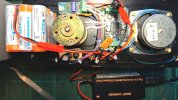
Irony on irony, after my original post on this thread. Just did the "big switch on" last night on my Goose #2. Nothing, nada, dead as a Do-Do. Never happened before in 8 conversions. Always work 1st time of asking. First thought has the Polyfuse tripped. No visual clue. Did I trap a wire, easy on these metal body jobs. Have I miss-wired something or is a wire at terminal not seated properly. Then I remember that the battery pack has been hanging around for about a year and I forgot to charge it up. Thereis not enough voltage to wake anything up. Out comes my original trusty Axtronic 14.4v (I've accumulated 3 more and one of the big voltage ones). Plug it in, flash red, flash green, steady red. Steady green light on after 2 hours and everything switches on and the TX bound and talking to Goose #2's RX. All is well with the world and I get a full 8 hours undisturbed sleep. Phew ! Max

Birds eye veiw of a Goose's bird's nest. And there is the charger doing its job.
20260509_192607.jpg
 
Irony on irony, after my original post on this thread. Just did the "big switch on" last night on my Goose #2. Nothing, nada, dead as a Do-Do. Never happened before in 8 conversions. Always work 1st time of asking. First thought has the Polyfuse tripped. No visual clue. Did I trap a wire, easy on these metal body jobs. Have I miss-wired something or is a wire at terminal not seated properly. Then I remember that the battery pack has been hanging around for about a year and I forgot to charge it up. Thereis not enough voltage to wake anything up. Out comes my original trusty Axtronic 14.4v (I've accumulated 3 more and one of the big voltage ones). Plug it in, flash red, flash green, steady red. Steady green light on after 2 hours and everything switches on and the TX bound and talking to Goose #2's RX. All is well with the world and I get a full 8 hours undisturbed sleep. Phew ! Max

Birds eye veiw of a Goose's bird's nest. And there is the charger doing its job.
View attachment 356210
After reading all the above posts I think I will stick to my Analogue layout with track cleaning , although a chore to some, a lot less complicated option
 
After reading all the above posts I think I will stick to my Analogue layout with track cleaning , although a chore to some, a lot less complicated option
Ooh, don't remind me of my elaborate hand written spread sheets to schedule regular recharging NiMH packs in little used locos and dry cells in transmitters and remotes :D Max
 
The one draw back with battery power, converting an expensive model from track power. It may seem simple, but we all know it's never quite as easy as it looks!
 
This year I have created a new regime for my battery conversions having a new hand written spread sheet and noting which session each batter macine runs at. Then I will make sure they all rotate to get enough runs in the year to keep batteries in good shape. As for the logic of going for battery power, best decision I ever made.
 
Back
Top Bottom