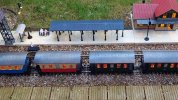
Finally figured out how to make coaches lights natural.

peterpavuk

Registered
Country flag
I've been experimenting with DIY solution for coaches lighting for a long time. I run DCC, which is 21-22v on the track. But problem is that DCC is not DC and not AC.

In fact DCC is AC with frequency far above 50-60hz. And that's what kills both leds and AC/DC bridges - there are filters for that - but that is beyond my skills.

So I reverted to filament bulbs. These are resistors, these don't care about DC, AC, DCC. And zero interference to DCC too - these are resistors.

24v rated E5 bulbs at DCC 21-22v glow naturally and softly.

That's what I'll use going forward.

I have designed and printed lights brackets for piko 2 axle coaches - see pictures of result. I will do the same for LGB standard 2 axles coaches too.

So far these looks like that: I find light to be natural and soft.

Next week I'll edit and upload a video how to integrate lightbulbs to PIKO coaches using 3D printed brackets.

Subscribe to JG Line
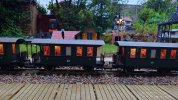
1000031440.jpg1000031441.jpg1000031442.jpg
 
I do not understand why DCC is a problem. I run DCC and that delivers a 24 V ACpower on the track. So every car can have its own lightning based on this continuous power supply. The best is to use LED's with a nice warm colour. You have to put these leds into series with a proper resistance and a small current rectifier. Compared to the old resistance bulbs this saves you a lot of amperage! Check our book "our model garden railway" how to do this.
 
I do not understand why DCC is a problem. I run DCC and that delivers a 24 V ACpower on the track. So every car can have its own lightning based on this continuous power supply. The best is to use LED's with a nice warm colour. You have to put these leds into series with a proper resistance and a small current rectifier. Compared to the old resistance bulbs this saves you a lot of amperage! Check our book "our model garden railway" how to do this.
Rectifiers just burns out on DCC, LEDs without rectifiers also have very short lifetime, and also these flicker on camera. I have very same leads in buildings run on 12v DC and have zero issues - on DCC they don't last long at all. I suspect it id because dirty frequency.
 
I do not understand why DCC is a problem. I run DCC and that delivers a 24 V ACpower on the track. So every car can have its own lightning based on this continuous power supply. The best is to use LED's with a nice warm colour. You have to put these leds into series with a proper resistance and a small current rectifier. Compared to the old resistance bulbs this saves you a lot of amperage! Check our book "our model garden railway" how to do this.
I previously had a circuit containing bridge rectifier, capacitor, resistor and LEDs. 4 out of 10 burned out. Maybe just dodgy rectifiers, idk, but bulbs are so much easier and looks much better on camera, which is important for me.
 
For your convenience/information , here's part of our book that handles about LEDs and how to connect them.
Do not forget the resistor at the right fig 5.1-4 !
There is a lot more in the book, I hope this will do for now.
 

Attachments

I am doing model railroads since I was 10. About 40 years. I obviously know how to connect a LED.

Issue with DCC is that DCC signal on track is a square waveform high frequency 5 kHz to 9 kHz switching DC, so many bridge rectifiers just can't survive it long term, the switching is too fast and too abrupt.

Everything designed for 50-60Hz AC won't survive any long. There are ways to deal with it, but that would mean high frequency rectifiers, which are expensive and hard to obtain. I could probably use 4 Schottky diodes to make own high frequency bridge rectifier, but that'll require pcb ordering, components, soldering - and likely in small batches will cost more than off the shelf coach lights decoder.

So bulbs here are solid choice - they are cheaper by order of magnitude and provide functionality I was after just fine.
 
I've been experimenting with DIY solution for coaches lighting for a long time. I run DCC, which is 21-22v on the track. But problem is that DCC is not DC and not AC.

In fact DCC is AC with frequency far above 50-60hz. And that's what kills both leds and AC/DC bridges - there are filters for that - but that is beyond my skills.

So I reverted to filament bulbs. These are resistors, these don't care about DC, AC, DCC. And zero interference to DCC too - these are resistors.

24v rated E5 bulbs at DCC 21-22v glow naturally and softly.

That's what I'll use going forward.

I have designed and printed lights brackets for piko 2 axle coaches - see pictures of result. I will do the same for LGB standard 2 axles coaches too.

So far these looks like that: I find light to be natural and soft.

Next week I'll edit and upload a video how to integrate lightbulbs to PIKO coaches using 3D printed brackets.

Subscribe to JG Line
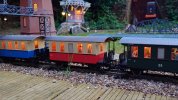
View attachment 356460View attachment 356461View attachment 356462


Here we go - step by step video tutorial on lights installation

 
You make that soldering look so easy!!
Soldering is one of those dark arts that gets easier the more you do, just watching a few ‘how to’ vids on YouTube then having a go following the tips and you can do it. I managed and it scared me to death in my youth.
 
Soldering is one of those dark arts that gets easier the more you do, just watching a few ‘how to’ vids on YouTube then having a go following the tips and you can do it. I managed and it scared me to death in my youth.
The one soldering tip (!) I can pass on is, if the soldering iron is falling off the bench for whatever reason, do not be tempted to try to catch it. Yes, ask me how I know.
 
Back
Top Bottom