You are using an out of date browser. It may not display this or other websites correctly.
You should upgrade or use an alternative browser.
You should upgrade or use an alternative browser.
Ello folks! Need some advice.
- Thread starter Brick Box
- Start date


Zerogee
Clencher's Bogleman

Yes, sounds like a mix of dirty track and/or poor connections, plus maybe some locos that are getting "sticky" through age... are you using rail clamps, or just relying on the push-fit rail joiners? You say your locos are old, but have they been run reasonably regularly or have they sat on a shelf for years?
As Gizzy says above, check all your track joints, apply some elbow grease with a track cleaning block, and see how it all goes then?
Jon.
As Gizzy says above, check all your track joints, apply some elbow grease with a track cleaning block, and see how it all goes then?
Jon.

Gerard
Geard Co-Author " Our Model Garden Railway"

Hi Brick Box,
1 If your locomotives run fine when powered via two wires connected to the power transformer, then the problem is indeed with the tracks and/or the locomotives’ current collectors.
2 First, check to make sure the current-collecting shoes are clean, and clean any current collectors on the inside of the wheels as well!
3 Next, the treads of the locomotives’ wheels must be thoroughly clean.
4 Finally, the top of the tracks must also be sufficiently clean; for example, you can sand the top clean with P900 sandpaper (attached to a sponge). I use that sandpaper on a pad measuring about 10 x 15 cm that I’ve attached to a stick at an angle of about 45 degrees. I’ve added two thin raised edges to the sides of this pad so that it stays centered on the rails when you run the stick diagonally downward across the track. Usually, one pass across the track at the start of the season (spring) is sufficient.
5 Finally, the connections between the individual rail sections must be highly conductive. This means that, before connecting the rails, you must brush away any corrosion from the rails beneath the fasteners using a wire brush. Then, always apply some copper grease to the connection (e.g., Molycote, which is resistant to rain and temperatures up to 300 degrees Celsius!), which ensures that corrosion no longer occurs and that you always have a good electrical connection. This applies to both the standard sliding rail connection and the clamp couplings with two screws.
Succes!
Gerard

maxi-model
UK/US/ROW steam narrow gauge railways 1:1
Previous advice the most likely and first things to check. Depending on make and age some of your loco's may have a fractured gear(s) in their drive trains that can manfest in the same way. Happens with a lot of older Bachman made large scale products - "Big Hauler" & "Spectrum" ranges. Been there done that.


All the above is good advice, but a look inside to see how the lubrication is doing. Often with old locomotives it will all have grouped into corners leaving little to no lube for moving parts. Also very old stuff can be a bit stiff and need cleaning iff to be replaced with new, LGB lube is my recommendation though others (suitable for nylon and plastic) are available.


stevedenver
Registered

Like gerard and other…
Most likely, the track is dirty.
But,
My checklist;
1 buy a red lgb track cleaning block. Worth twice what you pay. Thoroughly shine the track. I do not recommend sandpaper. If a rough abrasive is used, you create tiny grooves to collect dirt. My 2 cents….
2. Track joiners: they should be free from micro gunk/grit. A pipe cleaner is a start. Also those little gum cleaning brushes, like a tiny bottle brush, work into the tiniest crevice. Clean out the crud.
Then, If oxidation on the joiner inside, , ie dark colored, this can be cleaned by using liquid soldering flux on the pipe cleaner. Or, liquid metal polish liquid, such as clear silver cleaner. Rinse. This one step, especially after years, should help, a lot. Yes, you will need to disassemble the whole layout and clean. Pita.
If you’re so inclined, i guarantee you that if you choose to convert to rail clamps, operation will improve dramatically, and stay that way.(did this myself).
3. Gently ‘crimp’ or close the now clean joiners for an EVEN like new snug fit, ie slightly closed at both ends. I use a box nosed electrician’s plier that will evenly grasp the entire joiner length. However, Anything will do, just be gentle. If you dont go rail clamps, which i know are expensive, The lgb conductive grease, a pea sized piece, into the now clean tight joiners, greatly reduces micro grit from re-entering.
4. On your locos…clean the track pick up shoes, use your new lgb block to remove any gunk.
5. Clean the backs of the drive wheels where the contact brushes make contack. Over time, these collect the brush graphite resulting in a dark ring. It is easily cleaned using a pipe cleaner soaked in lighter fluid/naptha, or regular metal polish, simichrome, and wiped clean. I do this with the loco upside down and running, using a pipe cleaner or q tip, small bit of rag. Ditto the treads, if needed. Avoid sharp items that may scratch the metal.
Take note of the brushes (and springs that push them out). Make sure all 4 brushes touch the wheel backs.if not, the bush may be excessively worn. (Replace).
When replacing a set of wheels into the gear box, depress the brushes to clear the wheels so they dont break. Also, on steam locos quartering needs to be perfect. (Look up about quartering if you’re unfamiliar). Simply, if quartering is off, the loco will not run smoothly, but repeatedly ‘bind’ and then move freely.
6 clean the area where the axel enters the gear box, per above. Re-lube lightly with light oil.
When i disassemble a loco, i make sure i have time to do it all at once, so i dont forget the process. Remember this…everything fits, without force. You just need to figure out how to re-assemble. Often, on-line has step by step.
Second tip. I have been servicing my locos decades. Yet, sometimes i need to dis-assemble and assemble more than once to get things right. Quartering, reseating of a motor in its cradle (theres a position pin that needs to properly seat[.
Work over a towel to minimize bouncing screws et al. Use correct lubes, ie bachmann, hobbi lube, lgb grease. In any event, plastic compatible. Remove and clean the old grease. I use dish soap or other degreaser, dawn, toothbrush, rinse, dry, re-lube. Btw, check drive rods and gears for grit clinging to old oil. Again, if necessary, de grease, clean, rinse. If you have old lgb locos, btw, often there is a tiny ball bearing, a thrust bearing, at each end of the motor shaft. Dont lose these. Carefully pick them out with a toothpick, clean and relube, press the ball bearing back into the fresh grease.
Sounds complicated, but it really isnt. Just takes patience, and, you should be prepared with the stuff i suggest for servicing. Lgb stuff is designed for relatively easy upkeep.
Typically, say for a stainz or a mogul, a complete overhaul will take me a couple of hours, fwiw.
Once everything is clean and shiny and lubed, things should run great. If you still have stuttering, id suspect that the motor is worn. Sometimes a shot of electrical cleaner onto/into the commutator/brush area in the motor will flush and clean out old brush dust.The solution, more often, unfortunately, is a new motor.
Best of luck.
Its worth the hassle to get your trains running properly. Imho, theres nothing as annoying as a loco that doesn’t run smoothly. Lgb will run slowly and smoothly when conductivity is decent.
Last edited:
Gerard
Geard Co-Author " Our Model Garden Railway"
Another very effective solution for a locomotive that runs unevenly:
Install electrical rail contacts on all cars, equip the cars with lighting,
and simultaneously connect them electrically using a thin wire with a plug connection between the cars and to the locomotive.
I’ve used this method successfully with locomotives that have only 4 wheels, such as the Steinz.
Install electrical rail contacts on all cars, equip the cars with lighting,
and simultaneously connect them electrically using a thin wire with a plug connection between the cars and to the locomotive.
I’ve used this method successfully with locomotives that have only 4 wheels, such as the Steinz.
maxi-model
UK/US/ROW steam narrow gauge railways 1:1
You need metal wheel sets to do that, a lot of rtr stock is not supplied with them. Then you have the drag on the wheels from the added contacts/wipers on the wheel backs overcoming the pulling power of a weak loco with possibly poor adhesion. Never mind messing around fitting the contacts to fames/bogies. I have Accucraft J&S cars that have that set up, I removed alternate contacts on wheelsets to reduce drag, when I was track powered. I have found 0-4-0/0-6-0 type locos are notoriously poor in maintaining reliable electrical contact. It's what started my move to battery operation, even before track cleaning became a bit of a chore as I aged. I've spent a lot of time removing all pick ups on locos/tenders when I went to battery operation. Locos and stock move move a lot better without, even if I don't anymore.Another very effective solution for a locomotive that runs unevenly:
Install electrical rail contacts on all cars, equip the cars with lighting,
and simultaneously connect them electrically using a thin wire with a plug connection between the cars and to the locomotive.
I’ve used this method successfully with locomotives that have only 4 wheels, such as the Steinz.

Software Tools
Registered

Then you have the drag on the wheels from the added contacts/wipers on the wheel backs overcoming the pulling power of a weak loco with possibly poor adhesion.
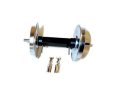
Not an issue with LGB 67403 Ballbearing Wheel Sets with power pick ups (or similar).
maxi-model
UK/US/ROW steam narrow gauge railways 1:1
Are they a standard fitment on LGB rtr or an extra cost item ? I have both plastic and brass Accucraft J&S cars. The brass have similar ball bearing wheelset/pick up arrangements, the plastic are plain bearing/ copper wipers on wheelbacks.Not an issue with LGB 67403 Ballbearing Wheel Sets with power pick ups (or similar).
View attachment 362722
Not a standard LGB fitments except some coaches, the Pullmans certainly had ball bearing wheels, well the 4 I once had did.Are they a standard fitment on LGB rtr or an extra cost item ? I have both plastic and brass Accucraft J&S cars. The brass have similar ball bearing wheelset/pick up arrangements, the plastic are plain bearing/ copper wipers on wheelbacks.
Similar threads

- Replies
- 25
- Views
- 1K


- Replies
- 41
- Views
- 1K

- Replies
- 15
- Views
- 1K
- Replies
- 9
- Views
- 704

