
Electronics Question - gaining more capacitor oomph

viaEstrecha

Spanish metre gauge in G scale (on the cheap)
Country flag
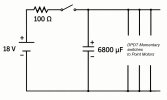
My understanding of electronics is embarrassingly weak - I'm hoping someone who knows about these things can help. Here is my homemade capacitor discharge unit, gleaned from the internet, which works reasonably well but I'm sure could be made to put out a touch more clout (pulse) to LGB EPL drives. Is there anything to be gained by either increasing the source voltage, or using a bigger capacitor, without frying the point motors? The capacitor I've used has a working voltage (?) marked 35V, and I could crank the input voltage up to 24V DC with my existing adapter, though I've not dared so far!rdm_cdu.jpg
 
Oh in my 0 gauge days I used a thousands power capacitor discharge setup with a circuit from Railway Modeller, but this was for old style motors certainly not EPL ones.it needd this amount of power to do a Diode Matrix Route selection system where up to 5 or so HnM type of motors could be thrown at once.
 
It's a t=CxR circuit, so 0.68 sec pulse.

The next capacitor size up would be 10000 uF which would give you 1 second. The voltage is fixed at 18V so that wouldn't fry you motors.

I think you may have the resistor and capacitor transposed on your diagram....
 
It's a t=CxR circuit, so 0.68 sec pulse.

The next capacitor size up would be 10000 uF which would give you 1 second. The voltage is fixed at 18V so that wouldn't fry you motors.
Would leaving the voltage unchanged and putting a second identical 6800μF capacitor in parallel give a usefully better pulse (presumably 1.36s)? I have one in stock and that would avoid forking out for a new one. Performance of more distant motors is the issue so a longer pulse seems very worth trying.
 
Would leaving the voltage unchanged and putting a second identical 6800μF capacitor in parallel give a usefully better pulse (presumably 1.36s)? I have one in stock and that would avoid forking out for a new one. Performance of more distant motors is the issue so a longer pulse seems very worth trying.
I believe it would when in parallel. Definitely not in series. Effectively like 2 batteries in the same configuration.....


Give it a go....
 
I believe it would when in parallel. Definitely not in series. Effectively like 2 batteries in the same configuration.....


Give it a go....
Thanks, Gizzy - sounds like plan. I noticed the Gaugemaster CDU and a fella on YouTube both use a pair of capacitors too.
 
LGB points motors are just that motor, not solenoids as in other gauges, 18 ac should work fine without CD.
 
Thanks, Gizzy - sounds like plan. I noticed the Gaugemaster CDU and a fella on YouTube both use a pair of capacitors too.
When using LGB or Massoth point decoders, it is possible to program the pulse for longer, which is useful for driving pairs of motors on a crossover. I can't remember how long but 1.2 sec seems to be in my mind.

Your analogue method should work likewise.

As JimmyB says, the LGB point motor is a actually a motor, turning for 180 degrees, and not a solenoid as used on the smaller scales....
 
but I'm sure could be made to put out a touch more clout (pulse) to LGB EPL drives.

The EPL drives are low current devices so using a Capacitor Discharge Unit is pretty much a pointless excercise. If you are having problems 'throwing' an EPL drive, you need to look for mechanical issues in the point assembly.

The EPL drive is design to throw reliably on half-wave 16v AC.... and also not to burnout if current is continuously applied. The energy involved is minimal.
 
The EPL drives are low current devices so using a Capacitor Discharge Unit is pretty much a pointless excercise. If you are having problems 'throwing' an EPL drive, you need to look for mechanical issues in the point assembly.

The EPL drive is design to throw reliably on half-wave 16v AC.... and also not to burnout if current is continuously applied. The energy involved is minimal.
Possibly also a good clean up inside the motor as well.
 
Back
Top Bottom