You are using an out of date browser. It may not display this or other websites correctly.
You should upgrade or use an alternative browser.
You should upgrade or use an alternative browser.
Drag/Inertia Car
- Thread starter Fred2179G
- Start date


Fred2179G
Registered

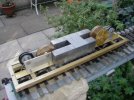
This is the DJB version, as you described it!I also reached out to Paul Bailey about David's mega-inertia wagon purely because i was interested in the design but it sounds as though that has long since gone. I still have a picture of it - belt driven dual flywheels from articulated bogies, one flywheel had a fan and it required a strong engine to pull it

DGE-Railroad
The Orchard Line

That's the fella!
and here's Dennis' version I was going to try and emulate. I think I'll need a lathe first though, to manufacture the platter spindle and arm adjuster
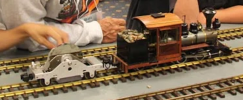
and here's Dennis' version I was going to try and emulate. I think I'll need a lathe first though, to manufacture the platter spindle and arm adjuster

beavercreek
Travel, Art, Theatre, Music, Photography, Trains
Because I have tortuous gradients on my line (peaking at about 1:12) I always wanted to find a system of holding back the coaches/cars on the downslope.
But I did not want any more drag going up the hills.
Back in 2006 when I first built the railroad I saw an inertia car on a railway that I visited and it operated very well indeed but great as it was on a level layout, on mine it would just cause far more problems climbing the hills.
My layout is both DCC and DC (not at the same time!) and I run R/C battery and live steam.
As I was multi-heading for long trains ( when using DC) I found that by finding the slowest loco and putting that towards or at the rear of the cars, it worked really well on holding back the train on the downward slope and then, even though it was the slowest, it still added some oomph on climbing as the forward loco(s) would slow up a bit taking up the strain of the train.. (with DCC I could 'make' one loco slightly slower by adjusting the CV).
But I still wanted single steam-loco running with a decent number of cars behind, so I built motorised freight or passenger cars and placed into the string of cars to help the single loco.
The motorised cars were just a smidge slower than the loco so they also stopped the force on it when going down hill.
But when running live steam I have relied on R/C geared locos like Shays, Climaxes and a Heisler to haul the trains on their own on the challenging layout, ironically, as the prototype was designed to do.
Sometimes I double head the live steamers to haul longer trains.
I thought of making R/C battery motorised freight/passenger cars to enable a single rod-driven live steam loco to climb the gradients but controlling the balance for the battery 'helper/retarder' car(s) and the live steam loco might need some very quick thinking and concentrated handling of the R/C transmitter(s).
Maybe that might be the way to go...
But I did not want any more drag going up the hills.
Back in 2006 when I first built the railroad I saw an inertia car on a railway that I visited and it operated very well indeed but great as it was on a level layout, on mine it would just cause far more problems climbing the hills.
My layout is both DCC and DC (not at the same time!) and I run R/C battery and live steam.
As I was multi-heading for long trains ( when using DC) I found that by finding the slowest loco and putting that towards or at the rear of the cars, it worked really well on holding back the train on the downward slope and then, even though it was the slowest, it still added some oomph on climbing as the forward loco(s) would slow up a bit taking up the strain of the train.. (with DCC I could 'make' one loco slightly slower by adjusting the CV).
But I still wanted single steam-loco running with a decent number of cars behind, so I built motorised freight or passenger cars and placed into the string of cars to help the single loco.
The motorised cars were just a smidge slower than the loco so they also stopped the force on it when going down hill.
But when running live steam I have relied on R/C geared locos like Shays, Climaxes and a Heisler to haul the trains on their own on the challenging layout, ironically, as the prototype was designed to do.
Sometimes I double head the live steamers to haul longer trains.
I thought of making R/C battery motorised freight/passenger cars to enable a single rod-driven live steam loco to climb the gradients but controlling the balance for the battery 'helper/retarder' car(s) and the live steam loco might need some very quick thinking and concentrated handling of the R/C transmitter(s).
Maybe that might be the way to go...
Last edited:

In the latest 16mm Society Mag for August 2020 there is an article by a guy that has made working Wagon Brakes using a Servo to operate them. Looks like a possible candidate though it would need to be on any Train worked by an itinerant uncontrollable live steamer or those going down tight gradients.

tac foley
Registered
Smoly Hoke!!!!! Me, I just drive my steam locos slower. Hauling THAT behind any of my locos would have me reaching for the eye bleach post haste.
DGE-Railroad
The Orchard Line
lol. David knocked it up when he was building and testing a big batch of large (K27? I don't recall..) live steam locos, and needed something to save sticking a load of rolling stock behind them all every time he wanted to do some testing.
I don't think he was fussed about how it looked
I don't think he was fussed about how it looked
Hm but you try shunting with a Roundhouse without a SloMo, pretty near impossible.Smoly Hoke!!!!! Me, I just drive my steam locos slower. Hauling THAT behind any of my locos would have me reaching for the eye bleach post haste.
tac foley
Registered
Hm but you try shunting with a Roundhouse without a SloMo, pretty near impossible.
Well, actually, I can shunt perfectly with my one and only Roundhouse loco - it's a battery r/c 'Harlech Castle'.
Ok Roundhouse Puffer, not sure you would invest a lot of dosh on a SloMo for a RH dismal.Well, actually, I can shunt perfectly with my one and only Roundhouse loco - it's a battery r/c 'Harlech Castle'.
That is also my thoughts about my Russell that is a very untamed beast, but I know that a SloMo will tame it. Just need to get my act together and order another one.I have considered ripping all that dangerous gas, and flame, and steam under pressure, out of one of these...
Then fitting an electric motor, and a pile of Lithium batteries!So much safer..


Rhos Helyg Loco Works
Registered
10-15psi, gas turned w-a-y down ... opinion is divided.Hm but you try shunting with a Roundhouse without a SloMo, pretty near impossible.
Hm but it still runs away uncontrolled even on a simple run between stations. Needs a serious look at and a SloMo.10-15psi, gas turned w-a-y down ... opinion is divided.
In all seriousness I think the regulator arm is rubbing against the poker and this is not helping, another of those round to it jobs that are less interesting then Battery Conversions.? Heavy water ? - Bit of weight, to slow it down, perhaps?
Similar threads

- Replies
- 18
- Views
- 1K


- Replies
- 3
- Views
- 650
