You are using an out of date browser. It may not display this or other websites correctly.
You should upgrade or use an alternative browser.
You should upgrade or use an alternative browser.
16mm and G gauge
- Thread starter Colin2897
- Start date


Gizzy
A gentleman, a scholar, and a railway modeller....

Welcome to the forum.
G is usually 1:22.5 in scale and 45mm track, representing metre gauge. There are other scales from 1:22 - 1:32 running on the same track.
16mm is on both 32mm and 45 mm, representing 2 and 3 ft gauge and is 1:19 Scale.
In essence, they are close enough for anyone with metre gauge and 3 ft to run both together....
G is usually 1:22.5 in scale and 45mm track, representing metre gauge. There are other scales from 1:22 - 1:32 running on the same track.
16mm is on both 32mm and 45 mm, representing 2 and 3 ft gauge and is 1:19 Scale.
In essence, they are close enough for anyone with metre gauge and 3 ft to run both together....

Doddy
Registered
GAUGE VERSUS SCALE
Gauge is the distance between the rails of the track in the scale chosen. Scale is the proportion of the model to the full-size item. Therefore, 4mm:1ft scale should be more correct in describing a layout, whereas OO gauge should really only refer to the track gauge.
Gauge is the distance between the rails of the track in the scale chosen. Scale is the proportion of the model to the full-size item. Therefore, 4mm:1ft scale should be more correct in describing a layout, whereas OO gauge should really only refer to the track gauge.

maxi-model
UK/US/ROW steam narrow gauge railways 1:1
A more complicated interpretation. Max's War and Peace time. Just a personal opinion. Settle back.
"G" is not a gauge, or a scale for that matter. However, it is usually a general "catch all" description applied to loco's and rolling stock built to run on 45 mm gauged track systems that use a chunky "code 332" rail (= rail height 332 thou"). Like LGB's , Bachmann's, USATrains' and other compatible makes.
Models built to operate on this type of 45 mm gauged track can usually be anything from 1:13 to 1:32 in scale. These scales can be expressed either as a ratio, e.g. 1:19.3 or as so many mm or fractions of inches needed to express a linear foot modeled, e.g 16 mm (to the foot) which as a ratio = 1:19.3, what a coincidence. The latter expression here is used for ease and its accuracy. Scales can also be represented by a letter, in the US primaraly, e.g. F = 1.20.3, which = 15mm to the foot. This letter can be applied to any gauge of 1:1 prototype for scaling. A letter type scale definition can then be followed "n" to denote a narrow gauge prototype being represented and then numerals to denote this prototype's actual track gauge, e.g. 3 for 3ft, e.g. Fn3 = a 15mm scale model of a prototype that runs on 3ft gauge track.
It should be noted that a model running on 45 mm gauged track may not have a scale correct gauge represented by the model, even though a scale and gauge is quoted. Infuruating, isn't it ?
Whereas, 16mm is not a track gauge, at least in garden rail terms as used here. It's a scale, see above. It is a recognised scale too, generally used to model locos and stock, in it's purest and originaly intended form, that would have run on 2 ft gauged track. As a result the correct track system for these models is 32mm (2 × 16mm to 1ft = 32mm). And a lot less chunkier rail. See above for this scale's definition.
However, the 16mm scale product manufacturers wanted to maximise sales and so made their items available to run on not just 32mm track systems but 45mm too. There are a lot more 45mm track based layouts and buyers about. So most product sold as "16 mm scale" is actually supplied gauge adjustable or ready set to work with either 32mm or 45mm gauges. But not all popular narrow gauge railways, in the UK and its former colonies were 2ft. And as a result the hobbyists wanted models of those that ran on diifferent narrow gauges, within reason, too. So,16 mm is a scale that is now used to represent anything from 2ft - 3ft gauged prototypes. To cap it all a lot of "16mm scale" products have no real life prototype, they are a figment of someone's imagination, so they are known as "freelance" models. You will see the term SM32 and SM45 bandied about, SM = 16 mm, nominal scale model built to, the numerals 32/45, the track gauge in mm they are built for. So you could have a model a 3ft gauged prototype, that would normally be reproduced in 15 mm scale to be true to guage at 45 mm, refered to as Fn3, actually modelled in 16mm that woulld be defined as SM45. Help !
It follows that "16 mm Scale" is as much a misnomer as "G Gauge" is, its all a scam to get us punters to shell out £€$'s. P.S. 16 mm scale is a British thing really, the Europeans use 1:22.5 mostly for similarly narrow gauged prototypes.
Confusing, infuriating ? Yes, catches us all out. Depends on how much of a purist you want to be and where you are coming from. Me ? I run Fn3 and 16mm scaled models, of actual prototypes (with one or two exceptions) all on 45 mm gauged LGB type track. And relax ! Max
"G" is not a gauge, or a scale for that matter. However, it is usually a general "catch all" description applied to loco's and rolling stock built to run on 45 mm gauged track systems that use a chunky "code 332" rail (= rail height 332 thou"). Like LGB's , Bachmann's, USATrains' and other compatible makes.
Models built to operate on this type of 45 mm gauged track can usually be anything from 1:13 to 1:32 in scale. These scales can be expressed either as a ratio, e.g. 1:19.3 or as so many mm or fractions of inches needed to express a linear foot modeled, e.g 16 mm (to the foot) which as a ratio = 1:19.3, what a coincidence. The latter expression here is used for ease and its accuracy. Scales can also be represented by a letter, in the US primaraly, e.g. F = 1.20.3, which = 15mm to the foot. This letter can be applied to any gauge of 1:1 prototype for scaling. A letter type scale definition can then be followed "n" to denote a narrow gauge prototype being represented and then numerals to denote this prototype's actual track gauge, e.g. 3 for 3ft, e.g. Fn3 = a 15mm scale model of a prototype that runs on 3ft gauge track.
It should be noted that a model running on 45 mm gauged track may not have a scale correct gauge represented by the model, even though a scale and gauge is quoted. Infuruating, isn't it ?
Whereas, 16mm is not a track gauge, at least in garden rail terms as used here. It's a scale, see above. It is a recognised scale too, generally used to model locos and stock, in it's purest and originaly intended form, that would have run on 2 ft gauged track. As a result the correct track system for these models is 32mm (2 × 16mm to 1ft = 32mm). And a lot less chunkier rail. See above for this scale's definition.
However, the 16mm scale product manufacturers wanted to maximise sales and so made their items available to run on not just 32mm track systems but 45mm too. There are a lot more 45mm track based layouts and buyers about. So most product sold as "16 mm scale" is actually supplied gauge adjustable or ready set to work with either 32mm or 45mm gauges. But not all popular narrow gauge railways, in the UK and its former colonies were 2ft. And as a result the hobbyists wanted models of those that ran on diifferent narrow gauges, within reason, too. So,16 mm is a scale that is now used to represent anything from 2ft - 3ft gauged prototypes. To cap it all a lot of "16mm scale" products have no real life prototype, they are a figment of someone's imagination, so they are known as "freelance" models. You will see the term SM32 and SM45 bandied about, SM = 16 mm, nominal scale model built to, the numerals 32/45, the track gauge in mm they are built for. So you could have a model a 3ft gauged prototype, that would normally be reproduced in 15 mm scale to be true to guage at 45 mm, refered to as Fn3, actually modelled in 16mm that woulld be defined as SM45. Help !
It follows that "16 mm Scale" is as much a misnomer as "G Gauge" is, its all a scam to get us punters to shell out £€$'s. P.S. 16 mm scale is a British thing really, the Europeans use 1:22.5 mostly for similarly narrow gauged prototypes.
Confusing, infuriating ? Yes, catches us all out. Depends on how much of a purist you want to be and where you are coming from. Me ? I run Fn3 and 16mm scaled models, of actual prototypes (with one or two exceptions) all on 45 mm gauged LGB type track. And relax ! Max
maxi-model
UK/US/ROW steam narrow gauge railways 1:1
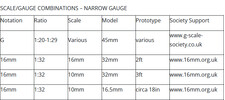
Something apears to have gone horribly wrong with your table Doddy. I cannot make sense of if apart from first line across, for G. Also, G Scale Society support 16mm scale and larger operators, track, battery/rc and live steam/rc. Likewise 16 mm NGM support 45mm track gauge operators and models below 16mm scale - 15mm and European 13.55mm. Primaraly battery/live steam/rc, but also those running track power. Sorry. MaxGAUGE VERSUS SCALE
Gauge is the distance between the rails of the track in the scale chosen. Scale is the proportion of the model to the full-size item. Therefore, 4mm:1ft scale should be more correct in describing a layout, whereas OO gauge should really only refer to the track gauge.
View attachment 354139

Rhos Helyg Loco Works
Registered
A lot of us take the view that anything "G" is what other people do and best avoided. 

Now, now, Tony...A lot of us take the view that anything "G" is what other people do and best avoided.


PhilP.

korm kormsen
Registered

"G" originally meant Groß and/or Garten (big/Garden) by the german Lehmann company, that created LGB.
(LGB originally = 1 metre narrow gauge trains in a scale of about 1:22.5 resulting in 45mm Gauge)
in the english speaking world it degraded to a "catch all" denomination for everything bigger than "O-scale".
16 (or any other number) mm (milimetres) per foot we have to thank the Brits for.
when they changed from Imperial to metrics, they decided to use & mix them both...
(LGB originally = 1 metre narrow gauge trains in a scale of about 1:22.5 resulting in 45mm Gauge)
in the english speaking world it degraded to a "catch all" denomination for everything bigger than "O-scale".
16 (or any other number) mm (milimetres) per foot we have to thank the Brits for.
when they changed from Imperial to metrics, they decided to use & mix them both...
maxi-model
UK/US/ROW steam narrow gauge railways 1:1
Yes, and the 15mm per foot scale is a direct corrolation that suits 3 ft gauge prototypes on 45 mm track too - 15mm x 3 (feet) = 45 mm, handy ! Hence all those "Colorado Circle" (D&RGW, etc'), logging locos and stock that Accucraft, Bachmann and a few artisan makers, like Hartford and Rio Grande UK have created and sold over the years. I have a few, ahem."G" originally meant Groß and/or Garten (big/Garden) by the german Lehmann company, that created LGB.
(LGB originally = 1 metre narrow gauge trains in a scale of about 1:22.5 resulting in 45mm Gauge)
in the english speaking world it degraded to a "catch all" denomination for everything bigger than "O-scale".
16 (or any other number) mm (milimetres) per foot we have to thank the Brits for.
when they changed from Imperial to metrics, they decided to use & mix them both...
It is also handy that 16mm per foot scale directly translates 2'6" gauge to.......45mm. Which is very nice if you are a fan of the Welshpool & Llanfair Light Railway. 16mm scale would be too for reproducing the 760 mm gauged Zillertalbahn stock, which the W&LLR borrowed from recently, but then those pesky European's don't get 16mm, do they. Just saying Roundhouse, I've got the Lineside Delight coaches ready and waiting. As Korm points out 16mm scale is a bit if a Brit thing. Glad I got that off my chest
Lineside Delight's(ful) Zillertalbahn 16mm scale coach kit, built. Sadly out of production now. I have an LGB Zillertal #2, but it's 1:22.5/13.55 mm scale (sort of)
 Before anyone says, there was a live steam Beck made 16mm scale "U Class" that some of the Zillertal locos are based on. I suppose I ought to pose them together to illustrate the issue. I'll get over this, honest.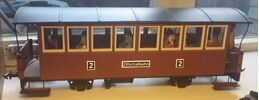

Hm metrification is a complex subject and mandatory for sundry goods did not apply till sometime after 1973, however we have almost always used metric and imperial to describe our UK scales, i well remember when I got into TT3 ( in the early 60’s) where it was described as 3mm to the foot. And that kind of description was around since my awareness of Model Railway scales going back to the early 50’s. Scale and gauge is an extremely complex subject easily confused, as noted by the amount of times that this subject gets raised in the forum and the posts it generates."G" originally meant Groß and/or Garten (big/Garden) by the german Lehmann company, that created LGB.
(LGB originally = 1 metre narrow gauge trains in a scale of about 1:22.5 resulting in 45mm Gauge)
in the english speaking world it degraded to a "catch all" denomination for everything bigger than "O-scale".
16 (or any other number) mm (milimetres) per foot we have to thank the Brits for.
when they changed from Imperial to metrics, they decided to use & mix them both...

Metrication in the United Kingdom - Wikipedia
Have a look round seee if there's a G Scale group local to you, I believe theres a 16mm group close , try the 16mm Association website. Note that 16mm people tend to use battery power or live steam, not track power. And despite what peoplecsay, 32 and 45mm modellers tend to get on really well!
Here in south wales, the Bridgend 16mm local group get on really well together, and our MES garden railway has both 32 and 45mm track to keep everyone happy. (We also seem to have most gauges from 3mm up to 7¼" on the MES site). The only time I have known a group fight was a few years ago, when the local G gauge society group had a split, but I never found out what caused it. just half the members stopped receiving emails about club things. I couldn't be bothered to get involved with the politics of it so just did not renew our membership, we also moved house not too long after as well. I assume they have sorted themselves out now as I see they are doing an exhibition this year. There does seem to be a tendency for 16mm to run battery or steam, but not all, and the G gauge group above ran track power, battery, and live steam on the club layout. I have never run track power in the garden, it just seems to be asking for trouble, but I do know friends who do. Battery technology has moved on an awful lot in the thirty years we have running in our garden, and even my first garden railway 60 years ago was not track powered, (maybe I get my attitudes from my dad). Anyway, however you run your trains, have a good day. David.Have a look round see if there's a G Scale group local to you, I believe theres a 16mm group close , try the 16mm Association website. Note that 16mm people tend to use battery power or live steam, not track power. And despite what peoplecsay, 32 and 45mm modellers tend to get on really well!
Similar threads

- Replies
- 10
- Views
- 379

- Replies
- 60
- Views
- 3K


- Replies
- 26
- Views
- 2K