The Claptowte Railway - One For You Old Buffers

David1226

Registered
Country flag
The Claptowte Railway was always intended, from concept, to be a Freelance British Outline railway. To that end, when looking for buffer stops, for the various sidings, I chose a rail and timber built item produced by Garden Railway Supplies (GRS) as they were very much in keeping with a British railway. Having lately decided to alter the whole design and concept of the Claptowte Railway these buffer stops would no longer be suitable as nothing on the base boards could be above rail height.
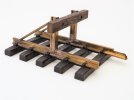
dig 200711001.JPG

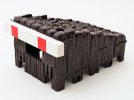
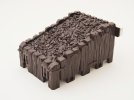
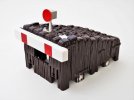
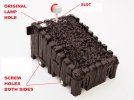
I decided to go with the LGB sleeper built buffer stop, being relatively inexpensive second hand, and could be clipped and unclipped from the rails, as required. The LGB buffer stop used to be offered unlit or with a working lamp powered from the track. The moulding was identical in both cases, only the working lamp being the extra item. This means that on the unlit version there are screw holes on each side, at rail height, and a hole on top where the working lamp would fit. There is also a small slot on top of the ballast, the purpose of which eludes me. I have no need of working lamps as all accessories on the layout are purely scenic and need to be removable.
dig 200711002.JPG

dig 200711003.JPG

I unclipped the white/red buffer beam to assist with painting. At the same time I scored the top, bottom and end surfaces of the beam, by drawing the teeth of a razor saw across the surface, in order to impart a wood grain effect, where there was none previously. I then filled in all the extraneous holes. The only filler I had to hand was a tube of grab adhesive for fixing skirting boards. This worked fine, but beware, it does shrink slightly, so will probably need two fills.

I drilled a new hole centrally above the buffer beam to take a dummy lamp of my own design. The body of the lamp is a short section of square tube, blocked off at the rear. with an off cut of plasticard, and at the front with a marker disc The marker disc is an old tiddley wink game counter, redundant as it’s now a long time since I’ve tiddled my wink, or winked my tiddle.
dig 200711004.JPG

dig 200711005.JPG

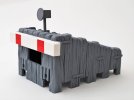
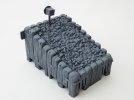
The body and dummy lamp were given a spray of Halfords grey plastic primer. The grey primer forms the base colour for the ballast top.
dig 200711006.JPG

dig 200711007.JPG

As with the majority of my modelling the biggest transformation is brought about with the humble paintbrush.

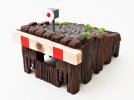
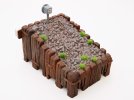
The finishing touches are to add a red 5mm self adhesive gem to the centre of the marker disc to simulate the lamp lens. When the light catches it just right, it looks as if it’s lit. I printed a location identification sign to attach to the rear of the lamp housing. The numbering system was devised by the line’s Chief Mechanical Engineer, oh, hang on, that’s me. Finally some tufts of 4mm spring grass were added to the old ballast. These tufts are produced by a company called Serious Play, located in Cornwall, UK, and bought on Evilbay.
dig 200711008.JPG

dig 200711009.JPG

David
 
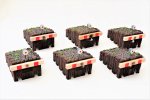
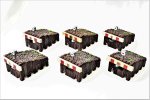
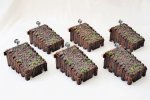
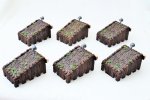
The stage photos of the updated buffer stops were taken using the last of six buffers, the other five having been completed previously. now all six are finished. Two each for Gernise End, Goudes Sidings and Phidell Yard.

dig 200729001.JPG

dig 200729002.JPG

dig 200729003.JPG

dig 200729004.JPG

David
 
I've been handling these buffer stops for a couple of decades...and never noticed the iron strappings before.....which your highlighting has highlighted!

Malcolm
 
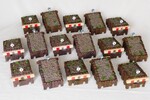
At the time that I modified the above buffer stops, the track plan that I intended to create only required six buffer stops. As the design of the layout has evolved , I find that I needed sixteen buffer stops. Over a period of time, I acquired another ten buffer stops, and altered them to match the original six. here is a pic of the completed sixteen.

dig 240207001.JPG

David
 
The Claptowte Railway was always intended, from concept, to be a Freelance British Outline railway. To that end, when looking for buffer stops, for the various sidings, I chose a rail and timber built item produced by Garden Railway Supplies (GRS) as they were very much in keeping with a British railway. Having lately decided to alter the whole design and concept of the Claptowte Railway these buffer stops would no longer be suitable as nothing on the base boards could be above rail height.

View attachment 269912

I decided to go with the LGB sleeper built buffer stop, being relatively inexpensive second hand, and could be clipped and unclipped from the rails, as required. The LGB buffer stop used to be offered unlit or with a working lamp powered from the track. The moulding was identical in both cases, only the working lamp being the extra item. This means that on the unlit version there are screw holes on each side, at rail height, and a hole on top where the working lamp would fit. There is also a small slot on top of the ballast, the purpose of which eludes me. I have no need of working lamps as all accessories on the layout are purely scenic and need to be removable.

View attachment 269916

View attachment 269917

I unclipped the white/red buffer beam to assist with painting. At the same time I scored the top, bottom and end surfaces of the beam, by drawing the teeth of a razor saw across the surface, in order to impart a wood grain effect, where there was none previously. I then filled in all the extraneous holes. The only filler I had to hand was a tube of grab adhesive for fixing skirting boards. This worked fine, but beware, it does shrink slightly, so will probably need two fills.

I drilled a new hole centrally above the buffer beam to take a dummy lamp of my own design. The body of the lamp is a short section of square tube, blocked off at the rear. with an off cut of plasticard, and at the front with a marker disc The marker disc is an old tiddley wink game counter, redundant as it’s now a long time since I’ve tiddled my wink, or winked my tiddle.

View attachment 269918

View attachment 269919

The body and dummy lamp were given a spray of Halfords grey plastic primer. The grey primer forms the base colour for the ballast top.

View attachment 269920

View attachment 269921

As with the majority of my modelling the biggest transformation is brought about with the humble paintbrush.

The finishing touches are to add a red 5mm self adhesive gem to the centre of the marker disc to simulate the lamp lens. When the light catches it just right, it looks as if it’s lit. I printed a location identification sign to attach to the rear of the lamp housing. The numbering system was devised by the line’s Chief Mechanical Engineer, oh, hang on, that’s me. Finally some tufts of 4mm spring grass were added to the old ballast. These tufts are produced by a company called Serious Play, located in Cornwall, UK, and bought on Evilbay.

View attachment 269922

View attachment 269923

David
Hi, what colour paints did you use please.
Kind regards
Josh
 
Hi, what colour paints did you use please.
Kind regards
Josh
Josh
I use enamel paints by both Humbrol and Precision Paints for the railway colours. The model was first sprayed with matt grey plastic primer, Halfords, or similar. The buffer woodwork would have been given a base coat of Precision Paints track colour (any suitable brown would do). I then overpainted some of the individual sleepers, in a random fashion, with the same colour either darkened with matt black, or lightened with matt white Humbrol. the metal strapping was then picked out in a rust colour. The grey primer of the ballast was then given a wash over with very thinned out track colour. The lamps were done with Precision Paints LMS Freight Grey, which I had to hand, it being the standard colour for the Claptowte Railway freight stock.

David
 
Thanks David , what’s track colour ?
Kind regards
Josh
Gungy, rusty brown that collects on the side of the rails. You’ve never seen shiny brass, or nickel silver, rail in the real world.

David
Is it my eyesight, or are there different sizes of buffer stops in the extra 10?
It’s your eyesight, all standard LGB buffer stops.

David
 
As David says, but most Garden Railway track will achieve a satisfactory colour once out side for a while, the only one to not always manage that was some of the heavily brassed Aristocraft Track oh and of course any Stainless Steel or Ally but we see few of these, though LGB and I think some others did Stainless.
 
As David says, but most Garden Railway track will achieve a satisfactory colour once out side for a while, the only one to not always manage that was some of the heavily brassed Aristocraft Track oh and of course any Stainless Steel or Ally but we see few of these, though LGB and I think some others did Stainless.
In the beginning the LGB founder brothers manufactured a battery powered train set with stop/go achieved by a side lever switch and signal contact, all very mechanical . The track was 30 cm straights and 30 degree radius 1 with the standard brown plastic ties with nickel plated aluminium metal rails. These rails were compatible with the original brass track being electrically conductive. But after a couple of years total black plastic track was substituted in these introductory toy sets.
Unfortunately after a short time the nickel plating flacked off, leaving a mess on the kids’ playroom floor. But it was a good robust toy mixing well with the emerging Playmobil houses and ‘clicky’ figures.
My children shared a couple of sets around the sandpit and I also gave a set to my two nephews.
I still have samples of the track (used for display of locos) and the “Spremberger” DR 995001 derived battery loco and two red tipper and yellow open trucks and passenger open sideseating cars. LGB still produces similar wagon items for the field railway series.
 
Last edited:
The above has nothing to do with modifying buffer stops. If you wish to start a thread on types of track, please start your own, but it’s not relevant to this thread.

David
 
Back
Top Bottom