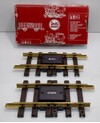
Question on LGB 10151 reversing loop kit.

blk69

Registered
Country flag
Hello. Concidering adding 2 reversing loops on a new outdoor layout, track powered. See LGB has a kit, one isolation section, a second isolation section you install some diodes in. Seams fairly straight forward to me. I am questioning what happons to an engine when it come to one of these sections with opposite polarity, some of the engine contacts are one one side of the isolator (say left rail is positive) and others on the other side (say right rail is positive). Wouldn't this cause a electrical short?

Only way I see thru this is if the engine can coast thru the isolator and then all contracts would be on rails of same polarity. What happons when engine is traving slow, how does it not sort out or just stop? What am I missing?
 
As this is analogue kit, you have to stop your train in the loop between the isolated breaks, then reverse the direction of your controller.

Make sure your loop is longer than your longest train, especially with metal wheeled rolling stock.

I had 3 of these in my analogue days, before I went to digital....
 
Last edited:
the point is, that your fear never happens. because of the time factor.
when the locomotive passes the first isolation, there is no change of plus and minus.
while the locomotive is in between the two isolations it always got the same direction - thanks to the diodes.

while the locomotive is in between the two isolations, the direction must be changed * - but stays the same in the section.
because the direction has changed on the mainline, at passing the second isolation there is no change of direction.

*) by hand or automatic.
 
I don't recall having to change direction at the transformer, when I had track power and also had the reverse loop track sections installed.
 
I don't recall having to change direction at the transformer, when I had track power and also had the reverse loop track sections installed.
You don't..

Because (in effect) you are swapping track-polarity, and motor-polarity.

So track is reversed, but so is the motor..

Which ever direction you put the loco on the track, controller 'forwards' is always forwards.

PhilP.
 
I had an analogue reverse loop on my line in Hertford. I always went round the same way changing the switch when the train was in motion and remembering to change it back after the train passed the last isolator. You could of course do this the other way with the next train etc. Then back to what happened with the first train but Inreckon this could get confusing with 2 loops thus always going the same way round each loop would make life much easier. There is/was an LGB set to do the diodes thing available.

Of course DCC makes things much simpler, but at the cost of converting locomotives to DCC, DCC controller and Revers Loop modules.
 
might it be, that you had two reed contacts (in each loop one) and an electric point motor with the additional switch to change polarity?
Yes, I did have both comment track sections in each reverse loop. And the train always entered the loop in the same direction, because I used a sprung turnout. It's been a long time since I had track power, but wasn't one of the component track sections marked with a "T", while the second section was marked with another letter. I have to get my brain cells to think harder, but that hurts.....:rofl:
 
one of the component track sections marked with a "T", while the second section was marked with another letter.
yes. entering the loop was/is the "T" section. "T" for Trennung (separation) before leaving the loop is the "K" section (i don't remember, what the "K" stands for) which contains the diodes to make sure, that the current always goes in the same direction.
 
but wasn't one of the component track sections marked with a "T", while the second section was marked with another letter. I have to get my brain cells to think harder, but that hurts.....:rofl:

1015 T = isolation breaks in both rails, with terminal connections to rail sections.
1015 U = isolation break is one rail only, the other rail is continuous, with terminal connections to rail sections.
1015 K = a 1015T section with diodes installed for reverse loop operation (normally sold with a 1015T as a set)

IMG_4981.jpeg
 
When I did my reverce loop in Hertford I was pretty naive re LGB and not aware of the 1015 setup so made my own equivalent with Isolating fishplates and chunky Diodes, much bench testing to get it right!
 
I experienced something similar. In the early '90s, when I made the transition from Lionel "O" gauge to LGB, I knew nothing about LGB's EPL System. For the first few years in large scale my mentality was still with AC operated trains with three rails. LGB's well engineered system simply was penetrating my skull. I don't recall how it happened, but it was like a light bulb lit up in my brain. All of a sudden I understood the EPL system.....:clap:
 
Back
Top Bottom