Open-Source 3D-Printed G-Scale Rail Bender

peterpavuk

Registered
Country flag
United-Kingdom
I have considered to purchase a rail bender for a long time, but i find prices of commercial solutions unfriendly. So I found well-known GitHub - PRouzeau/Garden-train-G-track-bender: 3D printed Garden train "G" track bender and decided to give it a go.

Printed on Bambu H2S in PETG, 100% density, 5 walls everywhere. Hardware (BOM is on github too) come from amazon at a cost about £30. Could be got cheaper offline - but I just don't have a decent hardware store anywhere near.

I have filmed assembly and operation - and so far I am satisfied - it does it's job perfectly well. Can't comment on longevity - but worst case scenario I can re-print it in ASA filament - that will make it much stronger.

Here is a footage of assembly and operation.

 
I have considered to purchase a rail bender for a long time, but i find prices of commercial solutions unfriendly. So I found well-known GitHub - PRouzeau/Garden-train-G-track-bender: 3D printed Garden train "G" track bender and decided to give it a go.

Printed on Bambu H2S in PETG, 100% density, 5 walls everywhere. Hardware (BOM is on github too) come from amazon at a cost about £30. Could be got cheaper offline - but I just don't have a decent hardware store anywhere near.

I have filmed assembly and operation - and so far I am satisfied - it does it's job perfectly well. Can't comment on longevity - but worst case scenario I can re-print it in ASA filament - that will make it much stronger.

Here is a footage of assembly and operation.

Very good demo, often forgotten that a railbender also unbends as you say. A use for all those unwanted R1 curves to turn them into straights, once the clipped in railjoiners are removed as you have 1 rail can be taken from each of 2 curves to make to slightly different straight sections if that is required, or as in your case replicating a larger curve. You should have them in the shoos for Easter!
 
Very good demo, often forgotten that a railbender also unbends as you say. A use for all those unwanted R1 curves to turn them into straights, once the clipped in railjoiners are removed as you have 1 rail can be taken from each of 2 curves to make to slightly different straight sections if that is required, or as in your case replicating a larger curve. You should have them in the shoos for Easter!
Yeah, these r1 - no one wants them. I have tons of them, bough several startsets at some point.
 
A use for all those unwanted R1 curves to turn them into straights, once the clipped in railjoiners are removed as you have 1 rail can be taken from each of 2 curves to make to slightly different straight sections if that is required, or as in your case replicating a larger curve.
i do use the inner, shorter rails of R1 curves for straights. - that results in straights of exactly the same length as the original straights.
the outer, longer rails i use, instead of flex-track, for various curves as needed.
(i used to cut them to needed length, but now i just stagger the joints. that makes for less "kinky" curves. and i have to cut rails only once at the end of a longer curve)


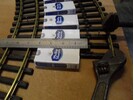
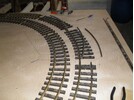
bending02.JPGtrack02.JPG
 
i do use the inner, shorter rails of R1 curves for straights. - that results in straights of exactly the same length as the original straights.
the outer, longer rails i use, instead of flex-track, for various curves as needed.
(i used to cut them to needed length, but now i just stagger the joints. that makes for less "kinky" curves. and i have to cut rails only once at the end of a longer curve)


View attachment 353832View attachment 353831
good way to reuse useless R1!
 
good way to reuse useless R1!
the best part was the price.
for the R1 track, i paid about $1.- per foot!
(the biggest toy shop in this country gave up on their try to introduce the (older) playmobil train line of products. i made a laughable low offer for all the remnants - and they accepted)
 
i do use the inner, shorter rails of R1 curves for straights. - that results in straights of exactly the same length as the original straights.
the outer, longer rails i use, instead of flex-track, for various curves as needed.
(i used to cut them to needed length, but now i just stagger the joints. that makes for less "kinky" curves. and i have to cut rails only once at the end of a longer curve)


View attachment 353832View attachment 353831
I have heard of designs being done on the back of a 'fag packet', but you have taken this to a new level!
:clap::giggle:

PhilP.
 
I printed one earlier in the year in PLA and it worked well for a bit mainly trying to unbend R1 curves and straitening second hand flex track. I found the M4 captive nut wore away the plastic and started to turn as there is so much force going through that bolt. The benefit of the M4 nut is the low pitch giving more control over the bend radius but the surface area is also really small. I thought about just printing that part again but had some issues with it jumping off and the bender does also seem to wear away the web of the rail leaving bits of brass everywhere.
Looking at what was happening between the bearings and the track when it was bending I could see the bearings were bending out to make better contact with the side of the gauge face (just looked up that term!) as they are held with a wood screw.

As it was wet and Miserable outside I started to design one without vertical bearings but instead with the bearings aligned with the gauge faces and M8 bolts instead of wood screws so the bearings can't bend out. I also upgraded to a M8 bolt for adjusting the bend and sandwiched it between two bolts for extra support. To make life easier a test one was printed for just a single rail.

It worked much better and produced a lot less brass shavings. The M8 bolt for adjusting the radius worked well, I think it was about 1 full turn from straight to R1 curve but I was able to dial in perfectly straight track checking with a ruler. Unfortunately I got the gauge angle wrong so needs to be update before doing another test print and then working on a dual design. Unfortunately this is another project that has stalled for me as I straightened all the track I wanted to. It is something that I will get back too and share once it's done.
 
I printed one earlier in the year in PLA and it worked well for a bit mainly trying to unbend R1 curves and straitening second hand flex track. I found the M4 captive nut wore away the plastic and started to turn as there is so much force going through that bolt. The benefit of the M4 nut is the low pitch giving more control over the bend radius but the surface area is also really small. I thought about just printing that part again but had some issues with it jumping off and the bender does also seem to wear away the web of the rail leaving bits of brass everywhere.
Looking at what was happening between the bearings and the track when it was bending I could see the bearings were bending out to make better contact with the side of the gauge face (just looked up that term!) as they are held with a wood screw.

As it was wet and Miserable outside I started to design one without vertical bearings but instead with the bearings aligned with the gauge faces and M8 bolts instead of wood screws so the bearings can't bend out. I also upgraded to a M8 bolt for adjusting the bend and sandwiched it between two bolts for extra support. To make life easier a test one was printed for just a single rail.

It worked much better and produced a lot less brass shavings. The M8 bolt for adjusting the radius worked well, I think it was about 1 full turn from straight to R1 curve but I was able to dial in perfectly straight track checking with a ruler. Unfortunately I got the gauge angle wrong so needs to be update before doing another test print and then working on a dual design. Unfortunately this is another project that has stalled for me as I straightened all the track I wanted to. It is something that I will get back too and share once it's done.
I have noticed shavings too, but very minor. Woodscrews as bearings shafts looks luke a bad design indeed, but it works for me for now - i tightened them well. Also, it is important to experiment with washers under bearings to get tolerances right. The captivated nut for tightening screw is a bit loose fit indeed. I've just oiled the bolt and then filled the gaps around nut with gel super glue.

In my view for occasional use it is a reasonable tool, and no time spent on design and little time to assemble. I i would have to install miles of track - I'd buy a commercial one, but for occasional use this seems good enough.
 
Back
Top Bottom