Hunslet BR Class 05 - First Print

GeorgeHarris

Registered
Country flag
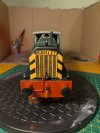
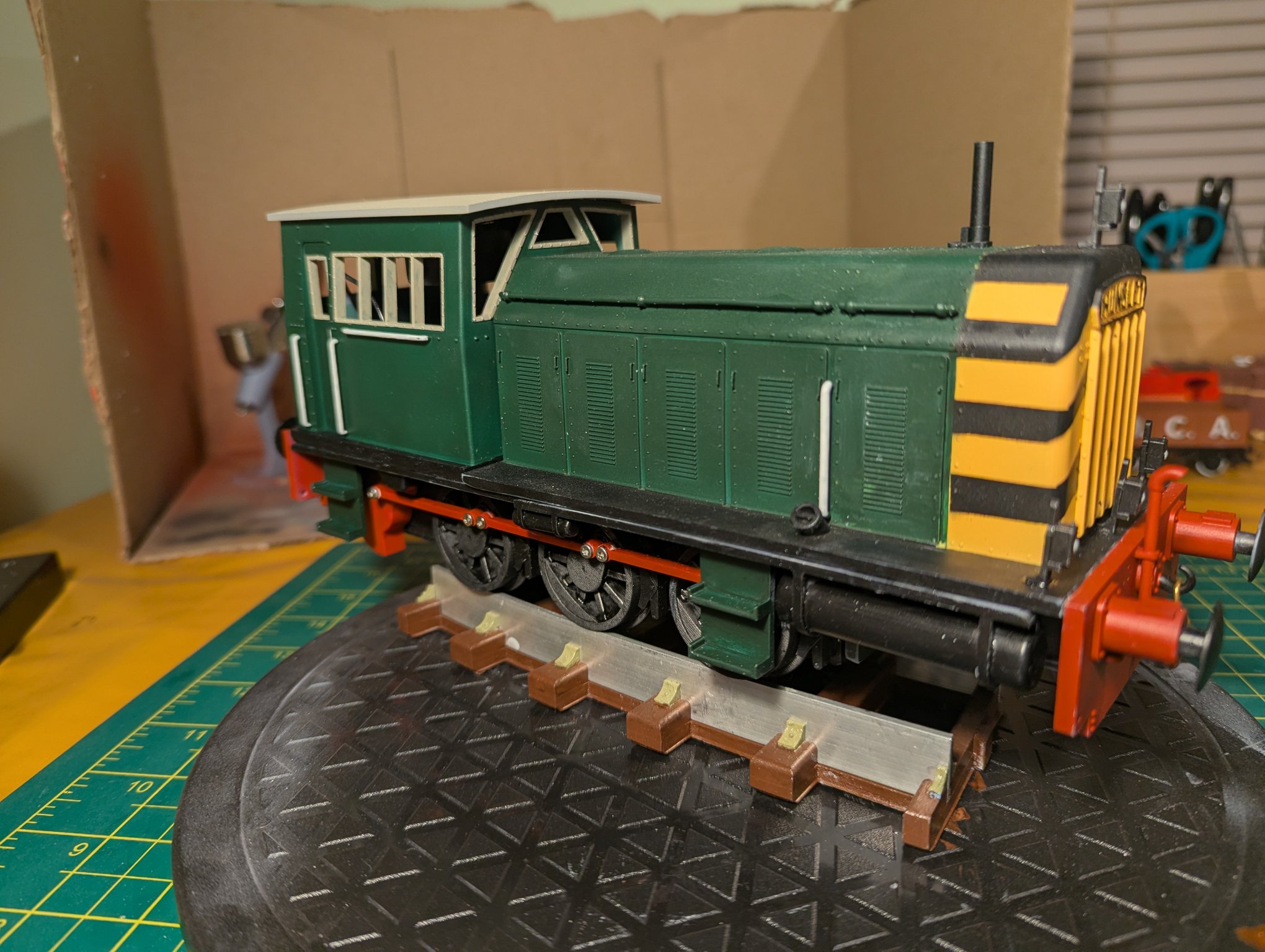
Hello everyone, here is my Hunslet British Rail Class 05 shunter - my first ever "fully" 3D printed locomotive and my first foray into Garden Railroading. I wanted to share some pictures, some lessons learned along the way, and open the door to any feedback from those more experienced in this forum. This loco is loosely based on D2554, which is still in non-passenger operation at the Isle of Wight steam railway (https://iwsteamrailway.co.uk/heritage/our-rolling-stock/locomotives/diesel-locomotives)

First off, some pictures.
Right side view
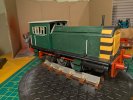
PXL_20260111_184126213.jpg
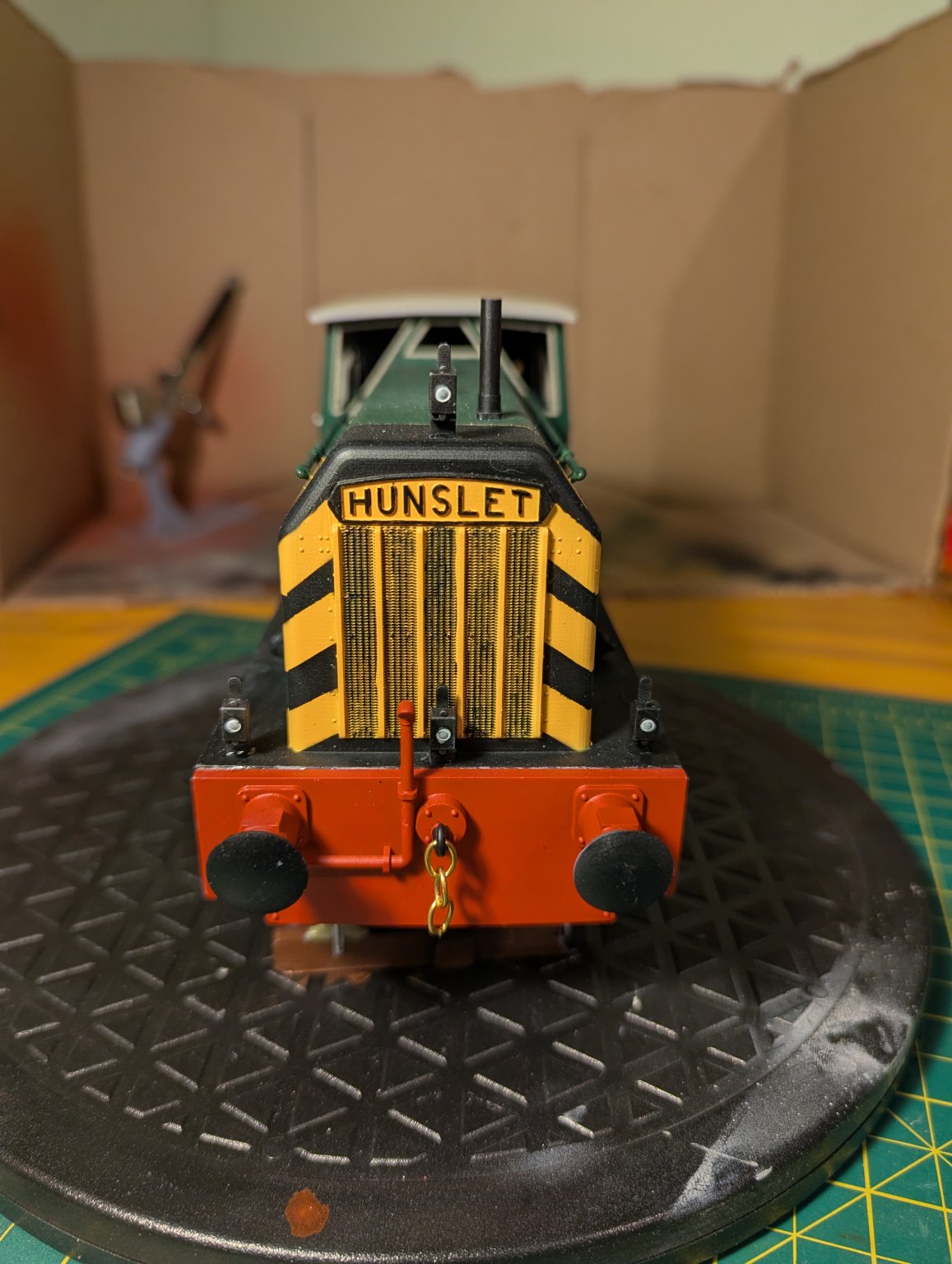
Front:
PXL_20260111_184113506.jpg
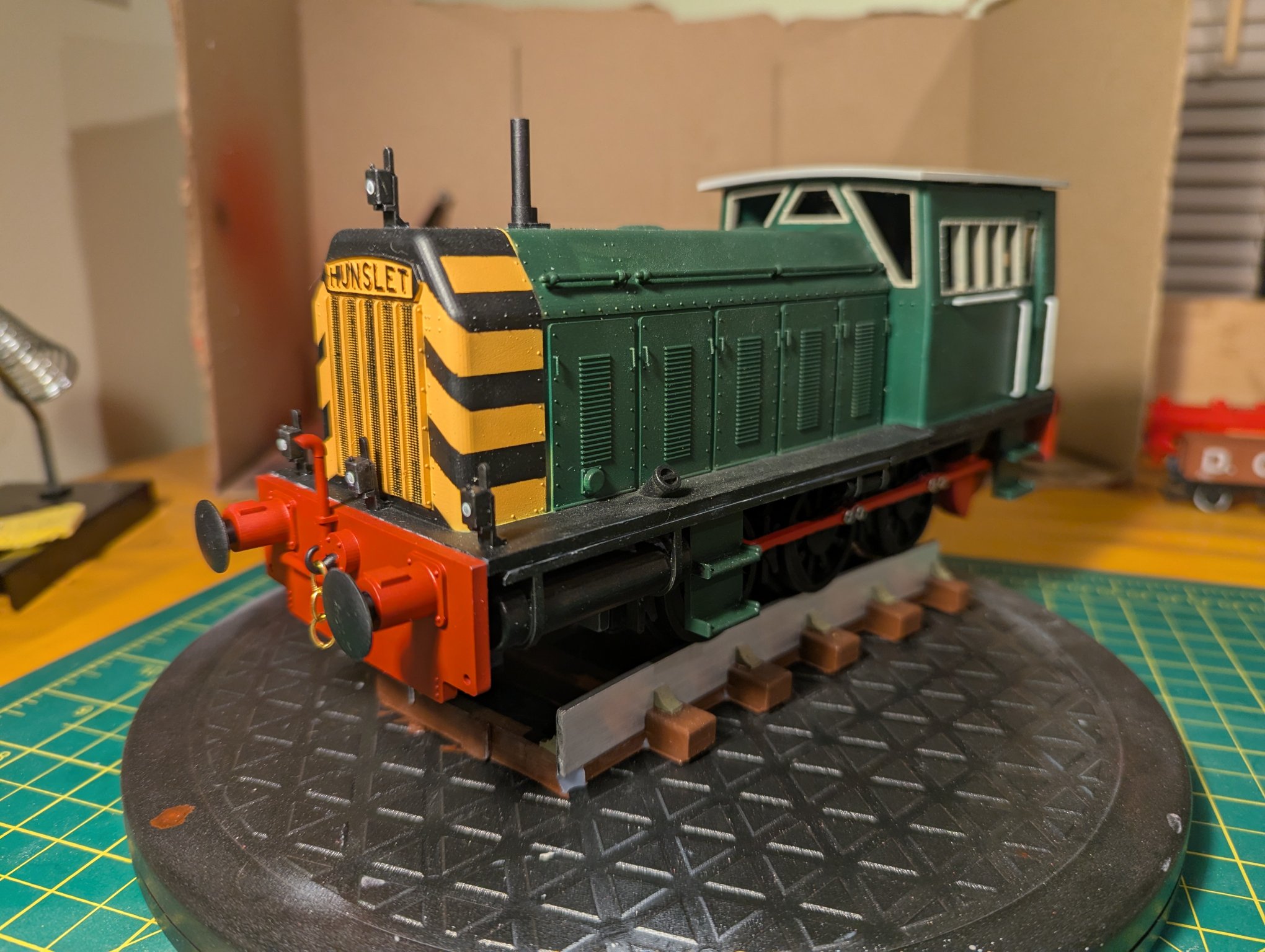
Left side. I only realised during painting that the white grab rail near the front had failed to print.
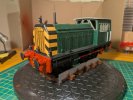
PXL_20260111_184047213.jpg
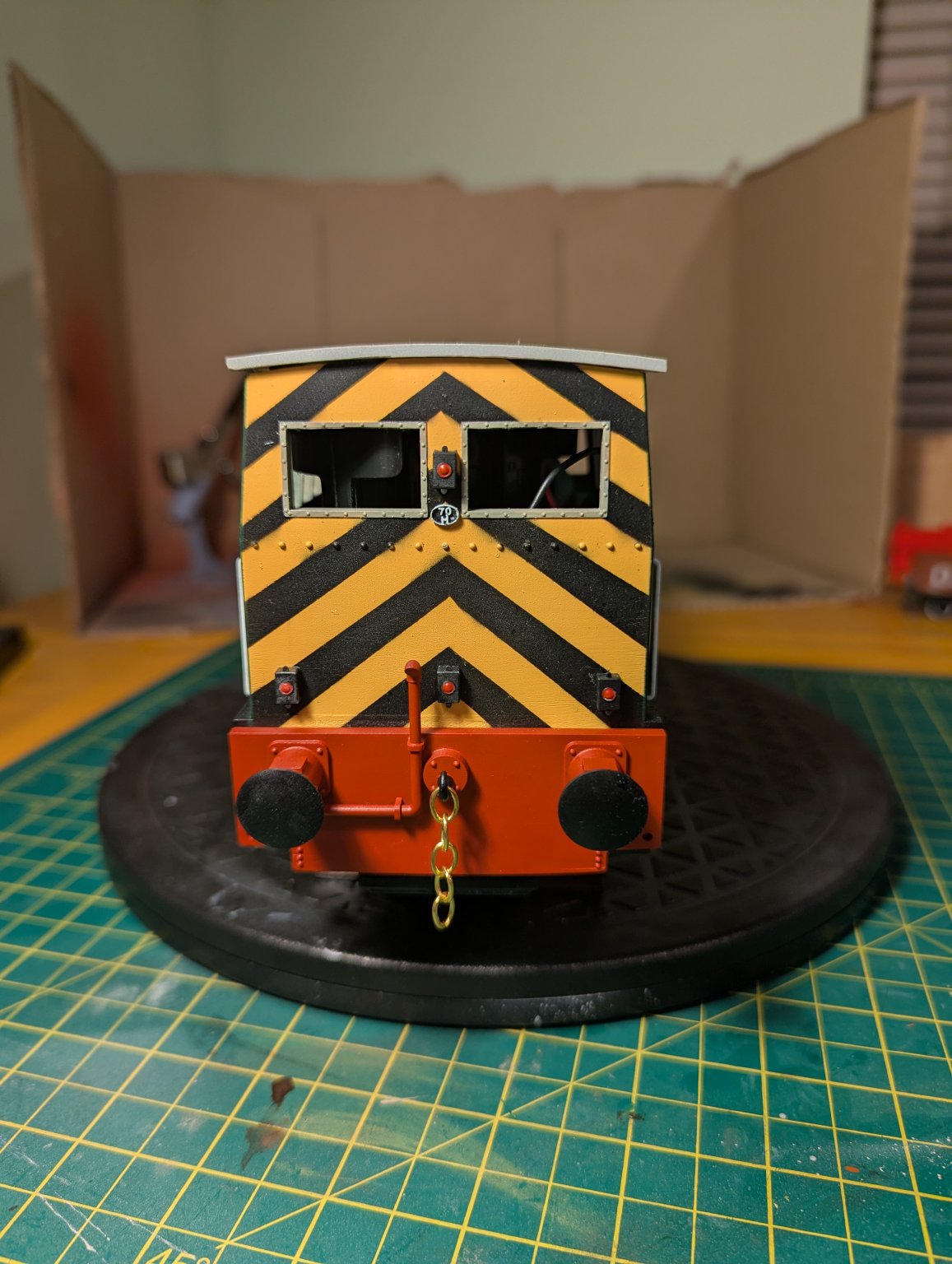
Rear:
PXL_20260111_184137783.jpg
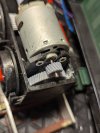
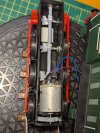
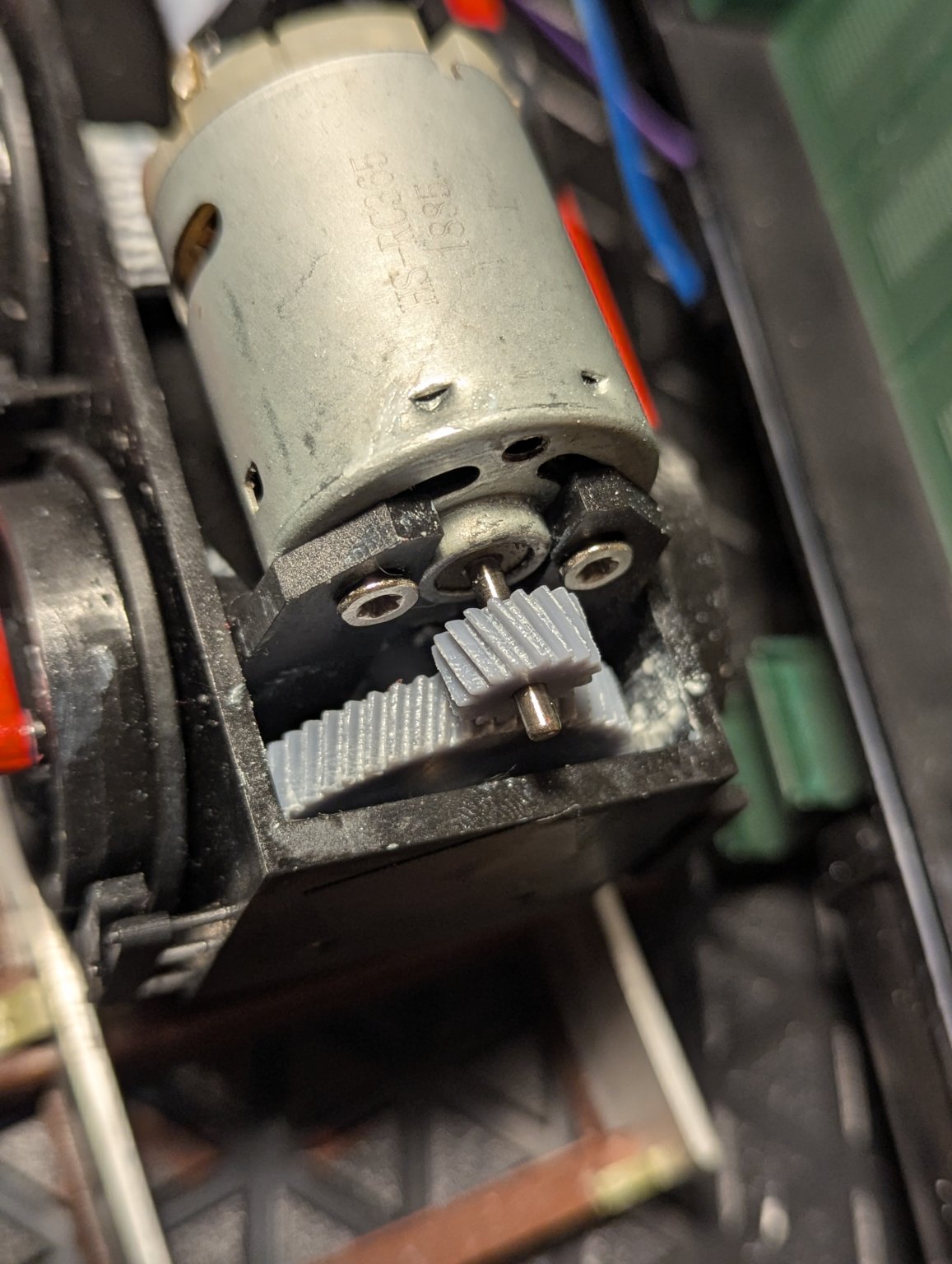
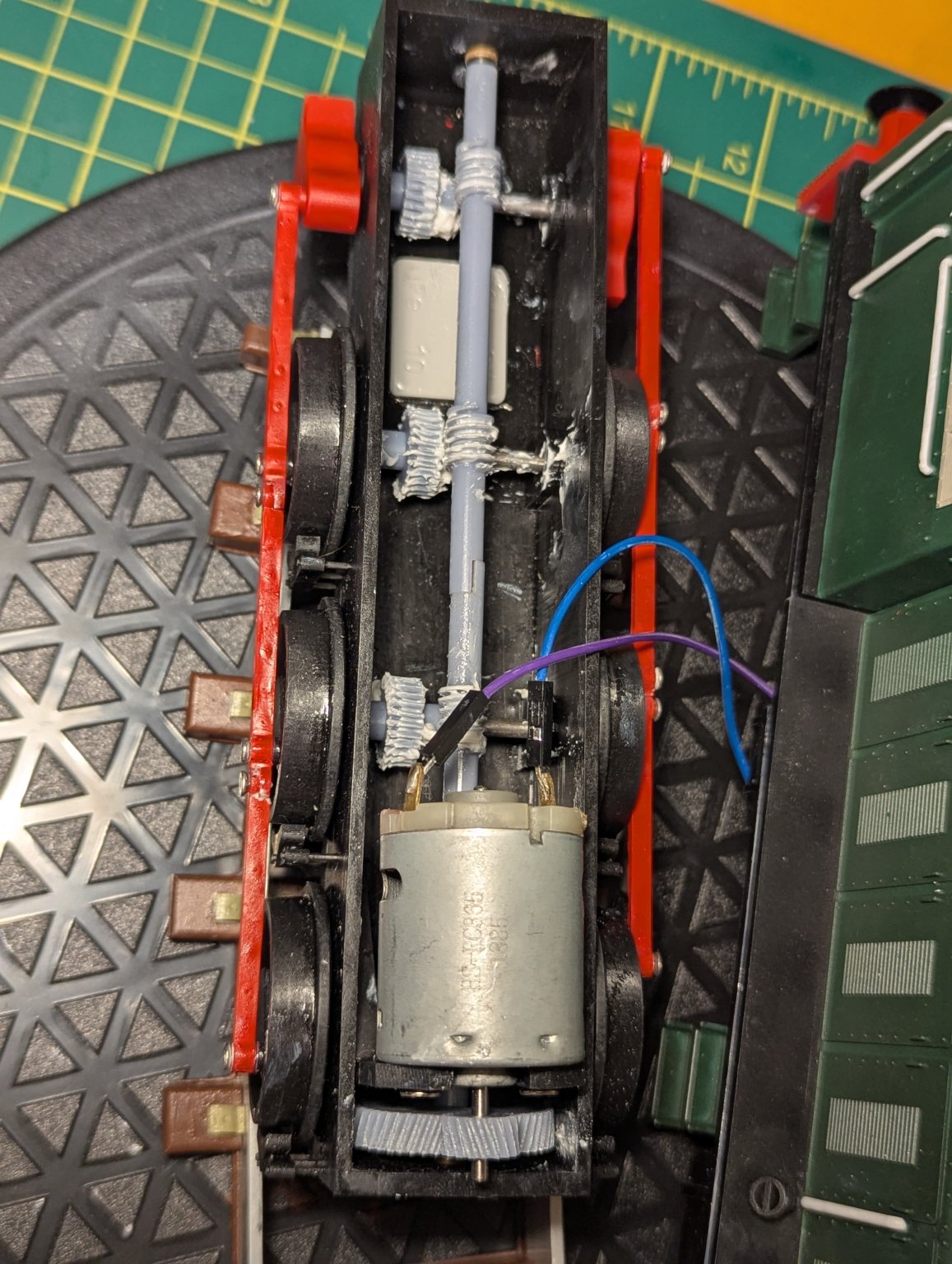
Motor block, also 3D printed:
PXL_20260111_184331447.jpgPXL_20260111_184354178.jpg

All of the 3d Printing was done on a Elegoo Saturn4 16K. The CAD work was done in the free version of Autodesk Fusion.
 
To address the elephant in the room..... the motor block. The design and ideas went through several iterations and I believe there are still improvements to be made.
The original iteration had the motor connected directly to a single axle, relying on the connecting rods to transmit power. The connecting rods were also a single piece. This resulted in the wheels locking up before being able to make a full rotation. I think this was being caused by the actual printed part having shrunk slightly compared to the design, and an inability to get this absolutely perfect meant this idea had to be abandoned.

Iteration number 2 came in the form of the conn rods being purely aesthetic and the use of a long driveshaft to drive all axles together (but more important, to lock their orientation together to prevent binding of the conn rod). This did work, but wow was it loud!

The pictures represent the final iteration, where redesigned conn-rods with joints allowing some movement between each rod section prevented the binding of the conn rods during rotation (the real Class 05 does this too - must be a good idea!). This means I can go back to powering a single axle and using the conn rods to transmit power, which if you look closely is happening in the image - the worm gears do not mesh as I've simply pushed them out of the way on all axles except the front, under the motor. A fourth iteration of this motor block could do away with the drive shaft altogether I think, simply driving the front axle.

The electronics are usable but a little oversized. There is an 8AA battery holder powering a L298N motor driver, which is also being used as a 5V step down to power an Arduino. The Arduino contains custom code to control the motor via Bluetooth - just using a free Serial Bluetooth app for now in lieu of something fancier later
 
The painting was mostly done via airbrush, with some touching up done with brush. This was my first time using an airbrush, it was the basic "Timbertech" kit from Amazon. The main colours are from Lifecolour British Railways "mid period" pack, with the black and red from some cheap Amazon listing.

Lessons learnt here:
1. Not all masking tape is made equal, don't skimp!
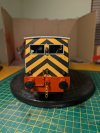
2. Don't rush the masking tape - for a first attempt, I'm fairly happy with the line work, but the rear view hazard lines could certainly do with being more even / straighter. I'd love to hear your hints and tips for getting nice straight airbrush lines
3. You can not airbrush yellow on to black. You will give up angrily after 5 coats attempting to do so, a lighter undercoat is required!
4. Apply a clear protecting varnish as soon as is appropriate - this definitely helps avoiding chips later. Just be sure to make sure the model is as dust free as possible first, I have trapped some dust on the top of the engine cabinet which, whilst subtle, is still annoying when you notice it.
5. Think about how to paint the model when designing it - applying masking tape to the back panel was tricky with the windows sticking out. If I were to do this again, I would experiment with printing the window frame separately and glueing them on after painting the back panel.
6. Speaking of glue, I found only an epoxy glue has any real sticking power with the Elegoo ABS-like resin.

The gears are also printed in the Elegoo ABS-like photo resin. Facebook 3d printing groups and other 3d printing forums tell me this is a bad idea, and will likely wear out quickly. I've yet to put the loco through any lengthy running sessions to test this, but I'm sure some replacements or iterations here will be required.

The electronics I've chosen are also a little large, just barely fitting inside the loco. I'd be keen to hear from others what kind of battery / motor controller / logic or remote control setup their putting in their battery-powered locos to see if I can shrink the current setup.

Finally, a big thank you to ge_rik ge_rik , who's blog The Peckforton Light Railway has been a constant source of inspiration & guidance whilst I get started in this hobby!
 
Something I'd forgotton to mention above - the loco is missing the D2554 identifier and the British Railways logo! If anyone has any good recommendations for where I can buy transfers for these in the UK (or shippable to the UK...), that would be greatly appreciated
 
Welcome to the forum.

I would try Tom at Endon Valley Transfers for the creat and numbers....
 
That's a good looking build and whilst you will notice things that you don't like about it, it looks rather fine to me. It will be interesting to see how the gears hold up, but this will depend on how much use the loco gets, how heavy your rolling stock is, how steep your gradients, and the radius of your curves: in other words, lots of variables! But it's a real achievement create a whole loco from scratch -bravo!
 
Well done, as has been said, quite an achievement.

Sorry to be a little negative, but do those gears motor to drive shaft mesh very well?
It looks very much like one is a 'mirror' of the other?

Also why make them skew cut?

PhilP.
 
Something I'd forgotton to mention above - the loco is missing the D2554 identifier and the British Railways logo! If anyone has any good recommendations for where I can buy transfers for these in the UK (or shippable to the UK...), that would be greatly appreciated
" + TITLE + "

Send him an email with your requirements.
 
Back
Top Bottom