Ballast glue

Martino

Photography, The GWR, Aviation, Travel, Cars.
Country flag
I know there have been many posts asking how to hold ballast down. I always recommended diluting PVA glue as that worked perfectly for me on the South Bucks when in Florida. It coped with hurricanes, downpours - everything. It wasn’t that cheap though and had to be mixed.
This year I’ve become aware of what is being marketed as mulch glue or shingle glue. Not having a current outdoor railway, I haven’t tested it for that, but have got some to try on my mulch and garden rocks and gravel.
Just wondering if this may be a good ballast fix.
https://www.amazon.com/gp/aw/d/B0CQ...d_r=88a77b8a-683e-462c-ad37-6b15b58bf504&th=1
 
Asked the same question last year, if it outside SBR, it works really well:

 
I know there have been many posts asking how to hold ballast down. I always recommended diluting PVA glue as that worked perfectly for me on the South Bucks when in Florida. It coped with hurricanes, downpours - everything. It wasn’t that cheap though and had to be mixed.
This year I’ve become aware of what is being marketed as mulch glue or shingle glue. Not having a current outdoor railway, I haven’t tested it for that, but have got some to try on my mulch and garden rocks and gravel.
Just wondering if this may be a good ballast fix.
https://www.amazon.com/gp/aw/d/B0CQKPGSDH/?_encoding=UTF8&pd_rd_plhdr=t&hsa_cr_id=0&qid=1780003601&sr=1-2-9e67e56a-6f64-441f-a281-df67fc737124&i=aps&aref=sksFbt9pMv&ref_=sbx__sbtcd_asin_1_img&pd_rd_w=Hdvf9&content-id=amzn1.sym.2fb72bc8-96ef-420d-b08f-c04b69f36507:amzn1.sym.2fb72bc8-96ef-420d-b08f-c04b69f36507&pf_rd_p=2fb72bc8-96ef-420d-b08f-c04b69f36507&pf_rd_r=KBDFR4QF5227JQ36PZF8&pd_rd_wg=4MlYl&pd_rd_r=88a77b8a-683e-462c-ad37-6b15b58bf504&th=1
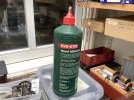
Have you watched the vid? Not sure about the benefit of this compared to watered down PVA, cartainly they appear to show spraying which in an indoor environment not the best plan. I would certainly not follow their mux with ballast and use ootion. I would also imagine it will be much more costly than PVA which mixed with water 50/50 and a small dab of washing up liquid will come out less than half the cost of that. I use a container like this with some even smaller to pour the mix. Also I have recently dismantled a 00 layout using this method of glue, a wallpaper striper did the job of disassembly perfectly with all the track suitable saved and reusable.
image.jpg
 
I know there have been many posts asking how to hold ballast down. I always recommended diluting PVA glue as that worked perfectly for me on the South Bucks when in Florida. It coped with hurricanes, downpours - everything. It wasn’t that cheap though and had to be mixed.
This year I’ve become aware of what is being marketed as mulch glue or shingle glue. Not having a current outdoor railway, I haven’t tested it for that, but have got some to try on my mulch and garden rocks and gravel.
Just wondering if this may be a good ballast fix.
https://www.amazon.com/gp/aw/d/B0CQKPGSDH/?_encoding=UTF8&pd_rd_plhdr=t&hsa_cr_id=0&qid=1780003601&sr=1-2-9e67e56a-6f64-441f-a281-df67fc737124&i=aps&aref=sksFbt9pMv&ref_=sbx__sbtcd_asin_1_img&pd_rd_w=Hdvf9&content-id=amzn1.sym.2fb72bc8-96ef-420d-b08f-c04b69f36507:amzn1.sym.2fb72bc8-96ef-420d-b08f-c04b69f36507&pf_rd_p=2fb72bc8-96ef-420d-b08f-c04b69f36507&pf_rd_r=KBDFR4QF5227JQ36PZF8&pd_rd_wg=4MlYl&pd_rd_r=88a77b8a-683e-462c-ad37-6b15b58bf504&th=1
See: Glued Ballast & Landscape:
This might be one of the most useful and practical “How to” garden railroad videos you’ll ever watch. Glued stone material has great potential for new and existing garden railroads, because it is so good, but rarely used. It drastically improves realism and durability, while decreasing maintenance time and costs. When you learn how to glue sand & gravel, you can use this technique all over your railroad for many things including track ballast, terrain and even mountains covered by different sizes of real rocks, gravel, sand and live plants. Its realistic appearance and low maintenance is why the most asked question at Cholla Patch Garden Railroad is: “How do you make your ballast”? This video is my detailed answer to such a great question.

Produced by John Carmichael: Email questions to: jlcarmichael@comcast.net Cholla Patch Garden Railroad, Tucson AZ on 6/28/26. Feel free to copy, use and modify any of the images or video clips you see here. Please help us spread this useful video with your Garden Railroading friends and organizations.

See more of my Design Construction videos at: Cholla Patch Garden Railroad: Cholla Patch Garden Railroad

And this: The Ultimate Guide to Glued Track Ballast for Garden Railroads
 
I forgot to mention how easy it is to remove glued ballast without damaging ties or switch points or anything else.
To Remove glued ballast Do This:
1) In the evening, wet ballast with hose and lay a wet bath towel on top overnight.

2)The next morning using a small hammer and small old screwdriver as a chisel, tap the screwdriver and the ballast breaks up easily.

3) Use a Shop Vac to vacuum up the loose ballast.


This works like a charm. Sometimes I'm in a hurry to remove ballast and don't have time to pre-wet and soak it, so I wet it with a spray bottle with diluted alcohol as I'm chiseling. You can still remove the unwanted ballast, but you need to chisel tap it a little more.
 
I forgot to mention how easy it is to remove glued ballast without damaging ties or switch points or anything else.
To Remove glued ballast Do This:
1) In the evening, wet ballast with hose and lay a wet bath towel on top overnight.

2)The next morning using a small hammer and small old screwdriver as a chisel, tap the screwdriver and the ballast breaks up easily.

3) Use a Shop Vac to vacuum up the loose ballast.


This works like a charm. Sometimes I'm in a hurry to remove ballast and don't have time to pre-wet and soak it, so I wet it with a spray bottle with diluted alcohol as I'm chiseling. You can still remove the unwanted ballast, but you need to chisel tap it a little more.
Another way if you are in a hurry is to use a Wallpaper Steam Stripper, works well even with External Waterproof PVA.
 
Another way if you are in a hurry is to use a Wallpaper Steam Stripper, works well even with External Waterproof PVA.
That's a good tip to know if I ever need to remove lots of material quickly. (like in a major redo in a large long section of track.) Personally I've luckily only had to remove small sections of ballast for small things like accessing buried wires in my electrical wire gap located between the bottom of the ties and the top of the stringer connector pieces (brownies). But it's so easy to wet it with a hose the day before. Besides, I'm a cheapskate and I hesitate to buy tools I won't use frequently. But if you have the tool and like it, use it by all means!

Thank you for the helpful comment:

p.s. Earlier today I stumbled across your thread where you are working to restore beat up old faded antique black & white photographs into beautiful color HD photos. I THINK THIS IS A FANTASTIC ENDEAVOR! LOVE IT! I collect those old photos. I'll need to read your thread about your photo restoration technique. Keep up this good work. You inspired me.
 
Back
Top Bottom