

justme igor
Registered

Lets get things on the rails...
Today i could finally start my garden railway:
Due to some life events i could not start a couple of years ago...its good to be back.
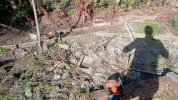
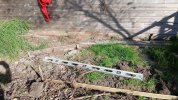
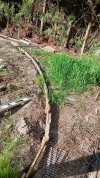
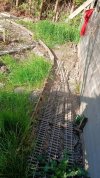
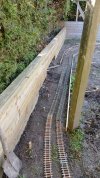
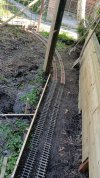
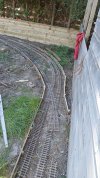
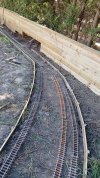
On my old phone (the one I accidentally stepped on) there are photos of setting out the boundary for the railway line.
I used a rope of 4.90 m in lenght for the inner 5‑metre radius, and a shorter 3.30 m rope. First I established the intersection points from the fence.
Then, at interfalls of 20 cm, I pushed an iron pin into the ground to mark the alignment.
The trackbed is a small “mimic” of real‑life railway construction: hardened ground, and on top of that a layer of weed control fabric.
A layer to prevent sand and grit from disappearing into the soil when the soil dries out (dry soil cracks and material sinks away).
In real railways they use a type of geotextile, but I’ll settle for HDPE weed‑control fabric. It also allows rainwater to drain into the ground.
On top of that will be sand, which will be levelled, and on that I will lay the track.
At a local gardening store I also found exactly what I needed for ballast. In Soviet times they used basalt, and what did I find?
Basalt gravel, 1–3 mm, sharp‑edged. How lucky can you be..... I should have bought a lottery ticket…sigh...
The trackbed is 5 to 7.5 cm above garden soil level, and the top of the rails are 1cm below the wooden outlining.
In the gap under the fence there will be a double track running around the house for locomotives that cannot handle 3‑metre radius curves, 5 meter and 5.12 meter radius.

Yes that turnout need to be integraded more into the dubble diamond.
This will be a 4-6 week build
Lets shovel some dirt.....any volunteers? it is just 15m3
With best regards Igor
Today i could finally start my garden railway:
Due to some life events i could not start a couple of years ago...its good to be back.
On my old phone (the one I accidentally stepped on) there are photos of setting out the boundary for the railway line.
I used a rope of 4.90 m in lenght for the inner 5‑metre radius, and a shorter 3.30 m rope. First I established the intersection points from the fence.
Then, at interfalls of 20 cm, I pushed an iron pin into the ground to mark the alignment.
The trackbed is a small “mimic” of real‑life railway construction: hardened ground, and on top of that a layer of weed control fabric.
A layer to prevent sand and grit from disappearing into the soil when the soil dries out (dry soil cracks and material sinks away).
In real railways they use a type of geotextile, but I’ll settle for HDPE weed‑control fabric. It also allows rainwater to drain into the ground.
On top of that will be sand, which will be levelled, and on that I will lay the track.
At a local gardening store I also found exactly what I needed for ballast. In Soviet times they used basalt, and what did I find?
Basalt gravel, 1–3 mm, sharp‑edged. How lucky can you be..... I should have bought a lottery ticket…sigh...
The trackbed is 5 to 7.5 cm above garden soil level, and the top of the rails are 1cm below the wooden outlining.
In the gap under the fence there will be a double track running around the house for locomotives that cannot handle 3‑metre radius curves, 5 meter and 5.12 meter radius.
Yes that turnout need to be integraded more into the dubble diamond.
This will be a 4-6 week build
Lets shovel some dirt.....any volunteers? it is just 15m3
With best regards Igor


