Idiots guide to DCC.......

For what it is worth @Fitz Orchard I also think you did a good job, there clearly is a view that @Software Tools has and is known for upsetting views elsewhere. I tend to ignore such comments these days unless I can see that they are entirely wrong or too elitist. Penanticism can be rather a nasty affliction, guilty of it myself at times but I keep it to things that I know are clearly off the wall.
 
Fwiw, Fritz, your post was exactly how i too understand things.
And, helpful.

Folks criticize but forget to add anything truly useful. Definitions are not illustrative, speaking for myself.
 
Last edited:
there clearly is a view that Software Tools has and is known for upsetting views elsewhere

The simple fact is that electricity is potentially deadly, and may kill you in flash if you get it wrong. Propagating explanations about electricity which are misleading remains extremely naive, no matter what the intent was.

As previously stated it is not hard to find simple, and correct, explanations regarding the nature of electricity. :banghead:
 
The simple fact is that electricity is potentially deadly, and may kill you in flash if you get it wrong. Propagating explanations about electricity which are misleading remains extremely naive, no matter what the intent was.

As previously stated it is not hard to find simple, and correct, explanations regarding the nature of electricity. :banghead:
Agree in part, but we are talking low voltage power to track and accesories, even the most electrically inept modeller should understand the difference between the mains from the house and the low power passing to the train set. Perhaps this could be mentioned in the guide to assist/save any possible doubt?
 
Agree in part, but we are talking low voltage power to track and accesories, even the most electrically inept modeller should understand the difference between the mains from the house and the low power passing to the train set. Perhaps this could be mentioned in the guide to assist/save any possible doubt?
Unfortunately the instruction about "disconnecting from the mains" is often the one ignored.
 
While I personally don't use DCC I found this thread interesting to understand the concept.

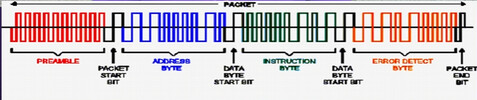
I got following image from internet which explains the pulse wave of DCC.


The pulse waves are fed thru tracks and go to every loco. But the address ensures only the intended recipient loco acts on this message.

DCC is similar to AC but AC follows sine wave (50 or 60 times per second) where as DCC creates square waves (thousands of times per second). While DCC is AC like it is actually DC because loco motors are DC motors.

As a side point, locomotives use brushed DC (BDC) motors. Technically brushless DC motors (BLDC) are superior but DCC can't handle BLDC due to some complex electronic signal management issues (as I understood from ChatGPT).

Batteries or analog DC can handle BLDC via simple electronic speed controller (ESC). Usually for same size, BLDC motors are more efficient and delivers more torque compared to BDC, thus it will run longer with same battery compared to BDC motor.

Has anyone here used BLDC in G scale locomotives?
 

Attachments

  • DCC signal.png
    DCC signal.png
    147.3 KB · Views: 0
While DCC is AC like it is actually DC because loco motors are DC motors.
NO!

The DCC waveform is alternating current, end-of.

As the DCC waveform / track-voltage enters the decoder, it 'sniffs' off the DCC signals, and then passes track-voltage through a bridge-rectifier, voltage regulation and conditioning to give DC voltages for powering the chips on the decoder, and to be fed to the speed controller circuitry on the decoder.
Nine times out of ten ALL the output voltages to the motor(s), lights, etc. are PWM DC.
The 'sniffed' signal is used to decide if incoming DCC data is addressed to this particular decoder. If it is, the information is used to instruct the decoder to 'do something'. If not, it is ignored.

PhilP.
 
NO!

The DCC waveform is alternating current, end-of.

As the DCC waveform / track-voltage enters the decoder, it 'sniffs' off the DCC signals, and then passes track-voltage through a bridge-rectifier, voltage regulation and conditioning to give DC voltages for powering the chips on the decoder, and to be fed to the speed controller circuitry on the decoder.
Nine times out of ten ALL the output voltages to the motor(s), lights, etc. are PWM DC.
The 'sniffed' signal is used to decide if incoming DCC data is addressed to this particular decoder. If it is, the information is used to instruct the decoder to 'do something'. If not, it is ignored.

PhilP.
Aha a quick question to someone who may know, would Dc power from DCC chip be OK for a Portescap motor?
 
Aha a quick question to someone who may know, would Dc power from DCC chip be OK for a Portescap motor?
You will most likely be fine..

Older Portescap motors tend to get hot if run from PWM. - Reducing the PWM frequency can help, but then you can hear it.

There are 1000's of older O gauge, and 100's of older gauge 1 models with these motors and running under DCC.

You best bet is to try running with the body off, and checking the motor every few minutes..
If it is slightly warm (it is using energy, and doing work) it should be fine. - If it is appreciably hot, then you need to look at a different solution.

PhilP.
 
Back
Top Bottom